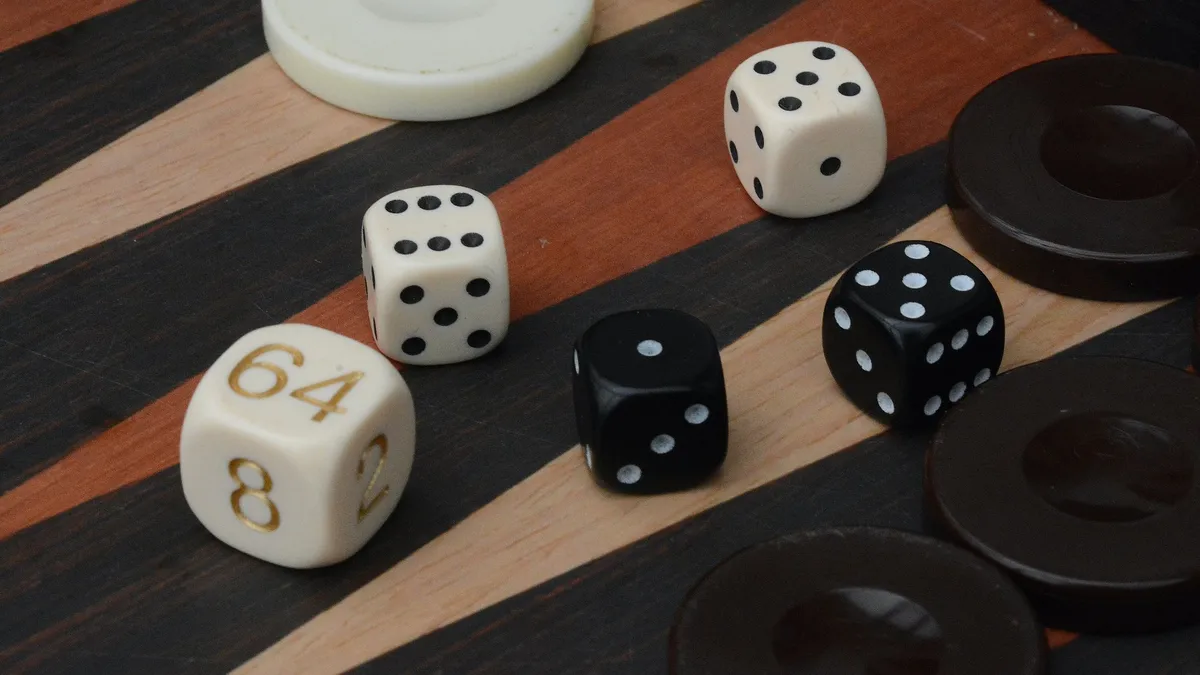
Backgammon: How to Play the Greatest Game in the World
Chess is for kings, backgammon is for pharaohs. A beginner's guide to the rules, the odds and the cube, and the five sets worth owning.
By Beau Brummell · October 31, 2026 · 16 min read
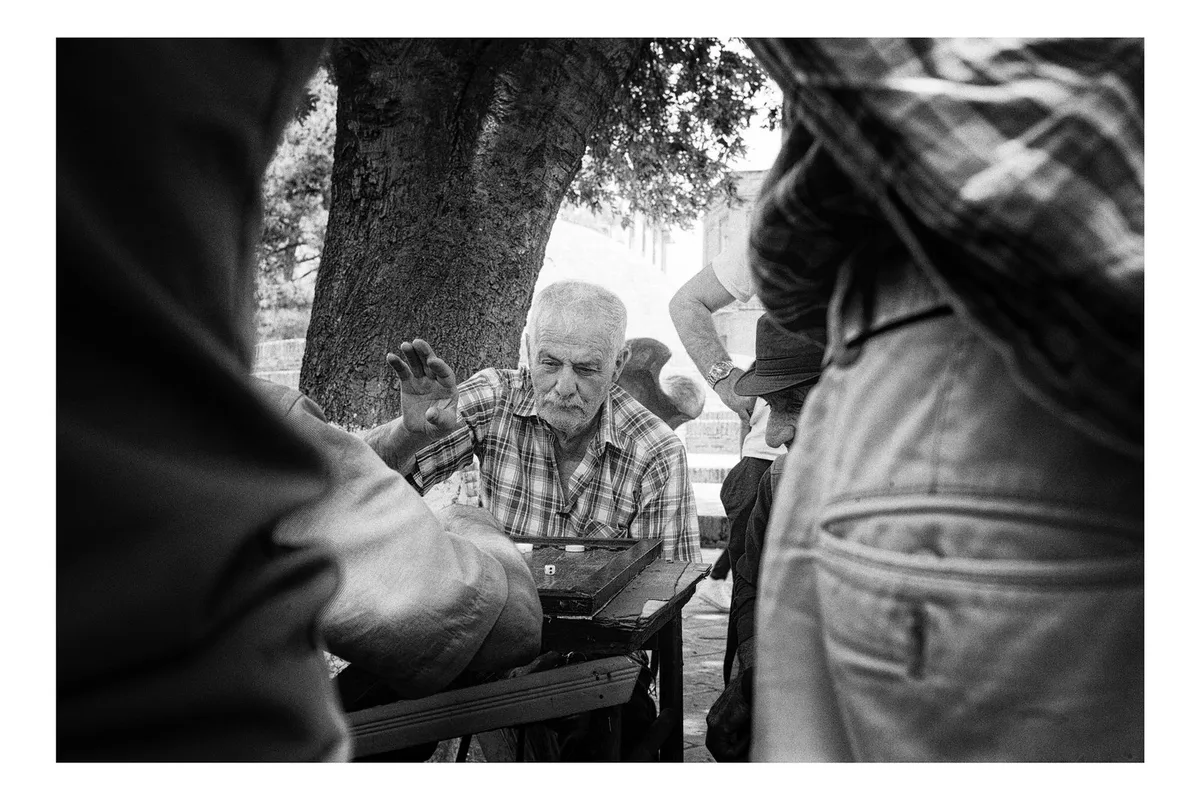
Photo: Clint Budd / Wikimedia Commons, CC BY 2.0
Every great game makes a promise. Chess promises that the better mind will win, every time, and then keeps that promise with a cruelty that has driven sensible men to drink. Poker promises money, which is a different thing from pleasure. Golf promises a walk and delivers four and a half hours of self-reproach.
Backgammon makes a better promise. It says that the better player will win over time, that anybody can win tonight, and that you will be able to talk to each other while it happens. It's the only game I know that is as good with a stranger in a Greek café as it is with an old friend after dinner, and the only one that lets the loser keep his dignity. He can always blame the dice.
What follows is the case for the game, a plain guide to playing it, and the five sets worth owning, from a cheap board for the beach house to one your grandchildren will fight over.
Chess is for kings, backgammon is for pharaohs
Chess has the better publicist. It calls itself the game of kings, and it can point to the knights, bishops and queens on the board to prove it. But chess is young. Its ancestor, the Indian game chaturanga, turns up clearly in the record only in the sixth century AD.
By then, men had been rolling dice and racing pieces around boards for more than three thousand years.
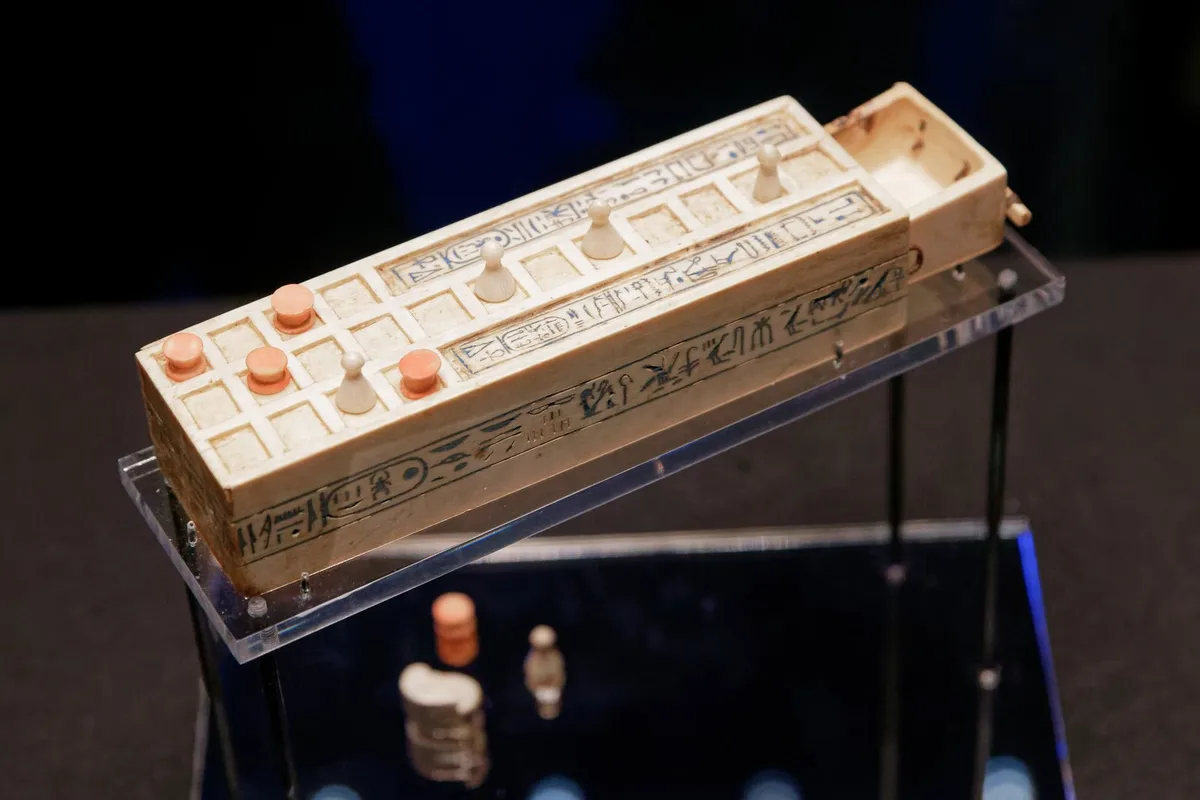
The pharaohs played senet. The earliest unmistakable painting of it comes from the tomb of Hesy-Re, a high official of Egypt's Third Dynasty, around 2620 BC. Queen Nefertari, wife of Ramesses II, is painted at a senet board in her tomb, and Tutankhamun took the game with him into his. Senet was a race game: players threw marked sticks, the ancient equivalent of dice, and moved their pieces along the board toward the end.
A miniature ivory senet box from the tomb of Tutankhamun, shown in Paris. The boy king took his games with him. Photo: Thesupermat / Wikimedia Commons, CC BY-SA 4.0
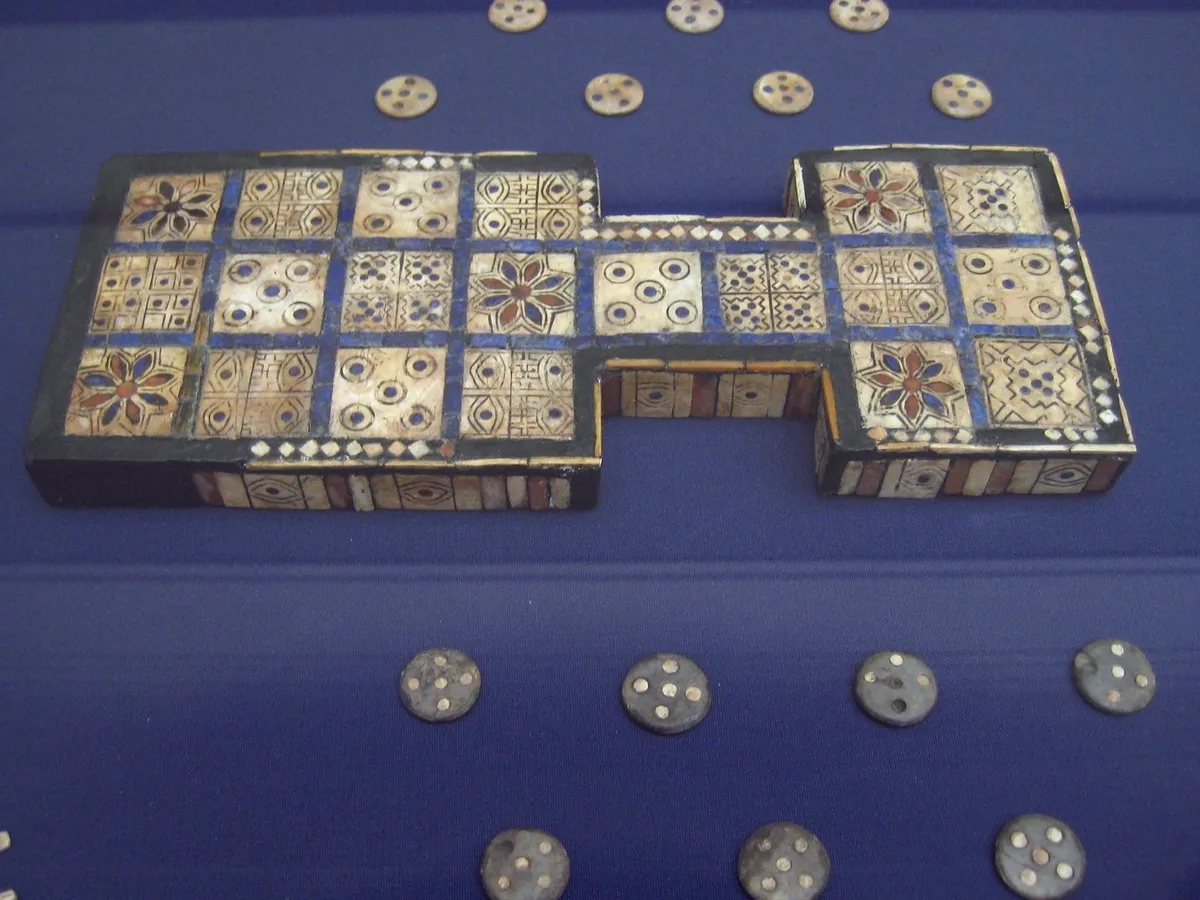
In Mesopotamia, at the same moment, they played the Royal Game of Ur. Sir Leonard Woolley dug five boards out of the Royal Cemetery at Ur between 1922 and 1934, and the finest now sits in the British Museum, dated to about 2600 to 2400 BC. It's a race game too: tetrahedral dice, two players and the object of moving all your pieces around the track and off the board. Its rules survive, in part, on a Babylonian clay tablet, which the British Museum curator Irving Finkel used to reconstruct the game. The tablet also tells fortunes. Land on the right square and "you will draw fine beer."
The Royal Game of Ur, from the Royal Cemetery at Ur, c. 2600 to 2400 BC, now in the British Museum. It is the oldest game whose rules have come down to us. Photo: BabelStone / Wikimedia Commons (CC0)
Older still is the board found at Shahr-i Sokhta, the Burnt City, in south-east Iran: a complete game set from around 2700 BC, with its pieces and its dice, now in the National Museum of Iran.
So here is the honest version of the claim you will hear in every backgammon bar in the world. The game we call backgammon, with its 24 points, 15 checkers a side, hitting and the bar, is not five thousand years old. The word itself first appears in English in 1647. But it's the living heir of the oldest family of board games on earth: dice races played by pharaohs and Sumerian nobles while chess was still three millennia in the future. The Romans played it as tabula, on a 24-point board with 15 pieces each, and the rules for hitting and bearing off were already recognisably ours. The Persians played it as nard, and still do. When the Greeks sit down to tavli and the Turks to tavla, they're keeping alive a line of play that runs back through Constantinople and Rome.
c. 2600 BCThe Royal Game of Urthe oldest race game with surviving rules
1647"Backgammon" first recordedin an English letter by James Howell
18 quintillionlegal positionsmore than enough for a lifetime
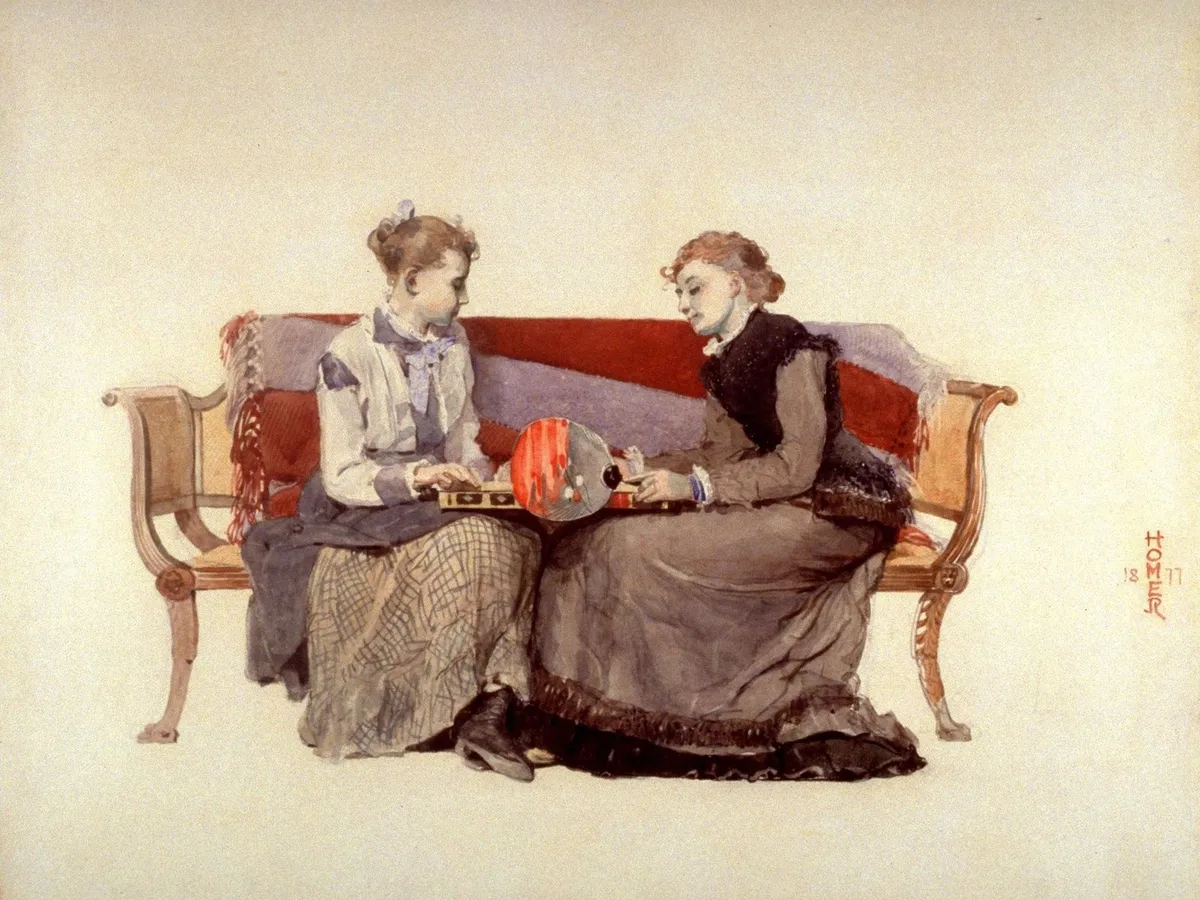
Winslow Homer, Backgammon, 1877. By the 19th century the game had crossed the Atlantic and settled into the American parlour. Winslow Homer / Wikimedia Commons (public domain)
The best story from the long middle of this history belongs to the Byzantine emperor Zeno, who reigned in Constantinople at the end of the fifth century. An epigram preserved by the historian Agathias records one of his games of tabula in detail, because of a single dreadful throw. Zeno rolled a 2, a 5 and a 6, and found himself forced to leave eight pieces standing alone, ready to be captured. Fifteen hundred years later, we still know exactly how the emperor lost. That is how much men have always needed to talk about their bad luck.
When you win, it's skill. When you lose, it's bad luck
That is backgammon's great gift to the ego. It's a game of skill wrapped around a game of chance, and nobody at the table ever has to admit which one decided the evening.
The dice are real. A beginner will beat a world champion in a single game often enough to keep everybody honest. In 1979 a computer program called BKG 9.8 beat the reigning world champion, Luigi Villa, seven games to one, and its own creator, Hans Berliner, said afterward that the machine had been lucky.
The skill is real too, and over enough games it always shows. In 1982 a judge in Oregon was asked to decide whether backgammon was gambling or a game of skill. Paul Magriel, a mathematician who had written the game's most important book, testified in the case. His argument was simple: in backgammon, nothing is hidden. There are no concealed cards and no bluffing. The judge ruled it a game of skill.
The modern era has proved Magriel right. In 1992 Gerald Tesauro of IBM built TD-Gammon, a program that taught itself by playing about 1.5 million games against itself. It played some openings in ways that experts had dismissed, and the experts ended up changing their own play to match it. Today's programs are stronger than any human, and they have shown how much skill was hiding in a game people once thought of as dice and nerve.
The skill is mostly arithmetic, of a friendly kind. There are 36 ways two dice can fall. A single checker six points away from an enemy checker will be hit by 17 of them, or 47% of the time. Move it to seven points away and only six rolls hit it: 17%. A good player isn't someone who rolls better. He's the man who has done that little sum before he moves, every time, without looking as though he has.
Short games, long conversations
A game of chess between two good players can take all afternoon, and you are expected to spend it in silence. A game of backgammon takes a few minutes. Serious players get through a match of several games in an evening. Casual players finish one, set up the board and go again.
That pace is the point. Your eyes need the board for only a few seconds at a time, so the rest of the evening is left for conversation, a drink and the occasional insult. A board on the table is a better host than a television. It gives people something to do with their hands and an excuse to stay another hour.
Backgammon has always been a game for talking over. Photo: madras91 / Wikimedia Commons, CC BY 2.0
It's why the game lives in cafés from Athens to Istanbul to Tehran, in the backgammon clubs of New York and London, and in hotel bars all over the world. It travels well, it fits on a table for two, and it ends before anybody gets bored. It's also why one of the rules in How to Be a Man puts it in the best company: a long walk, fly fishing or backgammon with a friend is better than therapy.
A workout for the brain
Every move is a small problem in probability, geometry and risk. You count, weigh what your opponent could roll next and decide how much danger you can afford. Then the dice change everything and you do it again.
There is some evidence this is good for you. A French study published in BMJ Open in 2013 followed 3,675 older people in the Bordeaux region for 20 years. Those who regularly played board games had a 15% lower risk of developing dementia, and less cognitive decline and depression over the period. The researchers were careful to call it an association, not proof: the difference in dementia risk was no longer statistically significant once they accounted for people's health at the start. But the picture fits common sense. A game that makes you calculate, remember and talk to another human being is unlikely to be bad for the mind.
15%lower dementia risk among regular board-game playersBordeaux study of 3,675 people over 20 years, BMJ Open, 2013
It's also a game for every age. In What to Teach Your Kids backgammon has a place on the list, because it teaches odds, patience and how to lose without sulking, and a child can play it with his grandfather on equal terms. Few hobbies last a lifetime. Backgammon is one of mine, on the list in Things I've Learned next to fly fishing, ranching, photography and golf.
✦
How to play backgammon: a beginner's guide
The rules take ten minutes to learn. Set up a board as you read and push the checkers around as you go.
The board and the setup
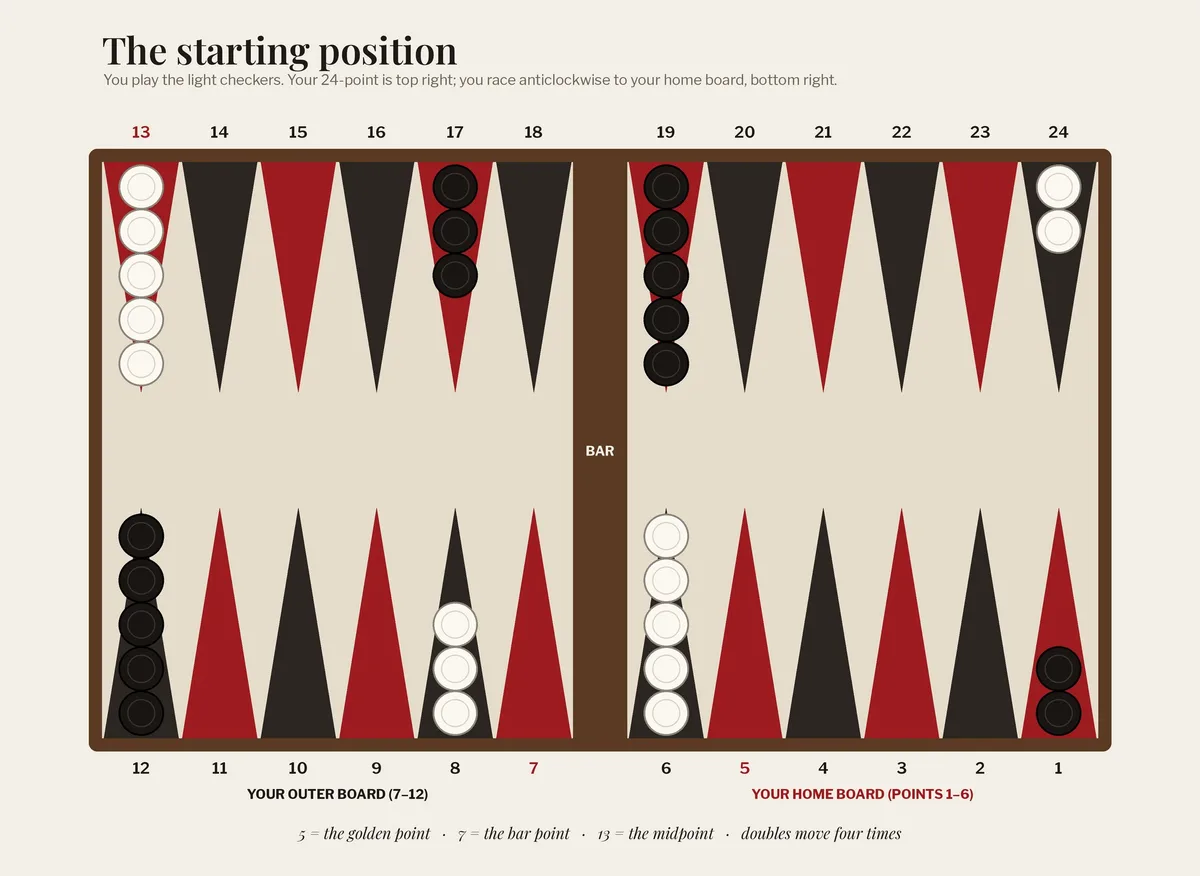
The board has 24 narrow triangles, called points, in four quarters of six. A raised strip down the middle, called the bar, divides it in two. Each player has 15 checkers, and the points are numbered from each player's own point of view, 1 to 24.
Your home board is the quarter that holds your points 1 to 6. You set up like this:
2 checkers on your 24-point, deep in your opponent's home board. These are your back checkers.
5 checkers on your 13-point, called the midpoint.
3 checkers on your 8-point.
5 checkers on your 6-point.
Your opponent's set-up is the mirror image. Two points have names you will hear constantly: the 7-point, next to the bar, is the bar point, and the 5-point is the golden point, the most valuable point on the board early in the game.
The starting position. You move your checkers from your 24-point down toward your home board; your opponent moves the other way. Diagram: The Graze
Rolling and moving
To start, each player rolls one die. The higher number goes first and plays the two numbers just rolled. After that, players take turns rolling two dice.
Each die is a separate move. Roll a 5 and a 3, and you can move one checker five points and another three, or one checker eight points, as long as it can land on an open point after each step. Roll a double and you play that number four times: double fours is four moves of four.
You must use both dice if you legally can. If you can play only one, you must play the larger number if possible. Checkers always move forward, from your 24-point toward your 1-point. A point held by two or more of your opponent's checkers is closed to you. You may not land there.
Blots, hitting and the bar
A single checker on a point is a blot. If your opponent lands on it, it's hit and goes onto the bar.
A checker on the bar must come back in before you can move anything else. You enter it in your opponent's home board, on the point that matches one of your dice: a 3 lets you enter on his 3-point. If that point is closed, you cannot use that number. If neither number lets you in, you lose your whole turn. This is why blocking points matters so much: every point you hold in your home board is a door shut in your opponent's face.
Bearing off
Once all 15 of your checkers are in your home board, you can start taking them off, which is called bearing off. A roll of 4 removes a checker from your 4-point. If there's no checker on that point, you must make a legal move with a checker on a higher point. If there is none on a higher point, you remove one from the highest point you have.
Get hit while bearing off and the checker has to travel all the way around and come home again before you can resume. The first player to bear off all 15 checkers wins.
Gammons and backgammons
A normal win is worth one point. If you bear off all your checkers before your opponent has borne off any, it's a gammon, worth double. If he still has a checker on the bar or in your home board when you finish, it's a backgammon, worth triple. Ambitious players play for gammons. Careful players avoid them.
The doubling cube
The cube is what turned a pleasant pastime into the serious game it is now. It was invented in the gambling clubs of New York in the 1920s, and it's a large die marked 2, 4, 8, 16, 32 and 64.
The game starts with the stakes at one. At the start of any of your turns, before you roll, you can offer to double the stakes. Your opponent has two choices. He can drop, conceding the game at its current value, or he can take, play on for double, and keep the cube. Only the player who owns the cube can double next.
A rough rule of thumb for beginners: take a double if you think you will win at least a quarter of the time. Below that, drop and start a new game. Gammons and who holds the cube complicate the sum, but a quarter will keep you out of trouble for years.
In casual money games most people use the Jacoby rule: gammons and backgammons count only as single wins until someone has used the cube. It stops one player from ignoring the cube in the hope of winning big.
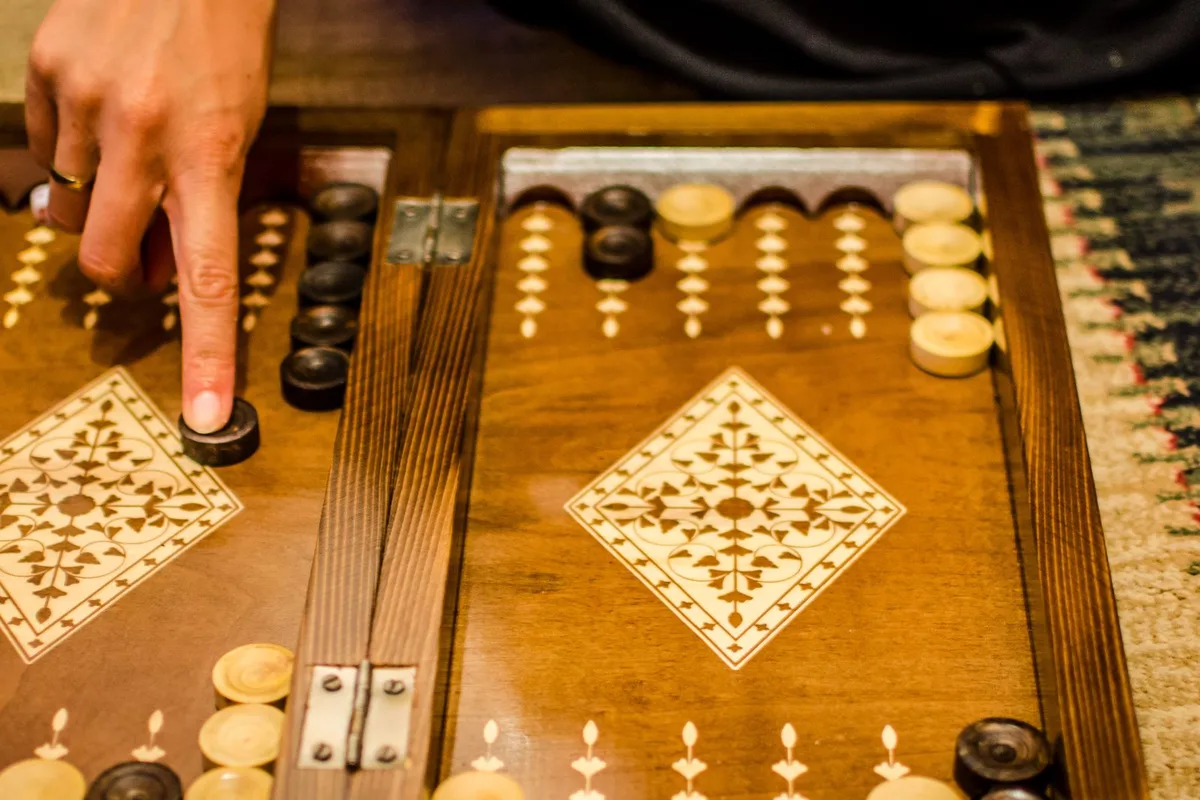
Bringing a checker home on an inlaid board in Iran, where the game has been played as nard for some fifteen hundred years. Photo: Chris Blackhead / Wikimedia Commons, CC BY-SA 2.0
Five opening principles
You will improve fastest by remembering a handful of ideas and the best first moves for a few rolls.
Make points, especially the 5-point. Two checkers together are safe, and they block your opponent. The most valuable points to make early are your 5-point, then your 4-point and bar point. With a 3-1, play 8/5 6/5 to make your 5-point. With a 4-2, play 8/4 6/4. With a 6-1, play 13/7 8/7 to make your bar point. With a 5-3, play 8/3 6/3.
Get your back checkers moving. The two checkers on your 24-point are the hardest to bring home. Split them early, before your opponent's board fills up and traps them. With 6-5, run one all the way to safety, 24/13, a move known as lover's leap.
Bring builders down. Checkers in your outer board, on your 7 to 11 points, are the raw material for making points next turn. Move them in from the midpoint.
Don't be too safe. Beginners hate leaving blots. Strong players leave them when the reward is worth it, especially early, when being hit costs little. Look at the shot count before you panic: most single checkers get hit far less often than you fear.
Hold an anchor. Two of your checkers on a point in your opponent's home board, called an anchor, give your back checkers a safe base and a place to land. An anchor on his 5-point or 4-point is worth a great deal.
The best backgammon sets, at every price
Buy the biggest board you have room for. Larger points and checkers are easier to read and nicer to play on. Look for a solid box that closes properly, dice cups lined with felt or leather so the dice don't clatter, and a doubling cube. Avoid magnetic travel sets except for flights: the game is as much about the sound and feel of the checkers as anything else.
Five boards, from the first set to the last one you will ever need.
Under $100: Get The Games Out, Large
The best place to start is the large folding set from Get The Games Out. It opens to 22.5 by 18 inches on a felt playing surface, and it comes with dice shakers, a doubling cube and a short strategy guide, all packed into a case with a handle. It's big enough to play properly and cheap enough to leave at the lake house, or to buy for a child.
$100 to $300: Manopoulos Walnut
In Greece, tavli is part of daily life, and Manopoulos makes its boards by hand there. The walnut set is a 19-inch board in walnut. It has no gimmicks, the wood is the real thing, and the checkers make the right sound when you slam them down.
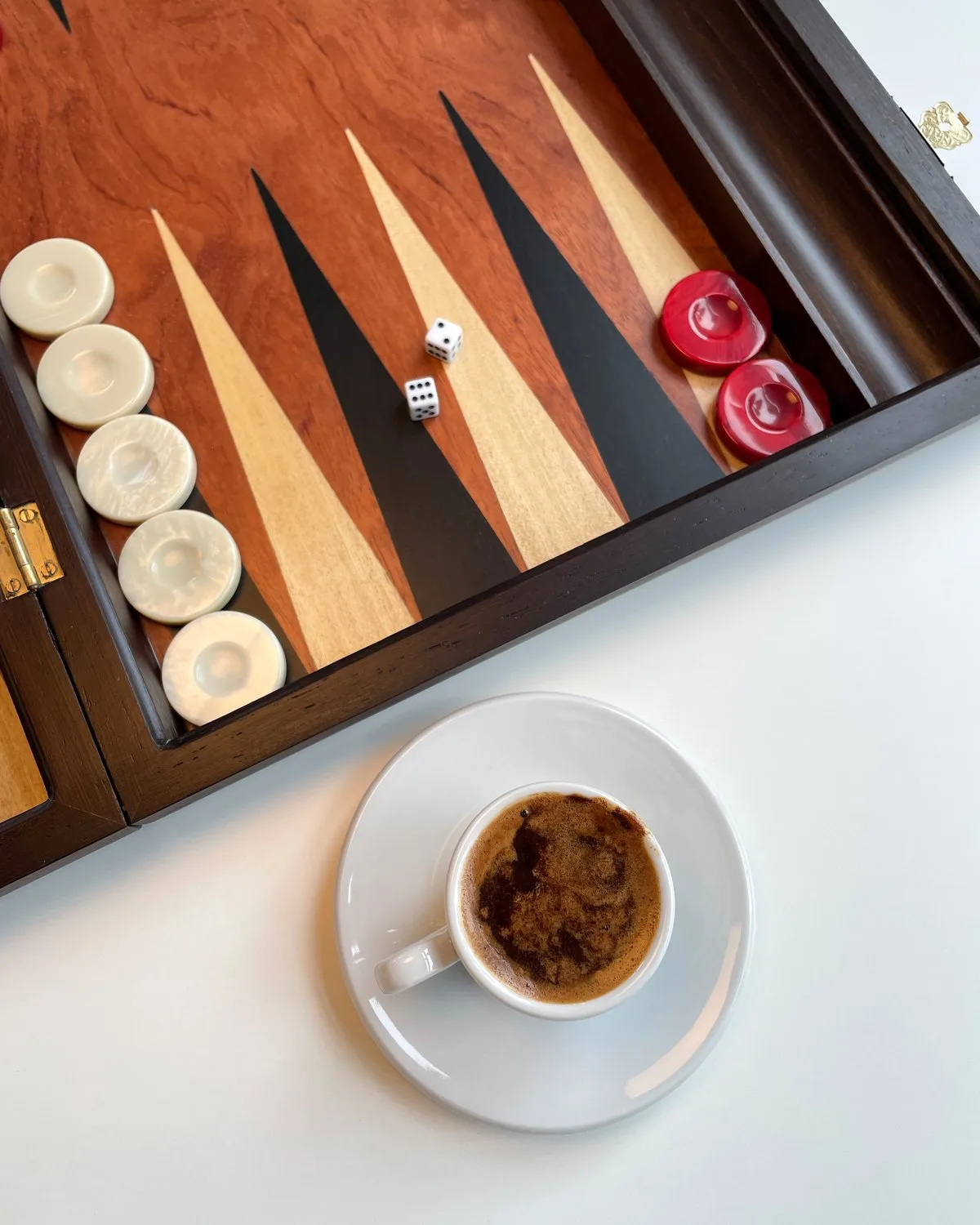
Tavli and a Greek coffee: the national pastime at the café table. Photo: Nikos Kitsakis / Wikimedia Commons, CC BY 4.0
$300 to $1,000: Hector Saxe Backgammon de Voyage
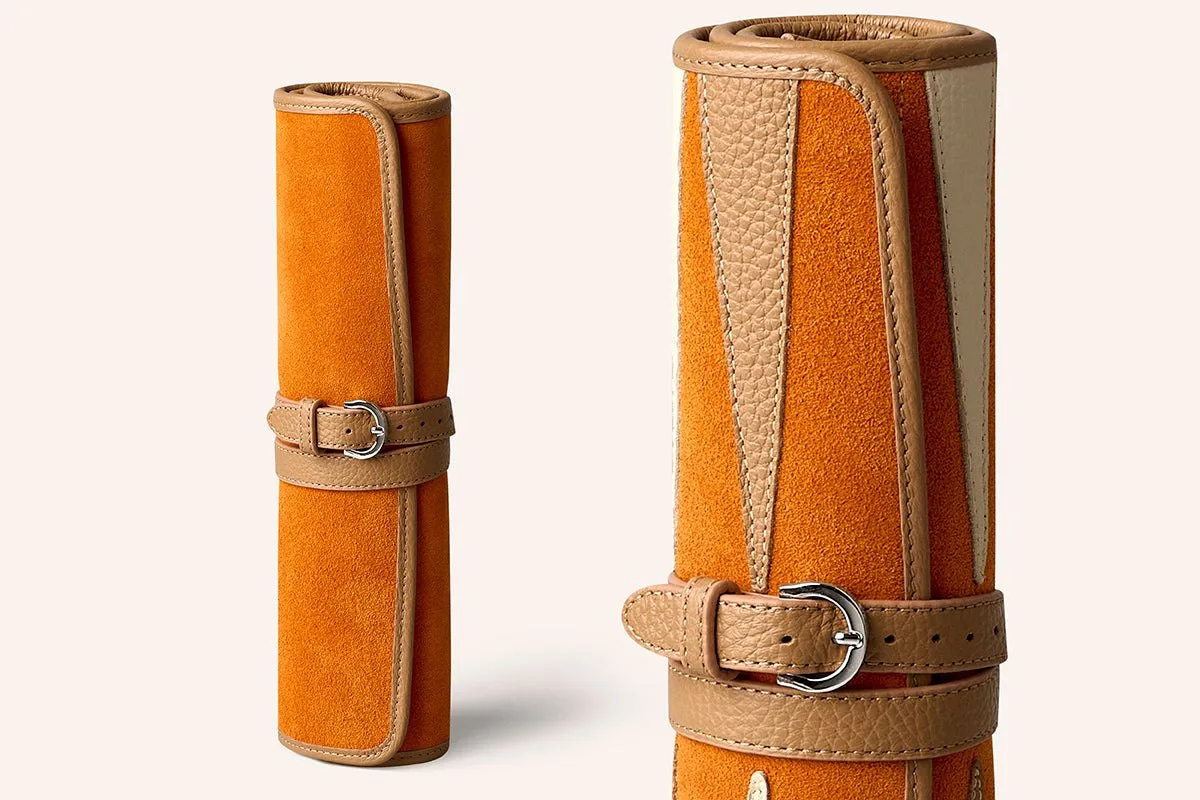
Hector Saxe in Paris makes games in leather for people who like their possessions to feel expensive. The Backgammon de Voyage, €565, rolls up like a shaving kit and buckles shut, so it fits in a weekend bag and opens on any café table or hotel bed. It comes in several colours.
Hector Saxe's Backgammon de Voyage, a leather board that rolls up for travel. Photo: Hector Saxe Paris
The verdict: the board for the man who travels. It's the one you will actually take with you.
$1,000 to $3,000: Bello Games Collezioni Donatello
This is the tournament board in leather. The Donatello from Bello Games is a 23-inch set in genuine leather, made in Italy. It has the big playing surface of a club board and the finish of good luggage. If you prefer a Parisian finish, Hector Saxe's Backgammon Médium in grained leather is €1,090.
The heirloom: Alexandra Llewellyn Tulip
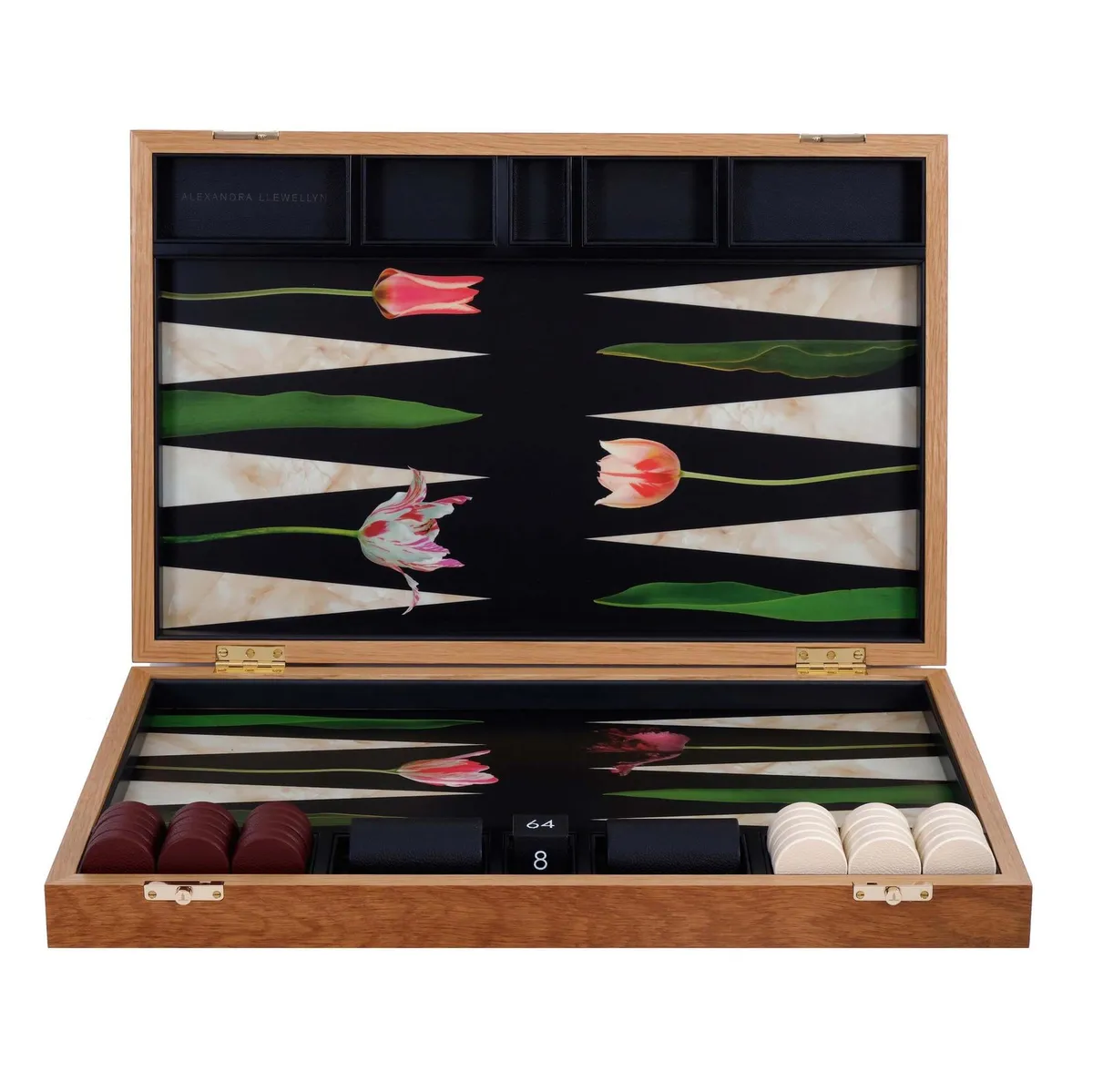
Alexandra Llewellyn makes the most beautiful backgammon boards in the world, in London. Her Tulip set, £6,450 in Britain and $7,420 on the brand's US price list, comes in an oak box made in the UK and opens to 77 by 60 centimetres, with tulips running down the points. You can order checkers in semi-precious stone for an extra £3,000. It's less a game than a piece of furniture that happens to be playable.
The Tulip backgammon set by Alexandra Llewellyn, made in London. Photo: Alexandra Llewellyn
For something more traditional, Geoffrey Parker has made backgammon sets by hand in England since 1958. Its leather tournament set costs £5,800. It's the quieter choice: plain, perfectly made and built to outlast its owner.
The verdict: the one your grandchildren will argue over. Buy it when you have decided this is a game for life.
Three books worth reading
You can learn the rules in an evening. Get these books to learn the game.
1
Backgammon
Paul Magriel
The book. Magriel's 1976 classic began the age of serious backgammon writing, and it's still the best explanation of how the game works, from the opening moves to the endgame. Long, thorough and worth every page.
The best thing about backgammon is that there's always one more game. The board is already set up, the last one took five minutes, and you have a score to settle. Somewhere between the second and the fifth game the conversation turns serious, or funny, or both, and you realise you have been talking to someone properly for an hour.
Buy a board. Leave it out where people can see it. Teach someone. And when you lose, as you will, blame the dice. Five thousand years of players have done exactly the same thing, emperors included.
Backgammon for beginners: common questions
How do you set up a backgammon board?
Each player has 15 checkers: two on the 24-point, five on the 13-point (the midpoint), three on the 8-point and five on the 6-point. Your opponent's setup mirrors yours, and you move from your 24-point toward your home board, points 1 to 6.
Is backgammon luck or skill?
Both. The dice decide single games, so a beginner can beat a champion on any night, but the better player wins over a series. A judge in Oregon ruled it a game of skill in 1982.
Is backgammon the oldest board game in the world?
Backgammon itself is first recorded in England in 1647, but it belongs to the oldest family of board games: dice race games like the Royal Game of Ur and senet, played around 2600 BC, and the Roman game tabula.
How does the doubling cube work?
Before rolling, a player may offer to double the stakes. The opponent either drops and loses the game at its current value, or takes, plays on for double and owns the cube. As a rule of thumb, take if you expect to win at least a quarter of the time.
What is the best backgammon set for a beginner?
A large folding board with a felt surface, dice shakers and a doubling cube, such as the Get The Games Out set at about $52. Buy the biggest board you have room for.
The Graze may earn a commission from qualifying purchases made through links in this article.