Eating out costs 38% more than before the pandemic. Here is where the money goes
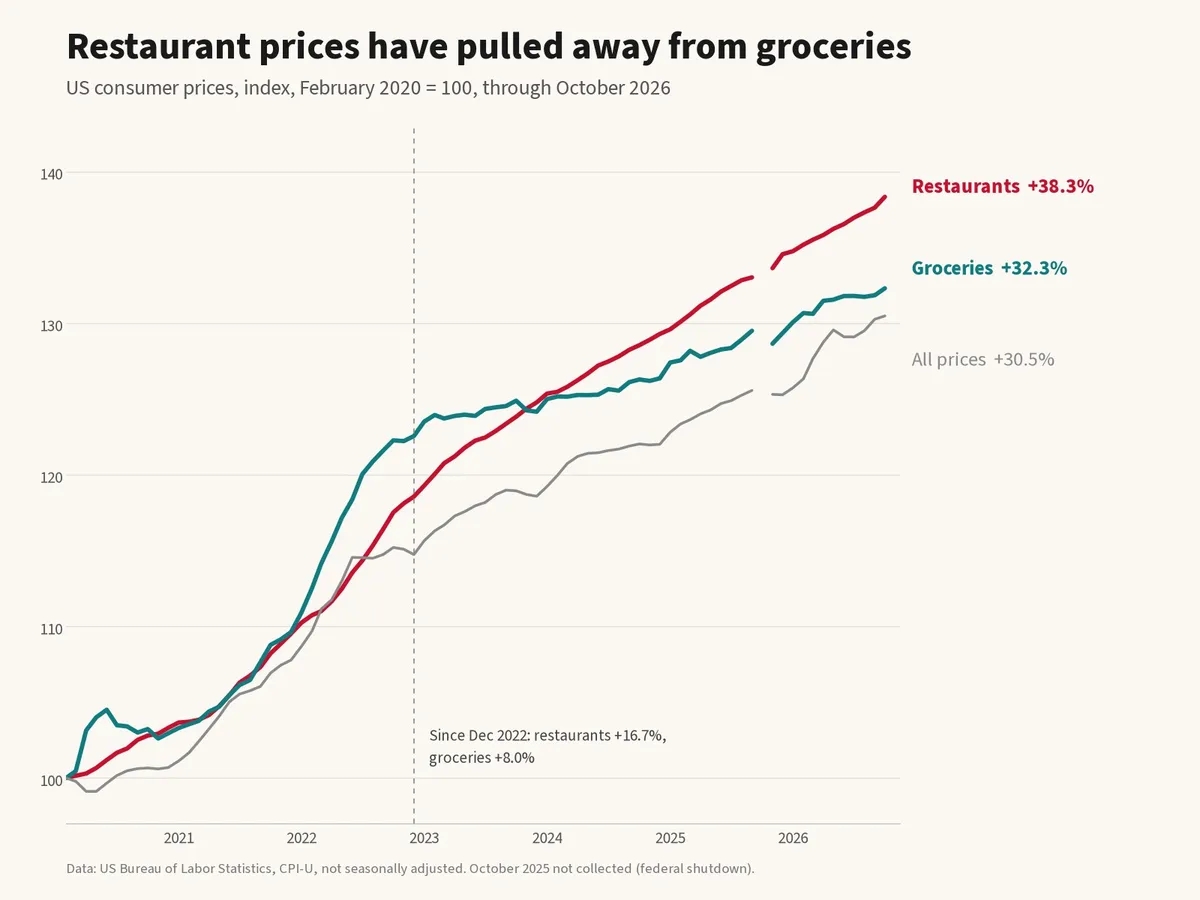
On average, a restaurant meal that cost $100 in February 2020 costs about $138 today. The same groceries cost about $132. The gap looks small, but it has opened fast since 2022, the tip is worked out on the bigger number, and sit-down restaurants are doing it with fewer people on the payroll.
Two lines that crossed
The Bureau of Labor Statistics' consumer price index splits food into two parts: "food at home", meaning groceries, and "food away from home", meaning restaurants, takeaways and other food service. From February 2020 to October 2026, grocery prices rose 32.3% and restaurant prices rose 38.3%. Prices across the whole economy rose 30.5%.
The timing is the more telling part. Groceries surged first. By December 2022 they were 22.6% above their February 2020 level, against 18.6% for restaurant meals.
Then groceries cooled, rising 1.3% in 2023, 1.8% in 2024 and 2.4% in 2025. Restaurant prices kept going, up 5.2%, 3.6% and 4.1% in the same years. Since December 2022, restaurant prices are up 16.7% and grocery prices 8.0%.
The gap is still widening. In the year to September 2026, food away from home rose 3.5% and food at home 1.8%, according to the Agriculture Department's Economic Research Service. Its October forecast has restaurant prices up 3.5% in 2026 and grocery prices up 2.3%. The October CPI, released on November 10, carries no 12-month comparison for most series because the BLS did not collect October 2025 prices during the federal funding lapse.
It is a lot of money. Total US food spending away from home, including by businesses and government, reached $1.41 trillion in 2025, against $1.10 trillion for food at home, the ERS estimates.
Fast food lost its edge
The cheap option has not stayed cheap. Limited-service meals, the BLS category that covers fast food and counter service, rose 41.0% between February 2020 and October 2026. Full-service meals, where someone takes your order at the table, rose 38.1%.
Where the money goes
A menu price is mostly labour and food. The National Restaurant Association, the industry's trade body, says that before the pandemic a typical independent restaurant spent about 33 cents of every sales dollar on food and about 33 cents on labour. Utilities, occupancy, supplies, administration, repairs and card processing fees took about 29 cents, leaving a pre-tax profit of about 5%.
Labour is the cost that moved most. BLS payroll data show average hourly earnings for all employees at food services and drinking places of $15.57 in February 2020 and $22.25 in September 2026, a rise of 42.9%. Across all private-sector jobs, hourly earnings rose 32.7% over the same period. Restaurant pay has risen faster than restaurant prices.
The association estimates that total expenses for an average restaurant rose 36% between 2019 and 2026, with utilities, occupancy, supplies and card swipe fees all up by double-digit percentages. It says 42% of operators reported that their restaurant was not profitable in 2025.
Fewer hands in the dining room
Sit-down restaurants have not rebuilt their workforce. Full-service restaurants employed 5.65 million people in February 2020 and 5.49 million in September 2026, seasonally adjusted: about 165,000 fewer. Limited-service restaurants employed 4.64 million, about 86,000 more than before the pandemic.
The BLS does not count tables or covers, so the data cannot say how many diners each server now looks after. They do show that sit-down restaurants are charging 38% more than in early 2020 with about 3% fewer people on the payroll.
The tip rides on top
A tip is a percentage, so it grows with the bill. At 20%, the tip on that $100 meal from February 2020 was $20. On today's equivalent bill of about $138 it is about $28, before anyone changes the rate.
The requests have spread, too. In a Pew Research Center survey of 11,945 US adults in August 2023, 72% said tipping is expected in more places than it was five years earlier. Forty per cent opposed businesses suggesting tip amounts, against 24% in favour, and 72% opposed automatic service charges or tips added to the bill. At sit-down restaurants, 57% said they would tip 15% or less for an average meal; a quarter said 20% or more.
The numbers, worked through
| Measure | February 2020 | Latest | Change |
|---|---|---|---|
| Restaurant prices (food away from home) | 100 | 138.3 (Oct 2026) | +38.3% |
| Full-service meals | 100 | 138.1 (Oct 2026) | +38.1% |
| Limited-service meals | 100 | 141.0 (Oct 2026) | +41.0% |
| Grocery prices (food at home) | 100 | 132.3 (Oct 2026) | +32.3% |
| All consumer prices | 100 | 130.5 (Oct 2026) | +30.5% |
| Restaurant hourly earnings | $15.57 | $22.25 (Sep 2026) | +42.9% |
| All private-sector hourly earnings | $28.54 | $37.86 (Sep 2026) | +32.7% |
| Full-service restaurant jobs | 5.65 million | 5.49 million (Sep 2026) | −2.9% |
| Limited-service restaurant jobs | 4.55 million | 4.64 million (Sep 2026) | +1.9% |
| A 20% tip on a $100 meal | $20.00 | $27.67 | +38.3% |
Where the value still is
The kitchen at home is the obvious winner: since December 2022, groceries have risen at less than half the pace of restaurant meals. The grocery aisle is uneven, though. The ERS expects egg prices to fall 29.3% in 2026 and beef and veal prices to rise 8.7%.
Out of the house, the full-service premium over fast food has narrowed a little, because counter-service prices have risen fastest.
Our take
The number that matters is not 38%. It is the 16.7% since December 2022, when grocery inflation broke and restaurant inflation did not. In our view, that is the signature of a business priced off labour rather than ingredients. Food costs can fall back. Wages rarely do. With labour taking about a third of every sales dollar and restaurant pay up 42.9%, menus are set against a cost that will not reverse, which is why the ERS still expects restaurant prices to outrun groceries next year.
It also explains why eating out feels worse. An owner who ran on a margin of about 5% before the pandemic has two levers: raise prices, or cut the most expensive thing in the room, which is people. Full-service restaurants have done both. Diners notice the second more than the first.
Three practical conclusions. First, the fast-food discount has shrunk, so a proper sit-down lunch looks better value against the drive-through than it did. Second, the tip is the part of the bill you control: 20% of a bigger bill is already a bigger tip, and a suggested amount on a counter screen is a suggestion, not a rule. Third, the best value is a place you go back to. A business on thin margins treats regulars well because it needs them.
What to watch: the November CPI on December 10, and whether the gap holds into 2027, when the ERS forecasts restaurant prices up 2.8% and grocery prices up 1.0%.
Sources
- US Bureau of Labor Statistics, Consumer Price Index: October 2026 (released November 10, 2026)
- US Bureau of Labor Statistics, CPI-U series, not seasonally adjusted: food away from home, food at home, full service meals and snacks, limited service meals and snacks, all items
- US Bureau of Labor Statistics, Current Employment Statistics, seasonally adjusted: full-service restaurant jobs, limited-service restaurant jobs, average hourly earnings, food services and drinking places, average hourly earnings, total private
- USDA Economic Research Service, Food Price Outlook: summary findings (October 23, 2026)
- USDA Economic Research Service, Food prices and spending (June 1, 2026)
- National Restaurant Association, Elevated costs continue to pressure restaurant profitability (July 8, 2026)
- Pew Research Center, Tipping culture in America: public sees a changed landscape (November 9, 2023)
- Chart and table: The Graze, calculated from the BLS series above