Coyotes are already using the wildlife crossing over Los Angeles's 101 freeway
A coyote was photographed on the southern slope of the Wallis Annenberg Wildlife Crossing on 28 October, the National Park Service said, ahead of a 2 December opening.
By The Graze · November 18, 2026 · 4 min read
Wildlife
A coyote was photographed climbing the southern slope of the Wallis Annenberg Wildlife Crossing on 28 October, the National Park Service said, before the vegetated bridge over the 101 freeway had officially opened. Days later, a second coyote was recorded walking on the deck itself. Scientists do not believe that animal made a full crossing from one side of the freeway to the other.
What the cameras have seen
The first picture was taken while the crossing was still unfinished. Park biologists at Santa Monica Mountains National Recreation Area, a unit of the National Park Service, released it with a 4 November announcement that they were about to install remote cameras on the structure. The official opening to wildlife is scheduled for 2 December.
The Los Angeles Times, reporting on 5 November, said a coyote had then been photographed on top of the crossing — the first large mammal documented on the structure itself, rather than on the slope leading up to it. Scientists think the two sightings were of different animals, the Times reported, though they are not certain.
They also do not think the second coyote completed a north-south traverse. Seth Riley, wildlife branch lead at the recreation area, told the Times the animal appeared to have come from the Simi Hills, north of the freeway, and was photographed moving south across the overpass at 1:30 a.m. Later frames showed it heading back. By 1:47 a.m. it was at the northern end. That it spent some 20 minutes on the crossing, Riley said, was a good sign: an animal spooked by light or noise would not have lingered.
Why the bridge is there
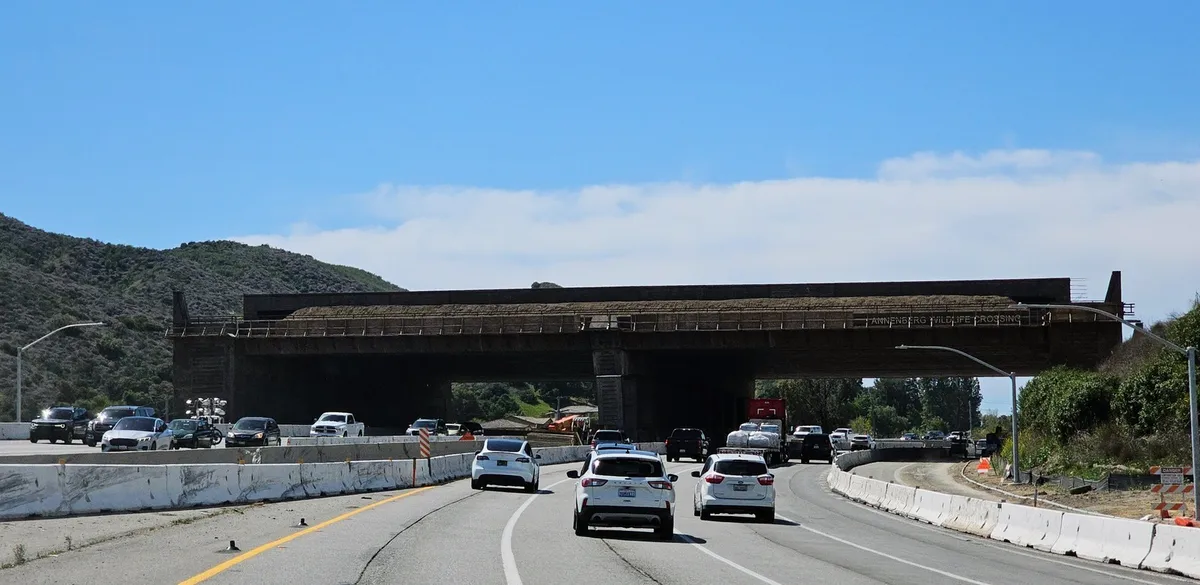
The crossing sits in Agoura Hills, west of Liberty Canyon Road, and is meant to reconnect the Santa Monica Mountains, south of the 101, with the Simi Hills to the north. The freeway, the Park Service says, carries more than 300,000 vehicles a day. For years, biologists have documented how that barrier has isolated mountain lions in the Santa Monica Mountains, with inbreeding and very low genetic diversity as the result. Caltrans's project page makes the same point, and lists bobcats, gray foxes, coyotes and mule deer among the other species cut off by the road.
Caltrans describes the crossing as a vegetated bridge, about 210 feet long over the freeway and about 174 feet wide, and as the largest wildlife crossing of its type in the nation. A June 2025 Caltrans announcement went further and called it the world's largest; Governor Gavin Newsom, in the same release, called it the largest urban wildlife crossing in the world. The project page puts the programmed cost at about $92 million, with major funding from the Annenberg Foundation, other private donors and the California Wildlife Conservation Board.
Construction has been in two stages: the span over the 101, finished in June 2025, and a second span over Agoura Road, due to be completed in 2026. The Times noted that the 101 overpass already has a planting of 6,000 native plants, while the Agoura Road span and a land bridge between the two were still bare in early November.
What biologists will now measure
Riley's caution is the right one. "This is more than just about whether animals use the crossing," he said, in the Park Service release. "We want to understand how effective it is in reconnecting an ecosystem that has been divided by the freeway for decades. That is a much bigger scientific question and answering it will take years."
The cameras are part of a 14-objective monitoring programme, covering use by mountain lions, mule deer and other wildlife, as well as changes in genetic diversity, vegetation, light and sound. During construction monitoring, park scientists had already seen bobcats, coyotes, gray foxes, mule deer and mountain lions regularly using a trail immediately beside the future crossing. Beth Pratt of the Wildlife Crossing Fund told the Times she now thinks there is a chance a mountain lion will use the bridge before the ribbon is cut. "Word gets out in the animal world," she said.
Our take
The ribbon-cutting is a date on a calendar. The coyotes, as coyotes will, declined to wait for it. That is cheering, and it is also easy to over-read. A photograph on a slope, and another of an animal that walked onto the deck and turned around, are not the same as a restored mountain-lion population. They are a start, and they are exactly what the cameras were put there to catch.
The useful claim is not that this is the world's largest crossing, a title that even the official pages do not phrase identically. It is that a freeway which carries more than 300,000 vehicles a day now has a planted lid on it, and that the first animals have already been up there in the dark, unimpressed by the ceremony still to come.
Sources
- National Park Service, National Park Service to Begin Scientific Monitoring at Wallis Annenberg Wildlife Crossing, 4 November 2026
- Los Angeles Times, A second coyote spotted on the wildlife crossing over the 101 Freeway, 5 November 2026
- Caltrans, US-101 – Wallis Annenberg Wildlife Crossing at Liberty Canyon, 2026
- Caltrans, World's Largest Wildlife Crossing Enters Final Phase of Construction, 25 June 2025