What happens to old private jets? Inside the business of scrapping aircraft
In the past year about 250 business jets were scrapped or parted out, roughly 1 per cent of the world fleet. Why flyable jets end up in salvage yards, what their engines and parts fetch, and why a wave of retirements is coming.
By The Graze · November 15, 2026 · 5 min read
In one widely shared clip, a private jet's last flight lasts a few seconds. In December 2020, at Miami-Opa Locka Executive Airport, a worker clamped an excavator's grapple around a Learjet bound for scrap, lifted it off the ground and swung it round as if it were taking one last flight. The clip still circulates. What happens before and after that moment is a quieter business, and it is about to get busier.
A fleet that refuses to retire
There are about 25,700 business jets in the world, according to JETNET, an aviation data company, up from roughly 11,000 in 2001. Very few leave. In the 12 months to October, 253 were scrapped or parted out, about 1 per cent of the fleet and below historical norms, JETNET said in its November market barometer.
"They're living longer than we ever expected them to," Rolland Vincent, an industry analyst, said in 2017. The industry's survivor curve, which tracks how long aircraft stay in operation, "goes to zero just beyond 50 years, and that's unheard of".
That longevity is building a backlog. JETNET says 74 per cent of the jets now for sale are 16 years old or more, up from 57 per cent in 2015. Aviation Week's fleet forecast, published in 2024, expects close to 6,600 older business jets and turboprops to be retired between 2025 and 2034, peaking at 744 in 2031, led by Cessna Citations, Hawker 800s, King Air 90s and Learjets. It expects the Citation I and the Learjet 35 and 36 to be almost entirely withdrawn over the decade.
When the maths stops working
A business jet is rarely scrapped because it cannot fly. It is scrapped because its next bill is bigger than the aircraft. Jack Caloras of CRS Jet Spares, a parts dealer, gave the example of a Challenger 601 worth perhaps $2m whose two engines each need about $750,000 at their next maintenance event. "Some people will pay that; other people are going to put it down and part it out," he told Aviation International News in 2017. That is $1.5m of work on a $2m aircraft, or three-quarters of its value.
The engines decide the outcome. Owners who pay into hourly maintenance programmes run by engine makers or independents can treat their engines, financially, as close to new. Jason Zilberbrand, president of VRef, an appraisal firm, says that from about 15 years of age a jet's value can "invert", until the two engines are worth more than the airframe, avionics, paint and interior combined.
Inside the yard
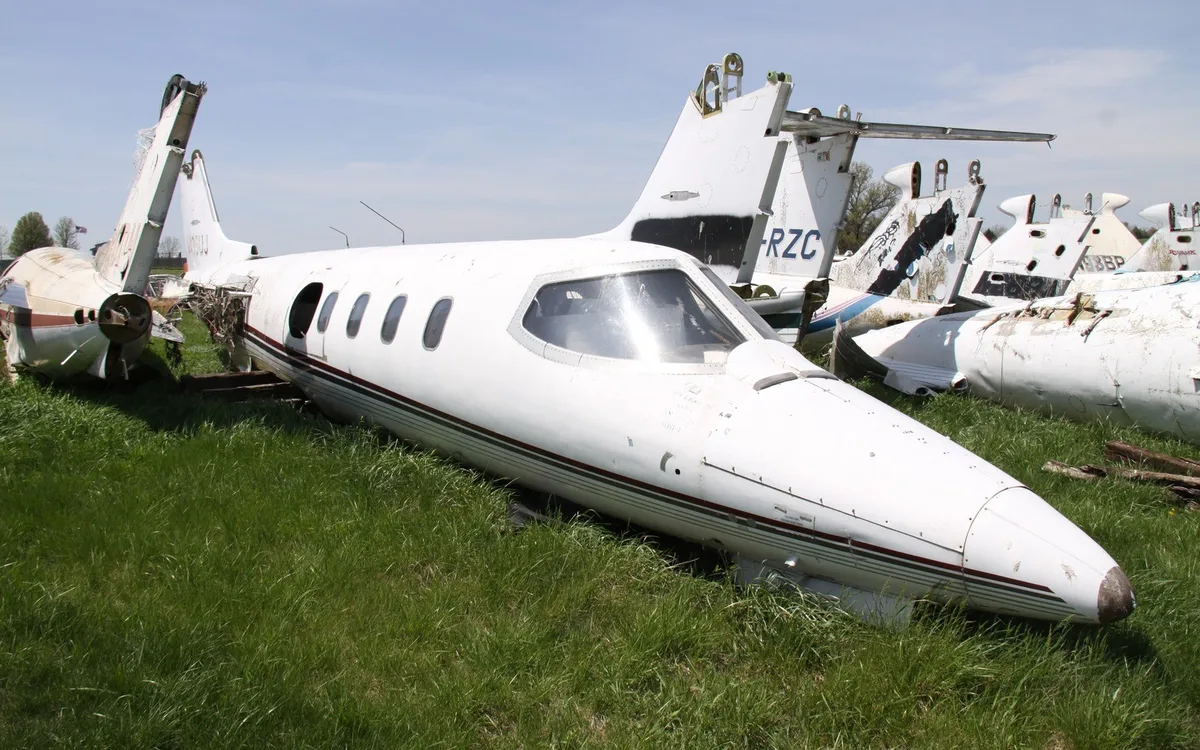
For many American small jets and turboprops, the last stop is a specialist salvage yard. In 2017 Business Jet Traveler counted four major ones: Alliance Air Parts in Oklahoma, White Industries in Missouri, Dodson International Aircraft Parts in Kansas and MTW Aerospace. Terry White estimated that his business had taken in about 2,800 aircraft since the mid-1960s, including 1,000 jets and turboprops. "Most everything that we purchase now is an undamaged airplane, flown in, that we dismantle for parts," he said.
The avionics come out first, then the engines. After that goes "anything you can unbolt", in the words of M.J. "Butch" Holtgrieve of Alliance, who said he had broken down nearly 50 Learjet 35s: control surfaces, landing gear, wheels, brakes, valves and actuators. A larger jet such as a Challenger takes up to several weeks. Engines that have not been run every 30 to 45 days, or kept in a storage programme, may fetch only their core value, warns Jeremy Cox, an aircraft appraiser.
What is left is worth almost nothing. Holtgrieve's scrap dealer paid "between eight and 10 cents a pound". Cox priced the stripped airframe of a hypothetical early Gulfstream V, worth $5m whole, at 21,750lb of mixed aluminium at an average of 19.5 cents a pound: $4,241, under a tenth of 1 per cent of the aircraft's value. Some pieces live on: cockpits sold to training companies or restaurants, polished fuselage sections hung as wall art, hulks sunk as reefs or used for firefighter training.
There is paperwork too. Under federal rules a US registration ends when an aircraft is "totally destroyed or scrapped", and the FAA must be told within 21 days. The Aircraft Fleet Recycling Association, founded in 2006, sets voluntary standards for dismantlers; its latest, BMP 5.2, and a new dismantling standard took effect on 1 January, with an end-of-life certificate to document an aircraft's permanent withdrawal.
The Learjet fleet that is left
| Learjet models | US registrations | Oldest | Newest | Median year built | Median age |
|---|---|---|---|---|---|
| 23, 24, 25, 28, 29 | 73 | 1965 | 1982 | 1974 | 52 |
| 35, 36 | 206 | 1974 | 1999 | 1979 | 47 |
| 55 | 67 | 1979 | 1990 | 1983 | 43 |
| 31 | 118 | 1988 | 2002 | 1997 | 29 |
| 60 | 235 | 1992 | 2013 | 2001 | 25 |
| 40, 45, 70, 75 | 426 | 1998 | 2022 | 2007 | 19 |
The Learjet is the textbook case. Bombardier said in February 2021 that it would end production that year, after more than 3,000 deliveries since 1963, and that it would keep supporting the fleet. On the FAA register, 1,125 Learjets still hold a valid US registration. Of those with a recorded build year, 263 were made before 1990. Teardowns also feed spare parts to the Learjets still flying.
Our take
The scrapyard is the honest appraiser of the private-jet market. A jet's listed price says what a seller hopes for; its part-out value says what it is actually worth once the next big maintenance bill arrives. For any jet older than about 15 years, the first questions are about the engines: when they were last overhauled, whether they are on a maintenance programme and what the next scheduled event will cost.
The low scrappage rate has a cost. With only about 1 per cent of the fleet retired each year, the market is carrying a large stock of older aircraft, and almost three-quarters of the jets for sale are at least 16 years old. When the retirements Aviation Week expects do arrive, owners of the oldest models will find fewer buyers, fewer shops and lenders, and a stronger pull towards the yard.
For buyers, a cheap 1980s Learjet 35 is cheap for a reason. The purchase price matters less than the next engine overhaul. For owners of the survivors, each teardown is useful: it puts more used parts on the market for the aircraft that are still flying.
Sources
- Federal Aviation Administration, aircraft registry releasable database (download of 13 November 2026)
- Code of Federal Regulations, 14 CFR 47.41, duration and return of certificate
- Bombardier, full-year 2020 results and Learjet production decision (11 February 2021)
- Aircraft Fleet Recycling Association, About AFRA and Best Management Practices
- JETNET, JIQ Market Barometer, November 2026 (12 November 2026)
- Aviation Week Network, 2025 Business Aviation Fleet and MRO Forecast, market summary (November 2024)
- Business Jet Traveler, Curt Epstein, End of the line: bizjets to beer cans? (December 2017)
- AvBuyer, Jeremy Cox, How to understand the scrap value of a jet (5 December 2018)
- VRef, The jet that's worth more dead than alive (episode 49, 28 July 2026)
- Interesting Engineering, Florida man flies Learjet with excavator like a toy plane (25 December 2020)
- Calculations by The Graze: Learjet registrations and build years from the FAA database; the Challenger 601 engine bill as a share of value; the Gulfstream V scrap value as a share of value.