
The world's oldest complete song ended up as a flowerpot stand. What Roman music really sounded like
The oldest complete song anyone has found was carved on a marble column in what is now western Turkey, roughly 1,900 years ago. After it was dug up, it was sawn flat to hold a woman's flowerpots. It is also the best place to start on a question people keep asking: what did the music of the Roman world actually sound like?
The short answer: more than most people assume, and far less than the "authentic ancient Roman music" videos suggest. The National Museum of Denmark counts about 50 surviving pieces of ancient music from the classical to the Roman period, most of them scraps of papyrus from Roman times. Armand D'Angour, the Oxford classicist who has spent years performing them, says about 60. It is written in the Greek notation system, because the music of Rome's empire leaned heavily on Greek music and Greek theory.
The song on the stone
The column, the Seikilos stele, stands 61 centimetres tall and is now in Copenhagen. It opens with the stone speaking, in D'Angour's translation: "I am an image and a stone; Seikilos sets me up here as a long-lasting marker of undying memory." Then comes the song: 17 words with small letters above them for pitch, plus dashes and dots for length and lift. One modern translation runs: "As long as you're alive, shine, don't be sad at all; life is short, time asks for its due."
It came to light in 1883 near Aydın, the ancient city of Tralles, while a railway was being built under the engineer Edward Purser. His wife wanted a flowerpot stand, so the base was sawn straight, destroying the bottom line of text. A paper impression taken earlier shows the name Seikilos followed by "EUTER-", usually read as a husband's dedication to a dead wife, Euterpe. D'Angour argues otherwise: Seikilos probably means "Sicilian", Euterpe is the Muse of lyric poetry, and the stone is a musician's monument to his own talent. During the burning of Smyrna in 1922 the Dutch consul took the column; it went via Istanbul and Stockholm to The Hague, was presumed lost, and was acquired by the Danish museum in 1966.
The tune is not alien. D'Angour points out that it has audible links to Gregorian chant of the 10th century, and that it can be sung to the words of "Humpty Dumpty".
How anyone can read it
The key is a dry 4th-century handbook by Alypius of Alexandria, mostly tables of the vocal and instrumental signs for 15 keys in three kinds of scale. Printed in Amsterdam in 1652, it is why letters above a word can be turned back into notes. In 1581 Vincenzo Galilei, lutenist and father of the astronomer Galileo, had already published three hymns by Mesomedes, a lyre-singer freed by the emperor Hadrian, whose melodies survived in Byzantine manuscripts.
Rhythm comes from the poetry: Greek verse is built from long and short syllables, so the metre gives the beat. Pitch is relative; the signs give intervals, not a key on a modern piano.
The Roman sound
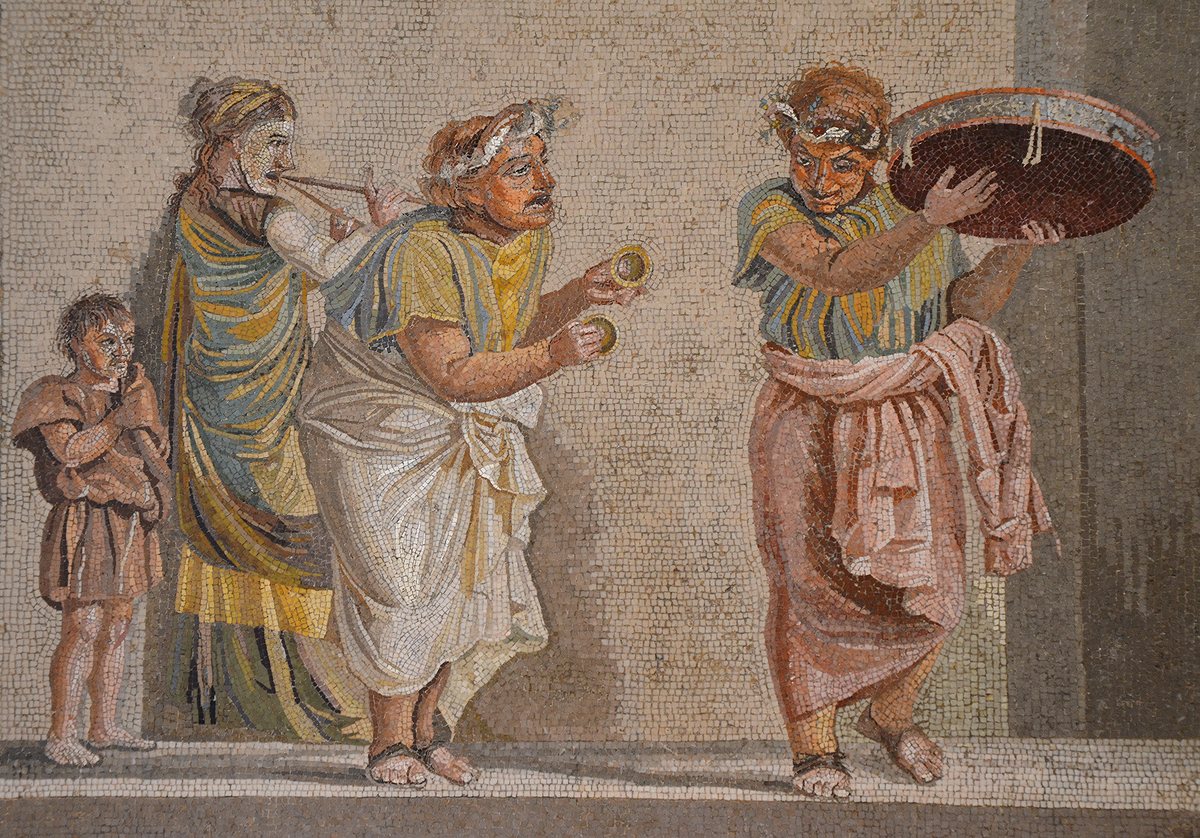
The key instrument of Roman ritual was the tibia, the Greek aulos: a pair of reed pipes played together at sacrifices. The mosaic above, signed by Dioskourides of Samos and found in the so-called Villa of Cicero at Pompeii, shows masked street musicians from a comedy with double pipes, small cymbals and a tambourine. Modern makers have copied an original 2nd-century AD aulos in the Louvre closely enough to play it.
Then there was the hydraulis, the water organ, which used water pressure to keep a steady flow of air to its pipes and accompanied gladiator fights. Nero was obsessed. Suetonius says that in AD 68, with the revolt that would end his reign spreading, Nero did not even address the Senate; he spent the day showing leading men "water-organs of a new and hitherto unknown form" and lecturing on how each worked. He vowed to play the water organ, the pipes and the bagpipes at his victory games. Dying, he kept repeating: "What an artist the world is losing!"
One real Roman organ survives in part. In AD 228 Gaius Julius Viatorinus, a councillor of Aquincum, now Budapest, gave a portable organ to the town's guild of textile dealers, which also ran the fire brigade. It had 52 pipes in four rows of 13. A mid-3rd-century fire dropped it into a cellar, where nearly 400 pieces were found in 1931; about 300 survive. Whether it ran on water or air is still argued.
What is known and what is guessed
Relative pitch and rhythm are on solid ground wherever notes survive. The sound of the pipes is fairly well understood from surviving instruments; strings less so. Tempo, ornament, singing style and accompaniment were rarely written down, so every performance fills those gaps by educated guesswork. D'Angour is candid about it: "the idea of a standardised performance is entirely foreign to music before the age of recording."
The timeline
| When | What survives |
|---|---|
| 408 BC | Euripides' Orestes premieres; a papyrus scrap of one chorus with notation survives |
| c. 128 BC | Delphic hymns to Apollo, carved on the Athenian Treasury at Delphi |
| 1st century BC | Dioskourides' street-musicians mosaic, Pompeii |
| AD 68 | Nero shows off new water organs as his reign collapses |
| 1st or 2nd century AD | The Seikilos song is carved |
| Early 2nd century AD | Mesomedes, freed by Hadrian, composes hymns |
| AD 228 | The Aquincum organ is donated |
| Late 3rd century AD | Oxyrhynchus hymn, the earliest Christian hymn with notation |
| 1883 | The Seikilos stele is found |
| 1966 | Copenhagen buys the Seikilos stele |
Our take
The surprise is not how little survives. It is how familiar it sounds. The oldest complete song from the ancient world is a short, catchy tune with a carpe diem lyric, written by a guy who may have had it carved on a column to advertise himself. That is not a lost civilisation. That is a pop single, and it rhymes.
The other lesson is about who paid. An emperor could hold an organ demonstration while his reign collapsed; a local politician gave the guild that doubled as the town's fire brigade a 52-pipe organ and made sure his name and the consuls' names were on it. Music in Rome was status, the way a name on a concert hall is status now. The tunes were Greek. The money and the ego were Roman.
Be sceptical of anything sold as "authentic ancient music". The honest reconstructions, D'Angour's included, tell you which notes are on the stone and which are theirs. Treat a recording that claims more like a dealer's "one careful owner".
What to watch: D'Angour has said he is working through about 30 more documents, with the aim of staging a Greek tragedy with its music in one of the surviving ancient theatres. That would be the closest anyone has come to hearing the ancient world as it heard itself.
Sources
- National Museum of Denmark, Seikilos-stelen, collection record 14897 (height, date, about 50 surviving examples)
- Armand D'Angour, The Song of Seikilos: a musically notated Ancient Greek poem, Antigone (December 2021)
- University of Oxford Humanities Division, What does ancient Greek music sound like? and TORCH, Recreating the music of an ancient Greek chorus: Euripides' Orestes
- Aquincum Museum, The Aquincum organ (dedicatory inscription, AD 228)
- Suetonius, Life of Nero, chapters 41, 49 and 54, Loeb translation (LacusCurtius)
- Wikipedia, Seikilos epitaph, Delphic Hymns, Mesomedes, Alypius of Alexandria, Oxyrhynchus hymn and Music of ancient Rome
- Wikimedia Commons, Mosaic of street musicians signed by Dioskourides of Samos (Naples National Archaeological Museum)
- Timeline: The Graze, from the sources above
Sources: National Museum of Denmark, Seikilos epitaph; Armand D'Angour, Antigone Journal; Oxford Humanities / TORCH; Aquincum Museum, the organ; Suetonius, Nero, LacusCurtius