Pauillac vineyard land has fallen from €3m a hectare to €1.7m
Official French valuations show Margaux almost halved in four years, and the average for Gironde appellation vines is down 35 per cent, to €85,600 a hectare.
By The Graze · November 17, 2026 · 5 min read
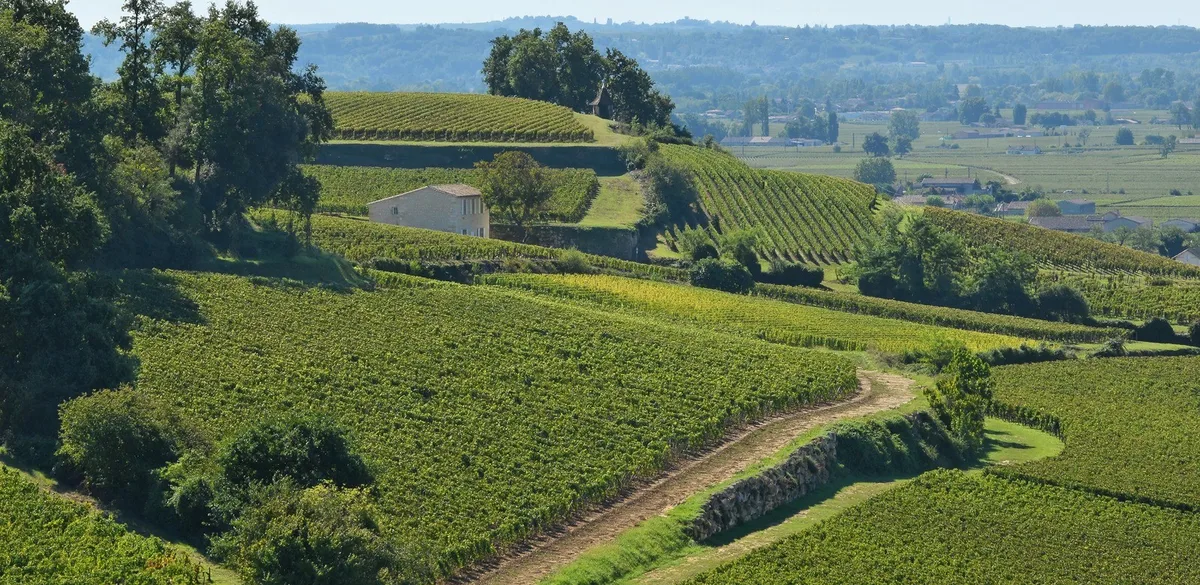
Official French land values show a hectare of Pauillac vineyard, the dearest in Bordeaux, has fallen from €3m in 2021 to €1.7m in 2025. Margaux is down from €1.5m to €800,000. Across the Gironde's appellation vines, the official average has dropped 35 per cent, to €85,600 a hectare.
What the official figures show
The numbers come from Agreste, the statistics arm of the French agriculture ministry, working with FNSafer, the federation of rural land agencies. They are published each year as the indicative "valeur vénale" — the official market-value scale — and are reproduced in the Journal officiel. For each appellation the figure is a "valeur dominante": the price most often paid, as observed or estimated, excluding tax and legal fees. It is not a valuation of any one estate, and it is not the price of every sale.
In Bordeaux, unlike Champagne or Alsace, there are often too few recorded transactions for a purely statistical estimate. Agreste says the 2025 appellation values were arrived at jointly by regional statistical services and the Safer network, as an expert assessment. Pomerol is marked unpublished for 2025 because the sample was too thin to release.
A trade-press reading this week, based on an inflation-adjusted presentation of the same official series, put the fall in Pauillac and Margaux at a little more than half. The official current-euro figures, set out below, are slightly less dramatic, and they are the ones that enter the government's scale. Even on that basis, four years have taken a sharp bite out of the top of the market, and a sharper one further down.
Official vineyard values, 2021 and 2025
| Appellation | 2021 | 2025 | Change |
|---|---|---|---|
| Pauillac | €3.0m | €1.7m | −43% |
| Margaux | €1.5m | €800,000 | −47% |
| Saint-Julien | €1.8m | €1.4m | −22% |
| Saint-Estèphe | €550,000 | €300,000 | −45% |
| Pessac-Léognan | €650,000 | €400,000 | −38% |
| Saint-Émilion | €300,000 | €200,000 | −33% |
| Haut-Médoc | €60,000 | €30,000 | −50% |
| Médoc | €38,000 | €10,000 | −74% |
| Sauternes | €30,000 | €20,000 | −33% |
| Gironde AOP, average | €132,000 | €85,600 | −35% |
The drop has not been a straight line. The official 2025 workbook also carries 2023 and 2024. Pauillac was still at €3m a hectare in 2023, then €2.5m in 2024 and €1.7m in 2025 — a 32 per cent fall in the latest year alone. Margaux slipped only from €1.5m to €1.4m between 2023 and 2024, then fell to €800,000. The Gironde appellation average went from €137,800 in 2023 to €112,500 in 2024 and €85,600 in 2025. Further back from the river, Haut-Médoc has been cut in half, to €30,000 a hectare, and generic Médoc is down 74 per cent, to €10,000.
Why the land has cheapened
Agreste, in its 2025 land-value publication, is blunt. "In 2025, the structural crisis in the vineyards continues, particularly those producing red wine, affected by the steady decline in consumption." A weak harvest last year, and grubbing-up that has reduced the area in production, have weighed on the land market as well as on the wine market. In some districts, the agency says, so few sale projects reached the Safer network that a price could not be published at all.
The official values matter beyond the asking price of a château. They feed the indicative farmland scale, and they influence how lenders and buyers think about an estate. The Drinks Business, writing on the 2021-to-2025 comparison, made that point, and it is the right one: a lower official value tightens the room for borrowing and for investment, just when many properties need both.
A slightly larger crop, still a short one
France's 2026 wine harvest, estimated at 1 November, has been revised up to 36.7 million hectolitres, Agreste said in its November Infos Rapides. That is 3 per cent above 2025, and still 10 per cent below the 2021-2025 average. The agency points to two causes: a smaller area of vineyard in production, down 5.6 per cent between 2024 and 2025 and by a further 1.9 per cent since, including under the national vine-reduction plan; and a hot, dry summer that held back yields in the northern basins.
The Bordelais is doing a little better than the country as a whole, and not well enough to change the picture. All wines in the region are estimated at 3.496 million hectolitres, 10 per cent above 2025's 3.189 million and 11 per cent below the five-year average of 3.948 million. Appellation wines, excluding eaux-de-vie, are put at 3.200 million hectolitres, up 9 per cent on the year and 12 per cent below average. A larger crop than last year's poor one is a relief for the cellar, not a reason to mark the land back up.
Our take
The official scale is not a price list, and anyone quoting it as the value of a particular château is doing it a disservice. A dominant value is a reference, observed or estimated. Estates still change hands at prices that sit well above or below it; the published range for Saint-Émilion in 2025 runs from €100,000 to €2.3m a hectare. The useful fact is the direction and the breadth of the move. Pauillac is down 43 per cent in four years in current euros. Generic Médoc is down 74 per cent. That is a two-speed bust: the trophy communes have been re-rated, the ordinary ones have been hollowed out.
Lenders who still underwrite on 2021 land values are kidding themselves. The government's own scale has moved, and it has moved after a period in which sales were so scarce that some of the grandest Right Bank names could not even be published. Paper wealth on the Left Bank has been reduced. Cash flow in the generic Médoc is the more urgent problem, because a €10,000-a-hectare official value does not support much of a balance sheet, or much of a family.
A slightly larger 2026 crop is welcome and does not fix this. France is still 10 per cent short of its five-year average, and Bordeaux is still 11 per cent short. The vines that have already been pulled will not be producing next year. The official land values are telling growers, bankers and buyers the same thing the cellar already knew: red Bordeaux is worth less, and the land underneath it has started to catch up. The open question is whether €1.7m a hectare for Pauillac, or €10,000 for generic Médoc, is the floor, or a landing on the way down.
Sources
- Agreste, Valeur vénale des terres en 2025 (Chiffres et Données no. 9, June 2026, and the associated official vineyard workbook)
- Agreste, Valeur vénale des terres en 2021 (Chiffres et Données no. 7, July 2022)
- Agreste, Infos Rapides Viticulture no. 143, November 2026 (estimates at 1 November 2026)
- data.gouv.fr, Agreste — Valeur vénale des terres (official open-data landing for the same series)
- The Drinks Business, Values of Bordeaux vineyards have fallen by more than half since 2021 (Arabella Mileham, 17 November 2026)