A Paris court voids Sotheby's 2024 sale of a Pissarro, finding it was looted in 1941
The court cancelled the June London sale, ordered the work returned to Salomon Flavian's heirs, and gave Sotheby's two months to name the buyer, under a €1,000-a-day penalty.
By The Graze · November 17, 2026 · 6 min read
Art market
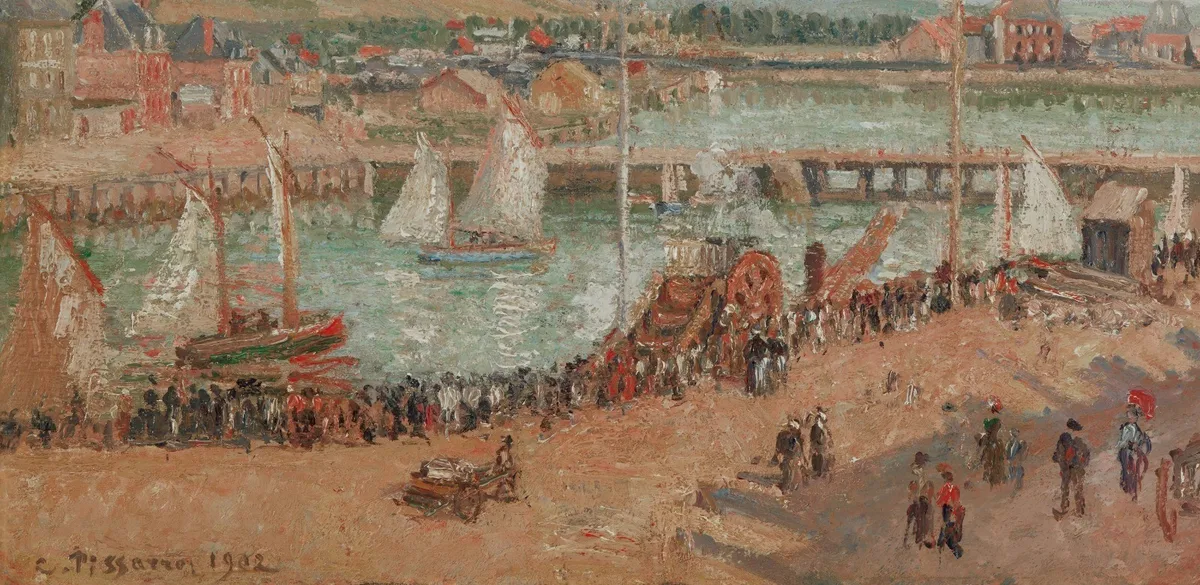
A Paris court has annulled Sotheby's June 2024 London sale of Camille Pissarro's 1902 view of Dieppe harbour and ordered the work returned to the heirs of Salomon Flavian, finding it was looted in occupied Paris in 1941. The official lot page still hides the price. The Art Newspaper put the hammer at £1.2 million. The court has given Sotheby's two months to name the anonymous buyer, under a penalty of €1,000 a day.
The official lot
The painting is Darse de pêche et bassin Duquesne, Dieppe, après-midi ensoleillée, oil on canvas, 65.3 by 81.2 cm, signed and dated 1902 at the lower left. It was lot 49 in Sotheby's Modern and Contemporary Evening Auction in London, sale L24006, closed at 18:56 GMT on 25 June 2024. The official estimate was £1.5 million to £2.5 million. The result is still behind a login.
The provenance on that page runs from the artist's daughter to a sale at the Hôtel Drouot on 20 March 1935, where Flavian, a Jewish banker in Paris, bought the canvas, and then on to the dealer Paul Rosenberg "acquired by 1937" and the British painter Edward Le Bas "acquired from the above by 1939." It also lists the picture in the Répertoire des biens spoliés en France, the official French register of looted property, 1947, volume II, number 7118. And it says: "This work is being offered for sale pursuant to a settlement between the current owner and heirs of Salomon Flavian."
The lot was guaranteed, and subject to irrevocable bids. It was always going to sell. The fight is about whether it should have been sold at all.
What the court held
The Paris Judicial Court gave its ruling on 5 November. According to The Art Newspaper, which quoted the judges, the family had produced "a set of precise, serious and concurring elements demonstrating that Pissarro's work was indeed looted during" the war, and there was "no direct and convincing evidence" of the pre-war sales to Rosenberg or Le Bas that the catalogue still prints. The court treated those catalogue steps as a hypothesis that Sotheby's and Mondex, the Toronto firm that arranged the settlement, "did not support ... by any direct proof of such sales."
It annulled every sale since the 1941 seizure, including the London sale of 25 June 2024, and ordered restitution of the work "wherever and in whoever's possession it may be," to Flavian's descendants. Sotheby's must disclose the "complete identity" of the 2024 buyer within two months, The Art Newspaper said, or pay €1,000 for each day of delay. The judgment applies immediately, even if it is appealed.
Seven Flavian descendants told the court, at a hearing on 18 September, that only two relatives had signed the Mondex settlement, and that the others had not been consulted. The Art Newspaper, which had seen a 17 October 2024 letter from Mondex, wrote in September that the firm later told unconsulted family members it had accepted in their name a "relatively modest" 8 per cent share of the net sale price "in exchange for their cooperation," while the two signatories were down for a 16 per cent commission. The court, The Art Newspaper said in November, chose not to cancel the agreement those two heirs had signed.
What Sotheby's and Mondex say
A Sotheby's London spokesperson said the house is "disappointed by the judgement regarding the restitution," and "welcomes the decision to dismiss all claims against Sotheby's." "The history of the artwork is complex," the statement added, "and we fully recognise the profound losses suffered by the Flavian family during the Nazi era and, from the outset, have approached this matter responsibly and with the care and respect it deserves." Client confidentiality, the house said, "is of paramount importance," and "there is a procedure that will need to be followed in order to enforce the decision in the UK." It is considering whether to join an appeal.
Mondex intends to appeal a judgment that, its lawyer Melina Wolman told The Art Newspaper, is "posing major difficulties in regard with historical factors." James Palmer, the firm's founder, told ARTnews an appeal would be filed "forthwith," and that "when the vast amount of complex provenance research evidence is properly understood and considered ... the court of appeal will reach a different conclusion."
Corinne Hershkovitch, the claimants' lawyer, called it "a very important ruling, which opens the way to a restitution that the Flavian family has demanded since the war."
The figures in one place
| Item | Figure | Source |
|---|---|---|
| Official lot, sale L24006, lot 49 | Estimate £1.5m–£2.5m; result hidden | Sotheby's |
| Press hammer, 25 June 2024 | £1.2 million | The Art Newspaper |
| Court ruling | 5 November 2026, Paris Judicial Court | The Art Newspaper |
| Buyer to be named | Two months, then €1,000 a day | The Art Newspaper, quoting the ruling |
| Répertoire des biens spoliés, 1947 | Vol. II, no. 7118 | Sotheby's catalogue |
Our take
Sotheby's did not hide the problem. It printed the official looted-property register in the same catalogue that printed a pre-war sale to Rosenberg and Le Bas, and a settlement with "heirs." That is a lot of work for a page to do at once. The court has now said the pre-war sales are unproven, the 1941 seizure is the story that holds, and every later sale, including London in 2024, is void. The settlement, on the court's account, was signed by two relatives. Seven heirs came to court.
The practical order is the one that matters next: name the buyer, in two months, or pay €1,000 a day. Without a name, a French restitution order is a piece of paper about a picture that has already changed hands in London. Sotheby's is already talking about the procedure for enforcing a French judgment in the UK, and about client confidentiality. Those two sentences do not sit comfortably together. One of them will have to give way.
The £1.2 million hammer, and the dollar figures that followed it, are a sideshow until the official result is posted and the canvas is back in the family's hands. Mondex will appeal, and Sotheby's may join. The ruling still applies now. A catalogue that lists a work in the official 1947 register of looted art, then sells it, has been told that a settlement with two heirs is not the same thing as a clearance. Other lots with the same footnote will be read more closely after this.
What to watch: whether Sotheby's names the buyer inside the two months, and whether a British court is asked to enforce the Paris order before an appeal is heard.
Sources
- Sotheby's, Camille Pissarro, Darse de pêche et bassin Duquesne, Dieppe, après-midi ensoleillée, lot 49, Modern and Contemporary Evening Auction (sale L24006)
- Sotheby's, Modern and Contemporary Evening Auction, including the Ralph I. Goldenberg Collection
- Répertoire des biens spoliés en France 1939-1945, volume II (official 1947 register, cited on the Sotheby's lot page as no. 7118)
- The Art Newspaper, French court orders restitution of Pissarro painting sold at Sotheby's for £1.2m to heirs of Jewish banker, Vincent Noce, 6 November 2026
- The Art Newspaper, Was this Pissarro painting sold at Sotheby's in 2024 looted by Nazis? A Paris court deliberates, Vincent Noce, 24 September 2026
- Smithsonian Magazine, A French Court Annuls the $1.6-Million Sale of This Camille Pissarro Painting, Allegedly Looted During World War II
- ARTnews, A Court Rules Sotheby's Must Facilitate Return of Nazi-Looted Pissarro, Brian Boucher