Palmer Luckey reveals SLAB, a 1,000-year floating city valued at $1bn in 2017
The Anduril founder says he and close friends valued SLAB at $1 billion in 2017, after the $2 billion Oculus sale paid for the work.
By The Graze · November 18, 2026 · 5 min read
Seasteading
Palmer Luckey said this week that he has been developing a seastead called SLAB since selling Oculus to Facebook in 2014, and that it was designed to last 1,000 years. The Anduril founder said the aim was a platform cheaper than land and "absent state/local laws" that, in his view, cripple American industries such as metal processing, medical research, desalination, oil refining and chemical engineering. He offered no location, timetable, cost or legal structure.
What Luckey said
On Tuesday evening, US time, Luckey set out the project in a series of posts, quoted at length by Engadget, Business Insider and Kotaku. "Selling Oculus to Facebook in 2014 gave me money for helicopter flight lessons and developing a seastead called SLAB with a 1,000 year design life," he wrote. "The goal was to be cheaper than land and absent state/local laws that cripple critical American industries like metal processing, medical research/treatment, desalination, oil refining, chemical engineering, and more."
He went on: "Me and a few close friends cashed it up at a $1B valuation back in 2017, and while it still has a long way to go, there has been significant progress towards my goal of reviving manifest destiny and westward expansion." He contrasted SLAB with other seasteading efforts. "At a time when most of the seasteading community wanted to escape the US and smoke pot, this was the one project explicitly designed to make America stronger, a relief valve for ill considered or outdated rules and regulations."
He said he was talking about it now only because "a few media outlets got wind of me and some friends topping up the coffers and plan on calling SLAB my new floating AI datacenter project." "It is way cooler than that, way older than that, and I hate looking like a hype-chasing consensus loser, so now you have to read this tweet." Engadget and Kotaku identified the reporters as Liz Hoffman and Reed Albergotti of Semafor. As of 18 November, Semafor had not published a SLAB story that could be found.
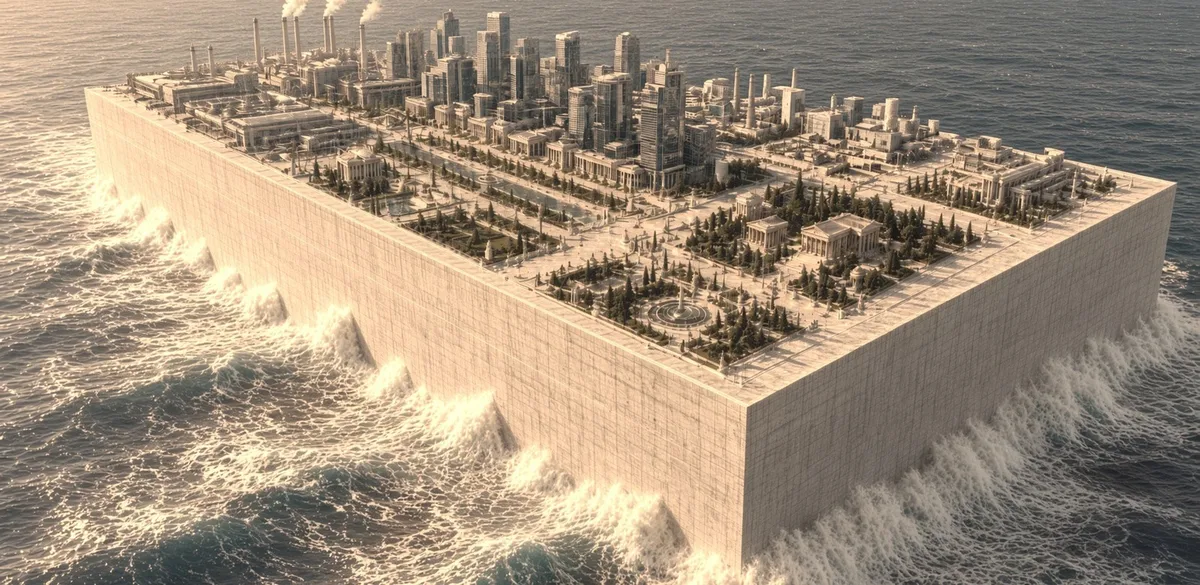
Luckey attached an image that Business Insider described as apparently AI-generated, showing a massive concrete slab above the waves with factories and offices on top. That picture is a render, not a photograph of a finished platform.
What can be verified, and what cannot
The Oculus sale is a matter of record. Facebook said on 25 March 2014 that it had agreed to acquire Oculus VR for approximately $2 billion, including $400 million in cash and 23.1 million shares then valued at $1.6 billion.
Almost everything else about SLAB rests on Luckey's own account. He did not name the friends, say how much money has gone in, either in 2017 or in the latest "topping up," or identify a site in US or international waters. He did not say which state or local laws he wants to avoid, or how a floating platform would be treated under federal law, maritime law or the law of the sea. A project "absent state/local laws" is not, on the words he used, a place beyond all government. Business Insider noted the same gap: he did not specify the rules he was trying to sidestep.
The 1,000-year design life is a claim, not a published engineering specification. The 2017 "$1B valuation" is how Luckey describes a funding round among friends, not a figure confirmed by an outside investor or a filing. He himself said the project still has a long way to go.
Anduril, the defence-technology company Luckey founded after Oculus, had no SLAB announcement on its media pages when they were checked on 18 November. SLAB appears, on the public record, to be a personal project rather than a disclosed Anduril programme.
An old idea, newly described
Seasteading — permanent settlement on the ocean, often pitched as a way to try new rules — has been a Silicon Valley hobbyhorse for years. Business Insider noted that Peter Thiel invested $1.7 million in The Seasteading Institute in 2008 and later left its board, saying the plan was not feasible. That history is useful only as context. It shows how often these projects have been announced, and how rarely they have become places you can visit.
What Luckey added this week is a date, a name, a slogan and a denial. The date is 2014. The name is SLAB. The slogan is a 1,000-year design life and a "relief valve" for rules he dislikes. The denial is that this is a new floating AI data centre. Those are all statements. They are not a construction schedule.
| Item | What can be verified | Source |
|---|---|---|
| Name and aim | Luckey says SLAB is a seastead, begun after the 2014 Oculus sale, meant to be cheaper than land and absent state and local laws | Luckey's posts, as reported by Engadget, Business Insider and Kotaku, 17-18 November 2026 |
| Design life | "1,000 year design life," in Luckey's words. No public engineering specification | Same posts |
| 2017 valuation | Luckey said he and close friends "cashed it up at a $1B valuation back in 2017." Not confirmed by an outside filing | Same posts |
| New money | Luckey said he and friends were "topping up the coffers." No amount, no named co-investors | Same posts |
| Oculus sale | Facebook agreed to acquire Oculus VR for approximately $2 billion on 25 March 2014 | Facebook announcement, 25 March 2014 |
| Location, timetable, legal structure | Not disclosed | Not disclosed |
Compiled by The Graze from Luckey's posts as reported by Engadget, Business Insider and Kotaku on 17-18 November 2026, and from Facebook's 25 March 2014 announcement of the Oculus acquisition. The 1,000-year design life and the 2017 $1 billion valuation are Luckey's claims.
Our take
The interesting fact in Luckey's post is not that a Silicon Valley founder wants to park industry offshore. That wish is old. It is that he is careful, in the same breath, to stay inside a national story. He is not, he says, trying to leave America. He wants a "relief valve" that makes America stronger, and he reaches for "manifest destiny" and "westward expansion" to say so. The politics of that are obvious, and so is the gap in the legal picture. State and local rules are not the same as federal statutes, environmental law or the law of the sea. A platform that is merely "absent state/local laws" could still be thoroughly regulated. Until someone publishes a flag, a site and a legal opinion, SLAB is a mood, not a jurisdiction.
The 1,000-year design life and the $1 billion friends-and-family valuation should be treated the same way: as the founder's language, not as measurements. Luckey has built serious companies. That is why the post travelled. It is also why the gaps matter. A man who sold a virtual-reality firm for about $2 billion, and who went on to found Anduril, is asking to be taken seriously about an ocean settlement for refineries and hospitals. The serious response is to ask for the drawings, the budget and the law, and to wait. In the meantime, the honest summary is the one he already wrote for himself: this is older than a floating data centre, and it still has a long way to go.
Sources
- Engadget, Palmer Luckey says his SLAB seastead is 'way cooler' than a floating data center, 18 November 2026
- Business Insider, Palmer Luckey wants to build US industries in ocean to sidestep laws, 18 November 2026
- Kotaku, Palmer Luckey reveals ocean city designed to last 1,000 years, 17 November 2026
- Facebook, Facebook to Acquire Oculus, 25 March 2014