Kohler made a gut-health tracker that clips onto your toilet
Dekoda, from Kohler Health, clamps to the rim of a toilet and uses optical sensors to track gut health, hydration and signs of blood. It went on sale in 2025 for $449.
By The Graze · November 15, 2026 · 4 min read
Lifestyle
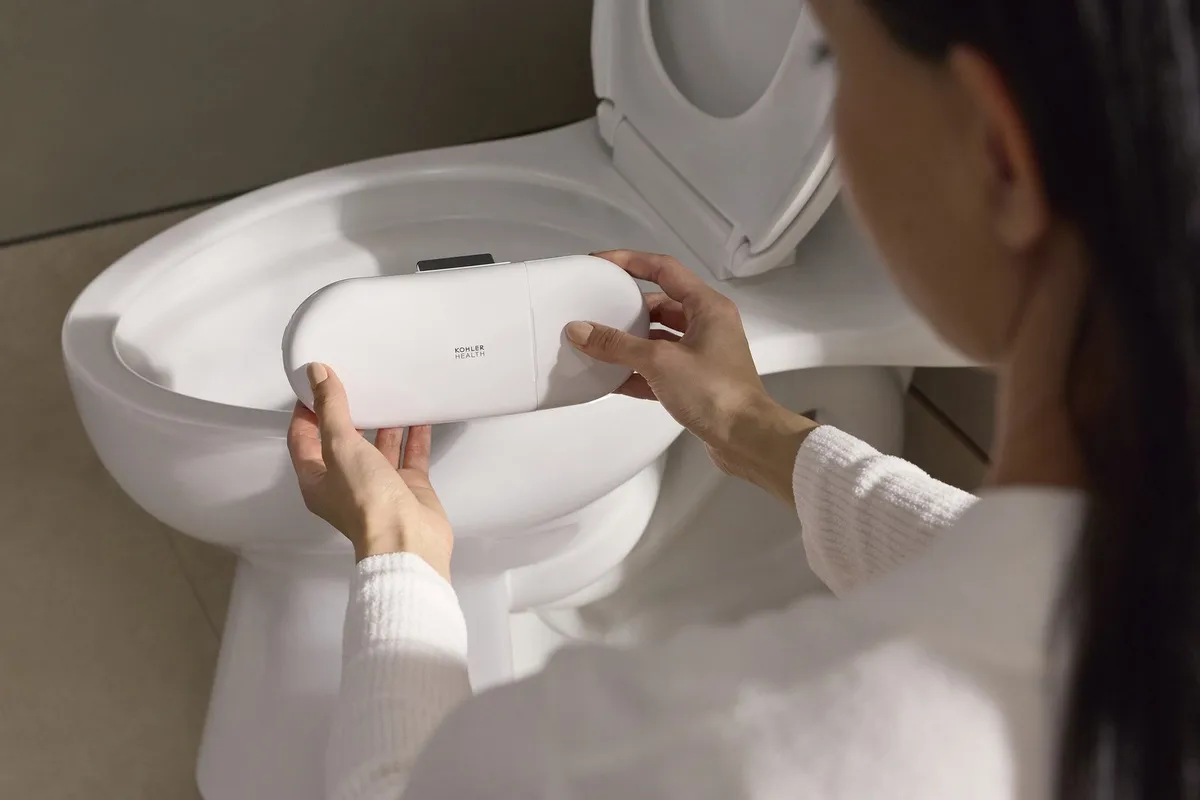
Kohler Health's Dekoda is a white capsule that clamps to the rim of a toilet and analyses what goes into the bowl. A year after launch, the bathroom company is pitching it as a gut-health tracker, a hydration monitor and, it says, the first such device that can detect blood at home.
A clip-on clinic
Dekoda attaches to most white residential toilets with an adjustable clamp and no tools, according to Kohler's product pages. On the outside of the rim sits a flattened white polycarbonate capsule; on the inside, a camera and optical sensors point down into the bowl. Kohler Health says the system uses spectroscopy to read colour, consistency and volume, and to look for haemoglobin.
A magnetic battery pops off the capsule for charging outside the bathroom, Dezeen reports, and a fingerprint scanner can be wall-mounted nearby so that a session starts only when a recognised user logs in. The Kohler Health app then shows three scores: gut health, hydration and blood presence. Users can tag meals, medication, exercise and travel, and share a report with a clinician if they choose.
The device went on sale in October 2025 and now retails for $449 at Kohler and Kohler Health, according to a company press release marking the first anniversary. A membership is required to use it.
What it claims to see
"When we developed Dekoda, our goal was to give people the tools to listen to their bodies, track meaningful results over time, and take charge of their own wellness journey," Nora Tophof, managing director of Kohler Health, told Dezeen. The human eye, she said, misses "trace amounts of blood or other issues" and "early signs of dehydration."
Kohler says the gut-health algorithms are trained against the Bristol Stool Chart, a clinical scale for classifying stool, and that hydration readings are informed by urine specific gravity. The blood-detection claim is the one the company leans on hardest. In its anniversary release, Kohler Health calls Dekoda "the first and only" at-home, toilet-based device that can detect blood in the bowl, using optical spectroscopy "tuned specifically to identify hemoglobin."
The intended users, according to Dezeen and the company's own site, include older people, patients managing chronic gut conditions such as Crohn's disease, and athletes who want a closer read on hydration. Kohler Health says it is a member of the Crohn's & Colitis Foundation.
A bathroom, not a wrist
Dekoda is part of a wider move to pull health tracking off the wrist and into the parts of daily life that wearables cannot see. Dezeen places it among a small group of devices that analyse bodily fluids rather than pulse or steps. Kohler's pitch is that the bathroom is already a private, daily ritual, so the sensors can work in the background.
Privacy is the obvious objection. Kohler Health says a session only begins after a fingerprint or app login, that the camera is aimed at the bowl rather than the user, and that data is encrypted in transit. The same press materials note that the data is then decrypted and processed to provide the service. Anyone buying a camera for the toilet is making a bet on that chain of custody.
The hardware is designed for a wet, chemical room: antibacterial, chemical-resistant polycarbonate on the outside, stainless steel in the mechanics, Dezeen reports.
Our take
The interesting idea here is not a "smart toilet." It is a modest, retrofittable sensor that tries to make an already daily habit produce a record a doctor might actually use. For someone with a chronic gut condition, a discreet log of consistency, timing and possible blood is more useful than another step count.
The claims still need to be treated as company claims. Spectroscopy can measure colour and some chemical signatures; it is not a colonoscopy, and a consumer app is not a diagnosis. The blood-detection feature is the one that will attract the most attention, and the one that most needs independent clinical validation.
The membership model is the part to watch. At $449 the hardware is a one-off purchase, but the device is useless without the service behind it. As with any health gadget that depends on a subscription, the long-term cost, and the fate of the data if the service changes, matter as much as the clamp on the rim.
What to watch: whether clinicians start asking patients for Dekoda reports, and whether any independent study tests the blood-detection claim in the messy conditions of a real bathroom.
Sources
- Kohler Health, Discover Dekoda, official product site
- Kohler Health, How Dekoda works and Intelligent gut health tracking
- Kohler Health, Dekoda one-year anniversary press release, PR Newswire, 15 October 2026
- Dezeen, Kohler's gut-health tracker clips onto the toilet bowl, 15 November 2026