Jensen Huang's two children work at Nvidia. How public companies handle the boss's family
Nvidia's proxies show the chief executive's daughter and son were paid about $2.55m in the year to January. The filings do not name them. Ford's do.
By The Graze · November 16, 2026 · 4 min read
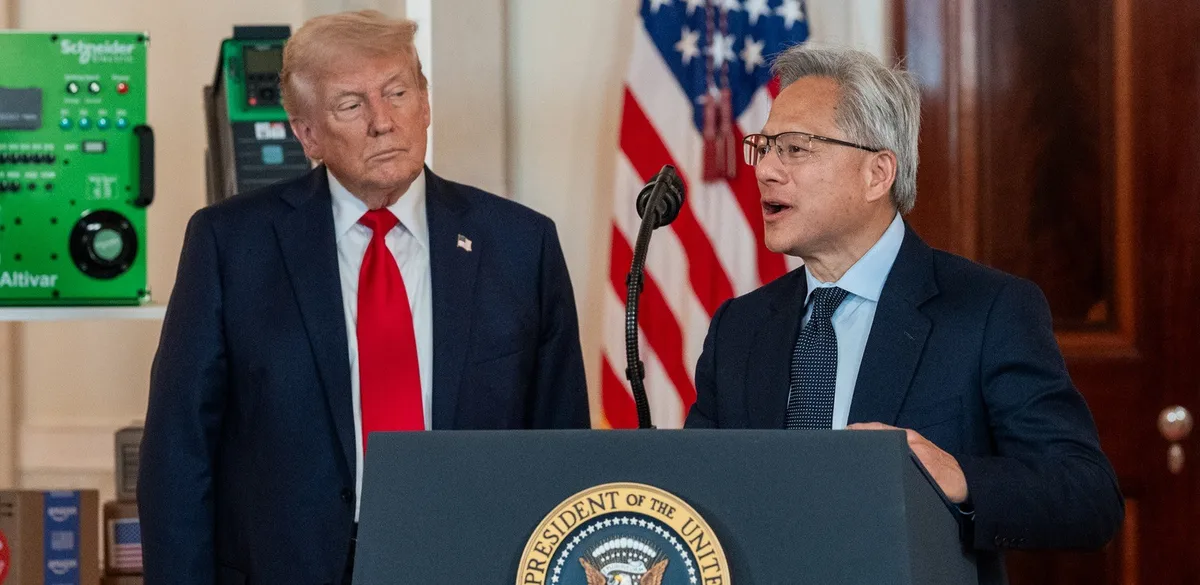
In the proxy Nvidia filed on 12 May 2026, when Jensen Huang was still president and chief executive, the company told shareholders something it had also said the year before: his daughter and son work there. Neither shares his household, the filing says, is an executive officer, or reports directly to him. Their total compensation for the fiscal year ended 25 January 2026 was approximately $1,232,000 and $1,320,000 respectively. The filing does not name them, and it does not say what they do.
What the filings actually say
Nvidia's own blog identifies Madison Huang as senior director of product and technical marketing for its physical AI platforms, including Omniverse, Cosmos and Isaac, and Spencer Huang as director of product for robotics. Those pages also record an MBA from London Business School and a technical MBA from New York University. They do not describe a family relationship. The proxy does the opposite.
A year earlier, in the definitive proxy dated 12 May 2025, the same two people — still unnamed — were paid approximately $1,130,000 and $530,000. The daughter's pay rose modestly. The son's more than doubled. Neither filing explains the change. The same pages disclose that the son of Aarti Shah, a director, is also employed by the company, at approximately $265,000 in fiscal 2026, down from approximately $475,000 the year before. His start date, February 2024, appeared only in the earlier filing.
Compensation, Nvidia says, was determined in accordance with the company's practices for employees with comparable qualifications and responsibilities, without Huang's or Shah's involvement. Each remains eligible for equity awards on the same general terms as colleagues in similar posts.
The $120,000 rule
This is not a loophole, and it is not, by itself, a scandal. Item 404 of Regulation S-K requires a public company to describe any transaction, since the beginning of its last fiscal year, in which the company was a participant, the amount involved exceeds $120,000, and a "related person" has a material interest. A related person includes a child of a director or executive officer. The item also asks for the related person's name, the basis of the relationship, and the approximate dollar amount. The $120,000 threshold has stood since the Securities and Exchange Commission rewrote the rule in 2006.
Nvidia cleared the dollar test in both years and said so in plain language. It did not print first names or job titles. That choice is the interesting part, because other large companies make the opposite one.
Two ways to tell shareholders
Ford Motor's definitive proxy, dated 27 March 2026, is a useful comparison — and not because Ford is a family company in a way Nvidia is not. During 2025, the filing says, William C. Ford III, son of executive chair William Clay Ford, Jr. and sibling of director Alexandra Ford English, was employed as general manager of Ford Performance. Nicholas Ford, also a son of the executive chair and sibling of that director, was director of corporate strategy. Each received 2025 compensation "in excess of $120,000." Ford names the people and the jobs. It does not give the figure.
What two proxies told shareholders
| Company | Who | Named | Job title | Pay |
|---|---|---|---|---|
| Nvidia | CEO's daughter | No | No | approx. $1,232,000 |
| Nvidia | CEO's son | No | No | approx. $1,320,000 |
| Nvidia | Director's son | No | No | approx. $265,000 |
| Ford | William C. Ford III | Yes | General manager, Ford Performance | in excess of $120,000 |
| Ford | Nicholas Ford | Yes | Director, corporate strategy | in excess of $120,000 |
Nvidia's nominating and corporate governance committee is charged with approving transactions that involve directors and executive officers. The company says it regularly reviews related-party dealings for conflicts of interest. Except for the family employment described, it said there were no transactions with related persons since the beginning of fiscal 2026 that required disclosure in the proxy.
Our take
Family members working at a public company is not, on its own, evidence of a rigged process. Ford has been employing Fords for a century. The test is whether pay and reporting lines are independent of the parent, and whether shareholders can actually see who is on the payroll.
Nvidia's answer on process is the one every well-counselled board gives: the children do not report to their father, they are not executive officers, and the compensation committee of one did not set the package. That is worth having in writing. It is not the same as an outside reader being able to judge the jobs.
The unusual part of these filings is the split. Nvidia told shareholders the precise dollars, to the thousand, and withheld the names and titles. Ford did the reverse. The SEC's item asks for the name. A company can argue that "the daughter of the chief executive" identifies the person well enough. It does not tell you whether she markets simulation software or sits in a post that would be hard to justify at $1.2m.
The son's pay more than doubling in a year, with no explanation in either proxy, is exactly the sort of movement the rule exists to put in the daylight. The $120,000 threshold, frozen since 2006, is now a low bar at a company of Nvidia's size. Almost any full-time job clears it. Shareholders were told enough to know the children are there, and what they cost. They were not told enough to judge the work.
Sources
- Nvidia, Definitive proxy statement (12 May 2026)
- Nvidia, Definitive proxy statement (12 May 2025)
- Electronic Code of Federal Regulations, 17 CFR 229.404 (Item 404)
- Ford Motor, Definitive proxy statement (27 March 2026)
- Nvidia Blog, Madison Huang
- Nvidia Blog, Spencer Huang