How Las Vegas became the world's magic capital
Las Vegas sells the idea that anything can happen, so it makes sense that it became the world capital of stage magic. The story runs from a railroad land auction in 1905 to a young sleight-of-hand performer in 1941, a pair of tiger tamers who built the modern mega-resort show, and a duo who have now played the same casino for a quarter of a century.
A railroad town that needed entertaining
Las Vegas was founded on May 15, 1905, when 110 acres of railroad land were auctioned off, according to Smithsonian magazine. It became a city six years later but stayed small until the early 1930s, when two things changed it: Nevada legalised gambling statewide, and work began nearby on what became the Hoover Dam.
The dam's own history, published by the Herbert Hoover Presidential Library, records that construction began in 1930, the dam was dedicated in 1935 and its generators went online in 1937. The project brought a surge of workers to the area, and they wanted something to do on their days off. Travelling vaudeville acts, with ventriloquists and aerial escape artists, followed.
The first magician on the Strip
Smithsonian, drawing on Lance Rich, author of a new history of Las Vegas magic, names Gloria Dea as the first artist to perform magic on the Las Vegas Strip, in 1941, when the stretch of casinos along U.S. Highway 91 was just taking shape. His book, "Neon Dreams", which carries a foreword by David Copperfield, presents her as a discovery and a story that "rewrites magic history".
From the late 1950s, French-style revues such as Lido de Paris at the Stardust and Les Folies Bergere at the Tropicana put large-scale stage illusions in front of casino crowds. Performers who later worked those stages, including Siegfried & Roy and Lance Burton, became some of the city's biggest names.
The mega-resort era
Siegfried Fischbacher and Roy Horn had been working their way up in Las Vegas since 1967. When Steve Wynn opened the Mirage on November 22, 1989, he built them a custom 1,500-seat theatre, and they opened there in 1990. Siegfried did the classic illusions while Roy handled white tigers, white lions and cheetahs, and the show became the template for the casino-as-spectacle. "I don't think a property and an act have ever been as synergistic as Siegfried & Roy were with the Mirage," Rich told Smithsonian.
The stunts grew with the buildings. In 1993, David Copperfield was strapped into a straitjacket and hung upside down ten storeys above a bed of flaming spikes at Caesars Palace, with the ropes set alight. He got out with about 17 seconds to spare. Nearly a dozen new casinos opened on the Strip between 1990 and 1999.
That era ended on October 3, 2003, when a white tiger named Mantecore attacked Roy Horn during a performance. The injuries ended his career. Entertainment on the Strip shifted towards ensemble shows such as Cirque du Soleil.
A century in milestones
| Year | Moment |
|---|---|
| 1905 | Las Vegas founded with a railroad land auction |
| 1930 | Hoover Dam construction begins |
| 1941 | Gloria Dea performs magic on the Strip |
| 1989 | The Mirage opens |
| 1990 | Siegfried & Roy open at the Mirage |
| 1993 | Copperfield's burning-rope escape at Caesars Palace |
| 2003 | Roy Horn injured on stage, ending his career |
| 2026 | Penn & Teller mark 25 years at the Rio |
Who carries it on
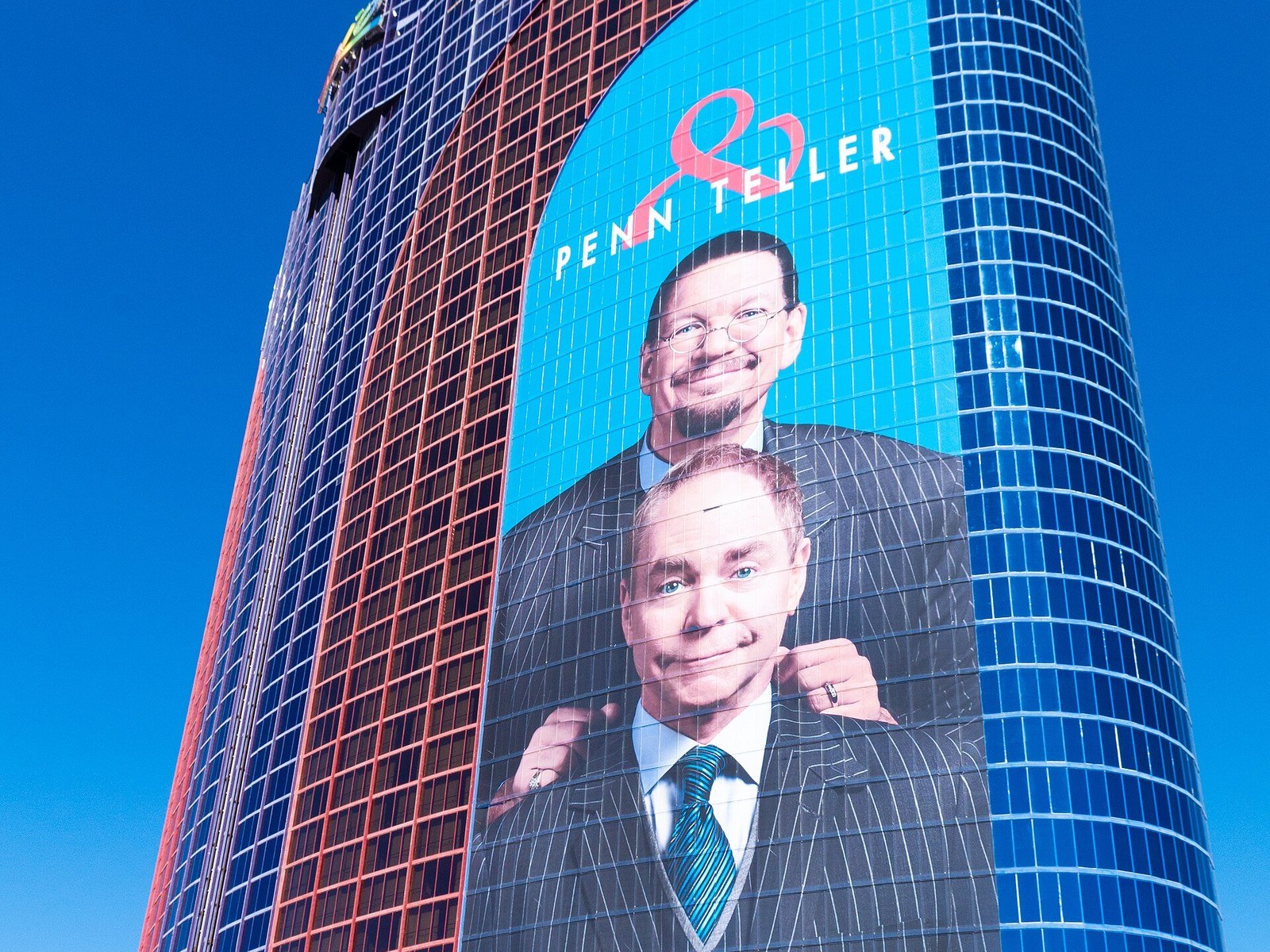
Penn & Teller are the survivors. The Rio, their home venue, bills them as the longest-running headliners in Las Vegas history and says they are celebrating 50 years together and 25 years at the hotel, in a theatre of nearly 1,500 seats. Smithsonian's list of current acts includes Nathan Burton, Jen Kramer, Piff the Magic Dragon and Shin Lim, whose close-up work is projected through synchronised cameras and screens.
Our take
Magic and Las Vegas fit because both sell the same thing: a controlled illusion that the audience agrees to enjoy. A casino asks you to believe the next spin could change your life. A magician asks you to believe the card really vanished. Rich's line to Smithsonian, that Las Vegas "has always been a fantasy land", explains why magicians found such a natural home there.
The business logic matters, too. Magic shows travel well across languages, suit all ages, and can run twice a night for decades with small casts, which is exactly what a resort needs to fill seats between dinner and the tables. Siegfried & Roy proved a single act could define a property. Penn & Teller have proved a smaller, smarter show can outlast almost everything built around it.
What has changed is scale. After 2003, the giant animal spectaculars gave way to intimate rooms, mind reading and camera-led tricks, while the biggest illusions in town are now architectural, from Meow Wolf's Omega Mart to the LED-covered Sphere. Magic did not leave Las Vegas. The city simply became the trick.
Sources
- Rio Las Vegas, Penn & Teller, show page
- Herbert Hoover Presidential Library and Museum, Hoover Dam
- Vanishing Inc., Neon Dreams, book page
- Laura Kiniry, Smithsonian magazine, How the desert town of Las Vegas became a hotbed of magic, November 12, 2026
- Table: The Graze, from the sources above