Former presidents get Secret Service protection for life. What it costs, and who else pays for a guard
Federal law guards former presidents for life, after a ten-year limit Congress repealed before it touched anyone. The cost per protectee is not published; Meta's is: $22.5m to guard Mark Zuckerberg last year.
By The Graze · November 14, 2026 · 6 min read
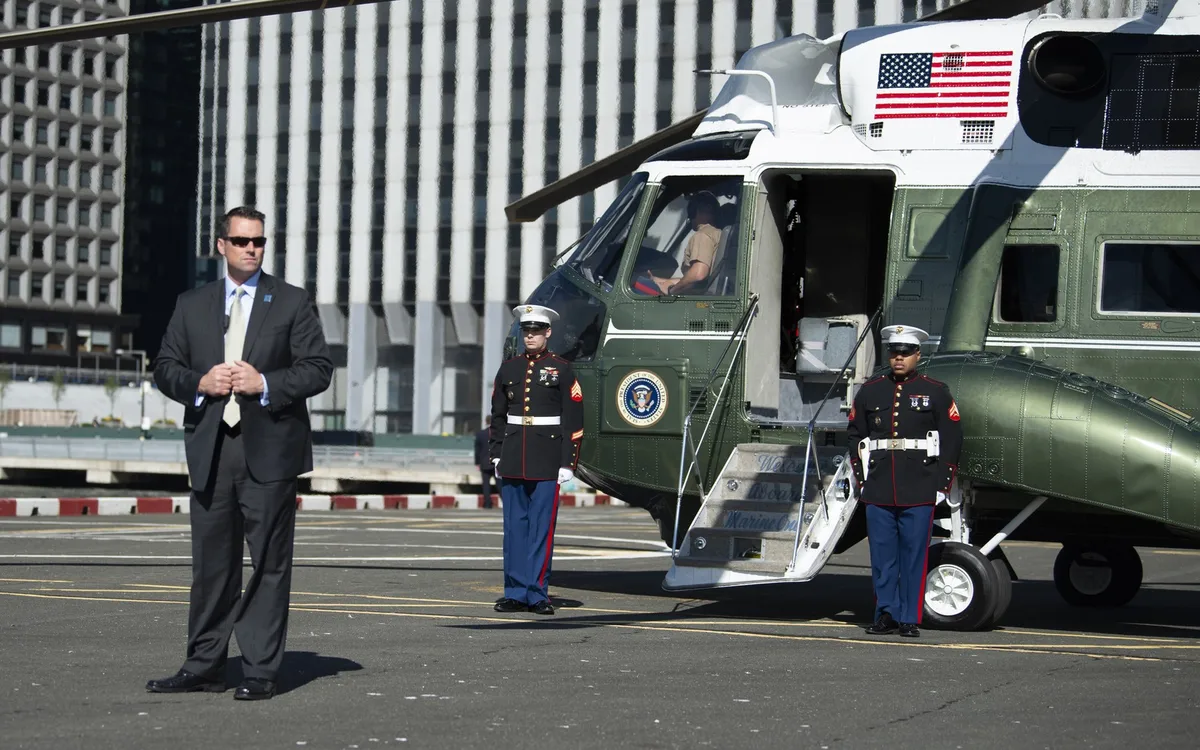
Every former president of the United States is entitled to Secret Service protection for life. For 18 years the law capped it at ten years for anyone first in office after 1996, until Congress repealed the limit in 2013. What the guarding costs is one of Washington's quieter numbers. America's biggest companies are, oddly, more open about theirs.
What the law says
The rules sit in section 3056 of title 18 of the US Code. The Secret Service is directed to protect former presidents and their spouses "for their lifetimes", except that a spouse's protection ends on remarriage. A former president's children are covered until they turn 16. Most protectees, former presidents included, may decline it.
Former vice-presidents get far less: under a 2008 law, six months, though the homeland security secretary can extend protection if conditions warrant it.
Ten years, then nothing
The limit arrived in a 1994 appropriations law. It left lifetime protection in place for anyone who had served as president before 1 January 1997, but capped it at ten years from leaving office for those who came later. The Treasury secretary, who then oversaw the agency, could order temporary protection if conditions warranted.
George W. Bush, who left office in January 2009, would have been the first to lose his detail, in January 2019. He never did. The Former Presidents Protection Act of 2012 passed the House on 5 December 2012 and the Senate on 28 December, and became law on 10 January 2013. Its operative text is two short paragraphs that strike the ten-year language for former presidents and for their children. The Secret Service's own history says Bush "and future former presidents" will be protected for the rest of their lives.
What it costs
No public figure exists for guarding any one former president. The Congressional Research Service, which works for Congress, says the Secret Service "does not provide detailed public reporting on its use of funding or personnel for protective missions", in part because staff move between protection and criminal investigations as duties require.
CRS instead tracks the parts of the budget Congress directs to protection. That money nearly doubled, from $764m in fiscal 2016 to $1.49bn in fiscal 2024, out of a total Secret Service budget of $3.09bn. The House and Senate versions of the 2026 homeland security spending bill, which had not been enacted when CRS last updated its count in April, both carry $1.46bn for protection. On top of that sits $1.17bn for the agency in the 2025 budget reconciliation law, available through fiscal 2029 and not assigned to any one mission.
The budget papers do show how specific the costs can get. The administration's 2026 request cut $14.6m that had paid for protecting former executive office officials given details by presidential memorandum, because that protection had been discontinued. And since the mid-1990s the law has let the Secret Service accept donations to offset its costs when a former president or spouse travels to give a paid speech.
The private version
Listed companies disclose what they spend on top executives in proxy statements filed with the Securities and Exchange Commission. Meta is the outlier. Its 2026 proxy says it spent about $8.5m last year on security at Mark Zuckerberg's homes and during his personal travel, and paid him a pre-tax allowance of $14m that he must spend on security for himself and his family. That is $22.5m in all, before $2.5m of personal flights the company also pays for under the same programme. The allowance has been $14m in each of the past three years. Zuckerberg takes a salary of $1.
Others spend less. Alphabet put Sundar Pichai's security at $8.8m in 2025, on the recommendation of an outside evaluation. Tesla paid about $4.8m to a security company owned by Elon Musk, which it says is only a portion of what his protection costs. Apple's board requires Tim Cook to fly privately on all trips, business or personal. Meta, Alphabet, Nvidia and Amazon all argue that the spending serves the company rather than the executive.
What companies spent guarding their bosses
| Company | Executive | What it covers | Cost ($m) |
|---|---|---|---|
| Meta | Mark Zuckerberg | Home and travel security, plus a $14m allowance | 22.5 |
| Alphabet | Sundar Pichai | Home security, monitoring, car and driver, travel | 8.8 |
| Tesla | Elon Musk | Fees to a security firm he owns; part of the total | 4.8 |
| Nvidia | Jensen Huang | Home and travel security, consultants, drivers | 4.0 |
| Amazon | Andy Jassy | Security beyond offices and business travel | 1.7 |
| Amazon | Jeff Bezos | Security beyond offices and business travel | 1.6 |
| Apple | Tim Cook | Personal security services | 0.9 |
Our take
The comparison flatters neither side. A former president's protection is a promise written into law with no published price. A chief executive's is a published price with no promise attached. Shareholders can see, almost to the dollar, what Meta spent shielding one man in 2025. Taxpayers cannot see what it costs to guard any one of the people the law covers for life.
Scale helps. The seven corporate figures in our table add up to about $44m. Meta's $22.5m alone equals about 1.5 per cent of everything Congress directed to Secret Service protection in 2024, a budget that also covers the sitting president and vice-president, their families, visiting heads of state, the White House complex and events such as inaugurations.
The ten-year limit is instructive too. Congress put an end date on the obligation, then removed it with two short paragraphs before it touched anyone.
What to watch: whether a full 2026 homeland security bill passes, and whether the agency publishes a spending plan for its $1.17bn of reconciliation money. On the corporate side, next spring's proxies will show whether Meta's $14m allowance, flat for three years, finally moves, and whether security lines keep spreading from a handful of famous founders to ordinary chief executives.
Sources
- US Code, 18 U.S.C. § 3056, powers, authorities and duties of the United States Secret Service, with amendment notes (Cornell Law School Legal Information Institute)
- US Government Publishing Office, Public Law 112-257, Former Presidents Protection Act of 2012 (approved 10 January 2013)
- US Secret Service, Timeline of our history
- Department of Homeland Security, US Secret Service congressional budget justification, fiscal year 2026
- Congressional Research Service, U.S. Secret Service protection mission funding and staffing: fact sheet (R48129, updated 28 April 2026)
- Meta Platforms, 2026 proxy statement (SEC filing, 16 April 2026)
- Alphabet, 2026 proxy statement (SEC filing, 24 April 2026)
- Amazon, 2026 proxy statement (SEC filing, 9 April 2026)
- Nvidia, 2026 proxy statement (SEC filing, 12 May 2026)
- Apple, 2026 proxy statement (SEC filing, 8 January 2026)
- Tesla, 2026 proxy statement (SEC filing, 19 October 2026)
- Calculations by The Graze: Meta security ($8.5m + $14m), table total ($44.3m), Meta as a share of 2024 protection funding ($22.5m / $1.49bn) and growth since 2016 ($1.49bn / $764m).