Forgotten History: Robert Smalls, the enslaved pilot who stole a Confederate ship and ended up in Congress
Before dawn on 13 May 1862, an enslaved pilot steamed a Confederate transport past Fort Sumter to the US Navy. Robert Smalls was paid $1,500, later sat in Congress and waited 38 years for a further $5,000.
By The Graze · November 17, 2026 · 6 min read
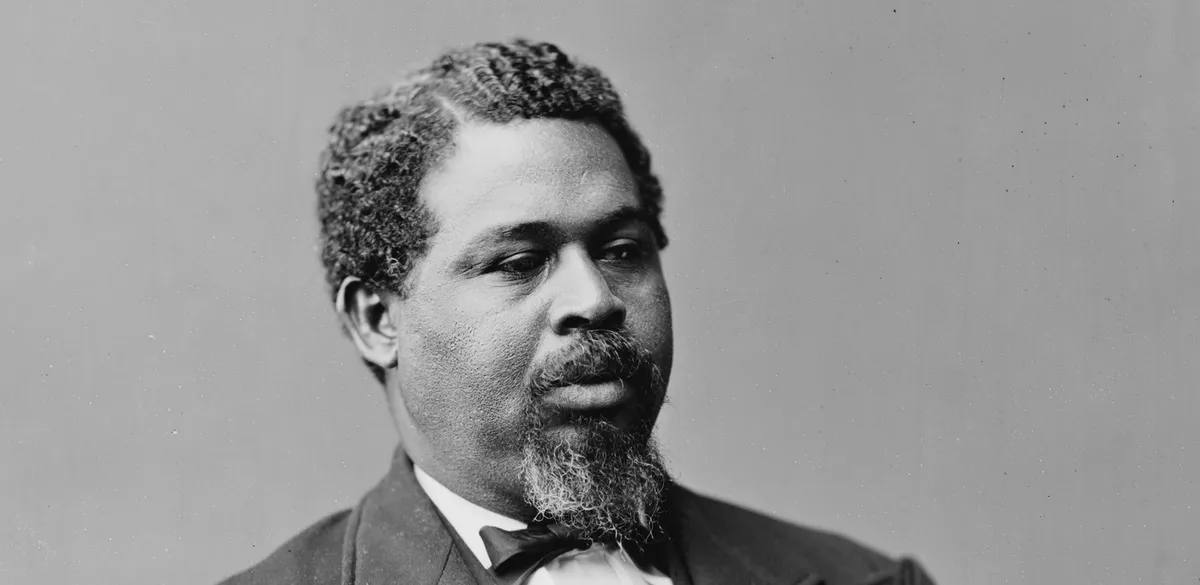
Before dawn on 13 May 1862, a Confederate steamer slipped away from a Charleston wharf, blew the usual whistle salute as it passed the harbour forts and kept going. At the wheel was Robert Smalls, a 23-year-old enslaved pilot. Soon after sunrise he handed the ship and her guns to the US Navy, with 16 people on board. Thirteen years later he took a seat in Congress.
The pilot without the title
Smalls was born enslaved in Beaufort, South Carolina, on 5 April 1839. At 12 he was sent to Charleston to be hired out, and most of what he earned went to the man who held him. On the waterfront he became an expert navigator of the South Carolina and Georgia coast. In 1856 he married Hannah Jones, who was also enslaved.
By 1862 he was steering the Planter, a shallow-draft steamer serving as General Ripley's armed dispatch and transport boat in Confederate Charleston. A congressional committee later found that he was in effect the pilot, but was listed only as a wheelman, because no Black man could then be given the title.
Sixteen people and a straw hat
On the night of 12 May the ship's white officers went ashore to sleep in the city. Smalls and the enslaved crew got up steam and collected their families, who were waiting at another wharf. Between 3 and 3.30am, by the Confederate army's own account, the Planter was gone.
According to the committee, Smalls stood in the pilot house with his arms folded and the captain's big straw hat on his head, just as the captain did, and gave the signal for passing Fort Sumter. Sumter answered "All right". Beyond the last gun, the crew hauled down the Confederate and palmetto flags and raised a white one. The first Union ship they met, the Onward, had turned her guns on them and was about to fire when her captain made out the flag. Flag-Officer Samuel F. Du Pont, commanding the blockading squadron, counted eight men, five women and three children on board.
What he brought
The Planter carried a 32-pounder gun on a pivot and a 24-pounder howitzer, plus four more guns due to be moved to a new harbour fort that morning. More useful still was what Smalls knew. He told the Navy that the Confederates had abandoned their defences on the Stono River, south of the city. Du Pont had it checked, and a week later three Union gunboats crossed the bar into the Stono.
The price of a warship
On 30 May 1862 Congress passed a private act giving Smalls and his associates half the appraised value of the Planter and everything on board. A Navy board valued the ship and her armament at $9,000 and the loose guns at $168. Half of that, $4,584, was divided as Du Pont proposed that August.
Who got what in 1862
| Name in Du Pont's list | Award, $ |
|---|---|
| Robert Smalls, leader of the party | 1,500 |
| J. Smalls | 450 |
| A. Gridiron, the Planter's engineer | 450 |
| J. Chisholm | 400 |
| A. Alston | 400 |
| G. Turno | 400 |
| A. Jackson | 400 |
| W. Morrison, who joined after she left the wharf | 384 |
| Two women of the party, together | 200 |
| Total | 4,584 |
Smalls's $1,500 was about a sixth of the official valuation. Later witnesses put the ship's worth far higher. A House committee report from the early 1880s, adopted by later committees, cited sworn valuations averaging $67,500 for the Planter alone and called the $9,000 figure "absurdly low". On that number his share was about 2% of what he delivered.
In January 1864, at a tax sale, he bought the Beaufort house where he and his mother had been enslaved, for $605.
After the Planter
Smalls kept piloting for the Union, pointing out the mines he had helped to lay. On 7 April 1863 he was pilot of the ironclad Keokuk in the attack on Fort Sumter; she was hit 96 times and sank the next morning. That December, when the Planter came under fire and her captain left the pilot house, Smalls took the wheel, brought her out and was made her captain. In Philadelphia in December 1864 he was put off a whites-only streetcar, and he joined one of the country's first mass boycotts of segregated transport. The city allowed integrated streetcars in 1867.
After the war he sat in South Carolina's 1868 constitutional convention and in both houses of its legislature, then served parts of five terms in the US House between 1875 and 1887. He was convicted of bribery in 1877 and given a full pardon by South Carolina's governor in 1879.
The money question never went away. After nearly a dozen bills, one finally passed in 1900: it asked for $20,000, the Committee on War Claims cut it to $5,000, and President William McKinley signed it on 5 June, 38 years after the escape. He was then collector of the port of Beaufort, and died there on 23 February 1915.
In February 2023 the Navy announced that the cruiser USS Chancellorsville, named after a Confederate victory, would become USS Robert Smalls.
Our take
The escape is usually told as a heist, and a great one: the hat, the folded arms, the whistle at Sumter. The more useful part of the story is what came after, and it is about valuation. The government took a working armed steamer, her guns and a pilot who knew where the mines were, and booked the lot at $9,168. By the terms of its own act it kept half, and it paid the man who delivered it $1,500. It then took him 38 years and a pile of committee reports to win another $5,000.
Anyone who has negotiated with a large institution will recognise the pattern. The side that sets the first price usually sets the outcome, and a low early number tends to stick.
The second lesson is about skill the system refuses to name. Smalls was a wheelman on paper because the rules would not call him a pilot. Du Pont, writing the next day, said he would keep employing him as one. Talent that is underpaid and unrecognised does not vanish. It waits for a better offer, and in 1862 the better offer was on the other side of the bar.
His own verdict, from 1895, still holds: "All they need is an equal chance in the battle of life."
Forgotten History runs every Tuesday.
Sources
- Official Records of the Union and Confederate Navies in the War of the Rebellion, Series I, Volume 12 (Government Printing Office, 1901), pages 807 and 820-825: Du Pont to Gideon Welles, 14 May 1862; Commander E. G. Parrott and Acting Volunteer Lieutenant J. F. Nickels, 13 May 1862; Du Pont to Lieutenant Daniel Ammen, 22 May 1862; the private act of 30 May 1862; Welles to Du Pont, 15 July 1862; Du Pont's apportionment, 19 August 1862; Confederate report of Lieutenant Ravenel, 13 May 1862
- US House of Representatives, Committee on War Claims, Robert Smalls, Report No. 51, 56th Congress (16 January 1900), reprinting earlier House committee findings on the Planter, first made in the 47th Congress
- US House of Representatives, History, Art and Archives, SMALLS, Robert (biography) and The House reimburses Robert Smalls (18 May 1900)
- National Park Service, Robert Smalls and The Robert Smalls House
- US Navy, SECNAV renames Ticonderoga-class guided missile cruiser USS Chancellorsville after Robert Smalls (27 February 2023)