Forgotten History: Cincinnatus, the farmer who was handed Rome and gave it back in 16 days
Rome's army was trapped in the hills, so the Senate sent for a man who was out working his fields. He took near-absolute power, won the war and handed the power back on the 16th day. More than 2,000 years later George Washington copied him, and a city in Ohio is still named after him.
His name was Lucius Quinctius Cincinnatus. The story comes to us from Livy, who wrote his history of Rome under the emperor Augustus, more than four centuries after the events. Modern historians generally accept that Cincinnatus was real and that he was dictator in 458 BC, the traditional date. How much of the detail is true is another matter, which we come to below.
A trapped army
In 458 BC Rome was at war with the Aequi. The consul Lucius Minucius marched out, camped near the enemy at Algidus and then, in Livy's telling, lost his nerve and stayed inside his camp. The Aequi built a wall of earth around it. Five horsemen slipped out before the gaps closed and rode to Rome with the news that the consul and his army were besieged.
The Senate decided it needed a dictator, a magistrate the Roman Republic appointed only in emergencies, with near-total authority for up to six months. It chose Cincinnatus "by universal consent", as an English translation of Livy puts it.
The man at the plough
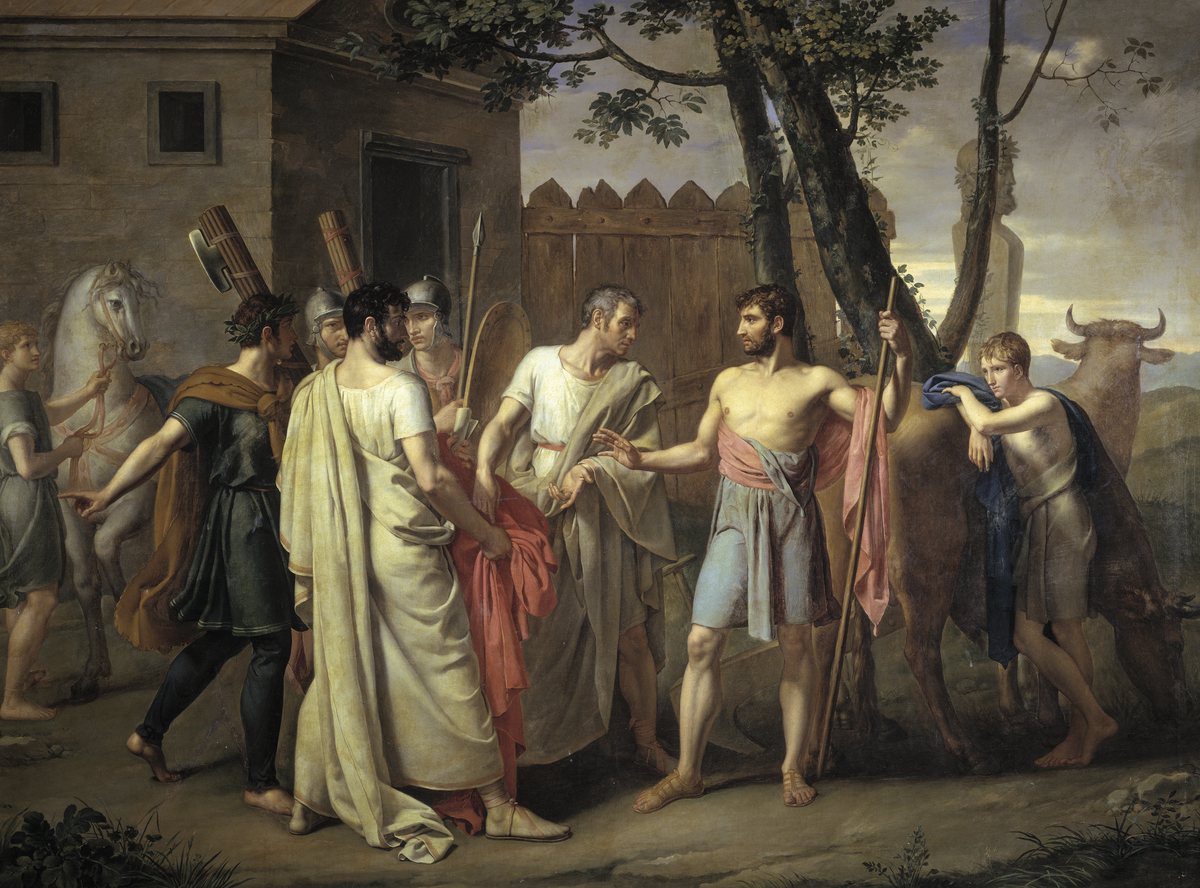
The envoys found him on his small farm across the Tiber, about four acres in that translation. Livy is not sure whether he was digging a ditch or ploughing, only that he was "engaged at least on some rural work, as is certain". They asked him to put on his toga and hear the Senate's orders. He asked, more than once, "whether all was safe", then told his wife Racilia to fetch the toga from their hut. He wiped off the dust and sweat, put it on, and was hailed as dictator.
That is the moment Juan Antonio Ribera painted around 1806, in the picture now in the Prado in Madrid.
Sixteen days
What followed was fast. Before daylight the next day Cincinnatus closed the shops, suspended all private business and ordered every man of military age to the Campus Martius by sunset, each carrying five days of cooked food and twelve wooden stakes. The army marched that evening and reached Algidus at midnight.
He spread his men in a ring around the Aequi, who were themselves besieging the Roman camp, and had every soldier dig a trench and plant his stakes. By daybreak the besiegers were the besieged. They surrendered, and Cincinnatus sent them under the yoke, a frame of three spears that a beaten army had to walk beneath. He gave all the plunder to his own men, demoted the consul who had needed rescuing and returned to Rome in a triumph. Then, Livy writes, "Quintius laid down his dictatorship on the sixteenth day, having received it for six months."
How much of it is true
The outline is old and widely repeated, but Livy tells this one as a moral lesson. He introduces it for the benefit of those "who despise all things human in comparison with riches". The heroic farmer is also not the whole man. Cincinnatus was a patrician who opposed the plebeians' push for more rights, and his son Caeso was accused of violently resisting their demand for a written code of laws. Livy himself records that the common people did not welcome his appointment, judging his power too great and the man "rather arbitrary". A second dictatorship, in 439 BC, is less certain, and the man involved may have been another member of the same family.
The American Cincinnatus
None of that mattered to 18th-century readers, who knew the story from Livy and popular histories. When Washington resigned his commission as commander-in-chief to Congress at Annapolis on December 23, 1783, and went home to Mount Vernon, the comparison wrote itself. According to the diary of the painter Joseph Farington, Benjamin West had told George III that Washington would retire to private life if America won, and the king replied that if he did, "He would be the greatest man in the world."
| Date | What happened |
|---|---|
| 458 BC | Cincinnatus named dictator; resigns on the 16th day (Livy) |
| 439 BC | A possible second dictatorship (disputed) |
| Under Augustus | Livy writes the story down |
| May 1783 | Continental Army officers found the Society of the Cincinnati |
| 1783 | Washington elected the Society's first president general |
| Dec 23, 1783 | Washington resigns his commission at Annapolis |
| 1790 | Arthur St. Clair names the town of Cincinnati after the Society |
| 1785-1791 | Houdon sculpts Washington in civilian dress beside a plough |
| c. 1806 | Ribera paints Cincinnatus leaving the plough |
Officers of the Continental Army founded the Society of the Cincinnati in May 1783, with the motto Omnia reliquit servare rem publicam, "He gave up everything to serve the republic". Washington was its first president general. In 1790 Arthur St. Clair, governor of the Northwest Territory and a member of the Society, gave a small settlement in what is now Ohio the name Cincinnati.
Our take
The story has survived nearly 2,500 years because it describes the rarest act in politics, and in business: giving up power when nobody can make you. Every founder who won't hire a successor, every chief executive who stays a decade too long and every "interim" leader who is still there years later fails the Cincinnatus test. It is not a test of talent. Minucius had the job and failed at it. Cincinnatus fixed the problem in about two weeks. The point is what he did on day 16.
It is also worth noticing who did the remembering. The Romans who told it were selling a moral, and the people closest to Cincinnatus, the plebeians, thought he was arbitrary and dangerous. Washington understood that reputations are built on the exit, not the entrance. He resigned his command in 1783, then declined a third term as president in 1797, when no law limited presidents to two. That is why a city carries a Roman farmer's name and not a general's.
So the next time someone tells you they are indispensable, ask the Cincinnatus question: when are you leaving? The ones with a good answer are usually the ones you want to keep.
Sources
- Livy, The History of Rome, Books 1-8, translated by D. Spillan, Book 3, chapters 26-29 (Project Gutenberg)
- George Washington's Mount Vernon, Cincinnatus, Society of the Cincinnati and Resignation of military commission
- Library of Congress, George Washington, "The greatest man in the world"?, Julie Miller (December 15, 2022)
- The Society of the Cincinnati, Name of the Society of the Cincinnati
- Wikimedia Commons, Juan Antonio Ribera, Cincinnatus leaves the plough to dictate laws to Rome, c. 1806 (Museo del Prado, Madrid)
- Wikipedia, Cincinnatus (dates and the debate over the second dictatorship) and Livy
- Timeline: The Graze, from the sources above