

Credit card debt hits a record $1.285trn, but fewer balances are going bad

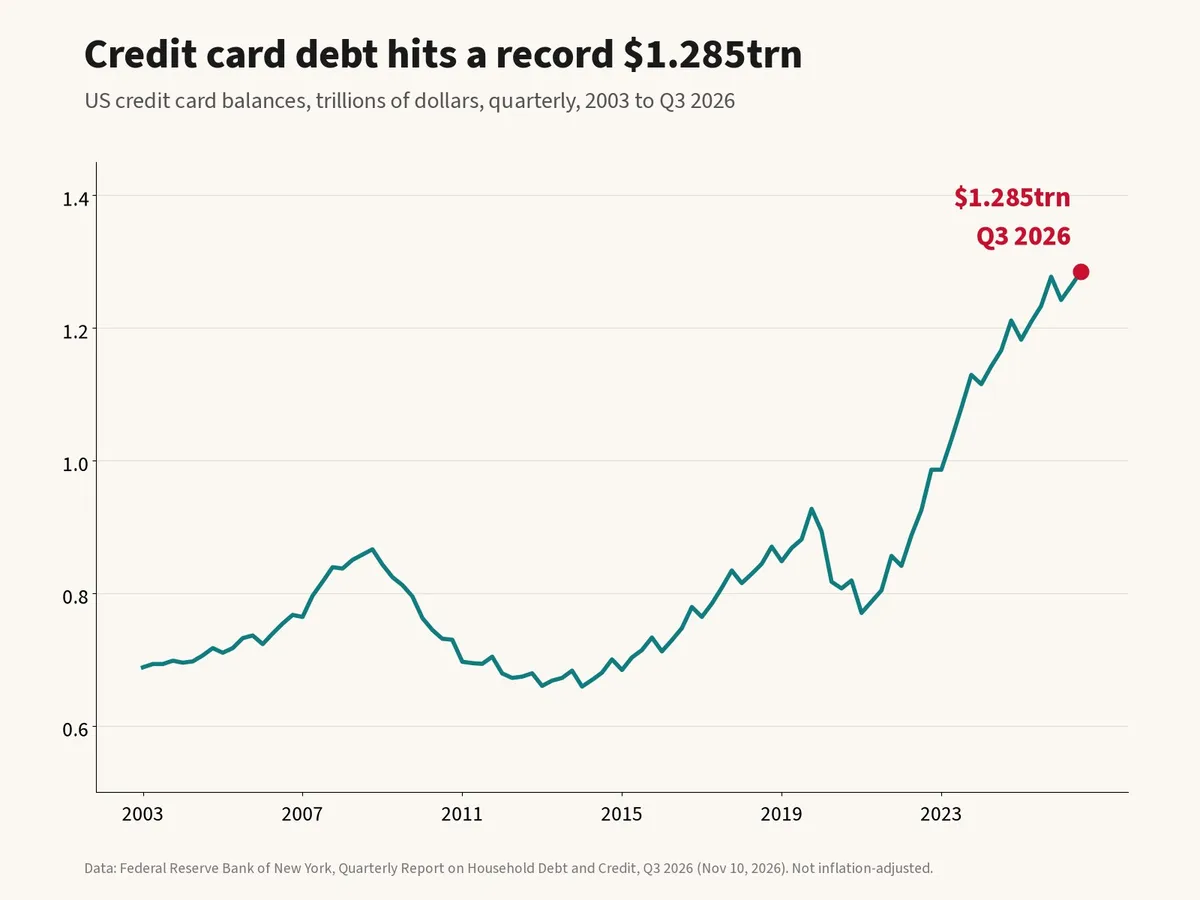
Americans now owe $1.285 trillion on their credit cards, the most the New York Fed has ever recorded. The surprise is underneath the headline: fewer card balances are tipping into serious trouble than a year ago.
The numbers
The Federal Reserve Bank of New York published its Quarterly Report on Household Debt and Credit on Tuesday, November 10. Credit card balances rose by $22 billion, or 1.7%, between July and September, to $1.285 trillion. That beats the previous high of $1.277 trillion set at the end of 2025, and it is $52 billion, or 4.2%, more than a year earlier.
Cards are a small slice of total household borrowing, which grew by $334 billion to $19.1 trillion, mostly on mortgages. But they are the most expensive slice. The average interest rate on a new card offer is about 24%, according to LendingTree data cited by CNBC.
TransUnion's quarterly Credit Industry Insights Report, published a few days earlier, puts the typical burden in household terms. The average cardholder carrying a balance owed $6,678 in the third quarter, up from $6,523 a year earlier. About 178 million Americans carry a card balance, up from 174.8 million.
Why the record is less scary than it sounds
Balances in dollars nearly always rise, because prices and incomes rise. Card debt is up about 39% since the end of 2019, before the pandemic, while consumer prices and wages have also climbed sharply over the same period. A record in nominal dollars is the normal state of affairs, not an alarm.
The more useful numbers are about stress. Here the report is mixed:
- The share of card balances moving into serious delinquency, 90 days or more behind, was 6.87% on an annualised basis, slightly better than 7.05% a year earlier.
- Transition into early delinquency also improved slightly for cards.
- Across all household debt, though, 5.0% was in some stage of delinquency, up 0.3 percentage points from the previous quarter, with mortgages and auto loans getting worse.
TransUnion sees the same split. The share of card balances 90 days or more past due fell to 1.99% from 2.05%, the lowest since 2023. But the share of borrowers who are that far behind rose to 2.50% from 2.37%. In other words, more people are in trouble, but they tend to have smaller balances.
Lenders are handing out more cards
Banks raised total credit card limits by $115 billion in the quarter, the New York Fed said, and TransUnion counted a record 22.4 million new card accounts in the second quarter. More than four in ten new cards went to borrowers with below-prime credit scores. Lenders say they are managing that risk with lower credit lines; the average new account limit was $5,785.
That pattern explains the split in the delinquency figures. Riskier borrowers are getting cards, some of them fall behind, but on small limits.
Our take
The record is real, and at 24% interest it costs real money: a $6,678 balance left alone at that rate adds about $1,600 a year in interest. That is the number worth remembering, not the trillion.
But the report does not show a consumer about to crack. Card stress is flat to slightly better on balances, and lenders are still keen enough to keep raising limits. The places to watch are elsewhere: mortgage and auto delinquencies are creeping up, and the borrower count in trouble is growing even as dollar losses hold steady.
For anyone carrying a balance, the practical answer has not changed. Pay down the highest-rate card first, ask the issuer for a lower rate, and treat a 0% balance-transfer offer as a deadline rather than a gift. Lenders are competing for customers, and that gives borrowers more leverage than usual.
This is general information, not financial advice.
Sources
- Federal Reserve Bank of New York, Household debt increased moderately; delinquency transition rates remain flat and the Quarterly Report on Household Debt and Credit, Q3 2026 (November 10, 2026)
- TransUnion, Credit access expands as lenders pair growth with more strategic risk management (Q3 2026 Credit Industry Insights Report) (November 5, 2026)
- CNBC, Credit card debt climbs to a record $1.29 trillion, New York Fed research finds (November 10, 2026)
- ABA Banking Journal, New York Fed: total household debt reached $19.1T in Q3 (November 10, 2026)