When Charles Dickens met Edgar Allan Poe
In March 1842, the most famous novelist in the English-speaking world sat down in a Philadelphia hotel with a struggling magazine editor called Edgar Allan Poe. Three years later, Poe published The Raven.
The meeting, and the strange bird that links the two men, is one of literature's best stories of influence, and most of it is well documented.
The invitation
Charles Dickens arrived in the United States in January 1842 for a six-month tour, travelling with his wife, Catherine. He was 30 and already a celebrity. Poe, three years older, was an editor at Graham's Magazine in Philadelphia, well known as a critic and much less so as a poet.
Poe had made sure Dickens knew who he was. When he heard of the visit, he wrote to him and sent him some of his work, including his reviews of Dickens' own novels. Dickens wrote back from the United States Hotel on Chestnut Street on March 6, 1842. The letter survives:
"My Dear Sir, — I shall be very glad to see you whenever you will do me the favor to call. I think I am more likely to be in the way between half-past eleven and twelve, than at any other time."
He added a note on the "construction" of William Godwin's novel Caleb Williams, which, he said, Godwin had written backwards, last volume first. Poe never forgot it. He quoted the note four years later in his essay The Philosophy of Composition, which describes how he wrote The Raven.
Two long interviews
Poe later told James Russell Lowell that he "had two long interviews with Mr. D." between March 5 and 9. According to the National Park Service, which runs the Poe house in Philadelphia, they talked about literature and, in particular, the need for an international copyright law. Dickens had been campaigning on it throughout his tour, because American publishers reprinted British books without paying a penny.
Poe had an agenda too, according to the scholar Sidney Moss. He wanted to impress Dickens as a critic, poet and writer of stories, and he wanted a London publisher. He brought an advance copy of Rufus Griswold's anthology The Poets and Poetry of America, which included three of his poems, and he read Dickens a poem by Ralph Waldo Emerson.
Dickens did try. In November 1842 he wrote from London that he had raised Poe's work with publishers, and offered a bleak consolation: "I do not believe any collection of detached pieces by an unknown writer, even though he were an Englishman, would be at all likely to find a publisher in this metropolis just now." Nothing came of it.
The raven
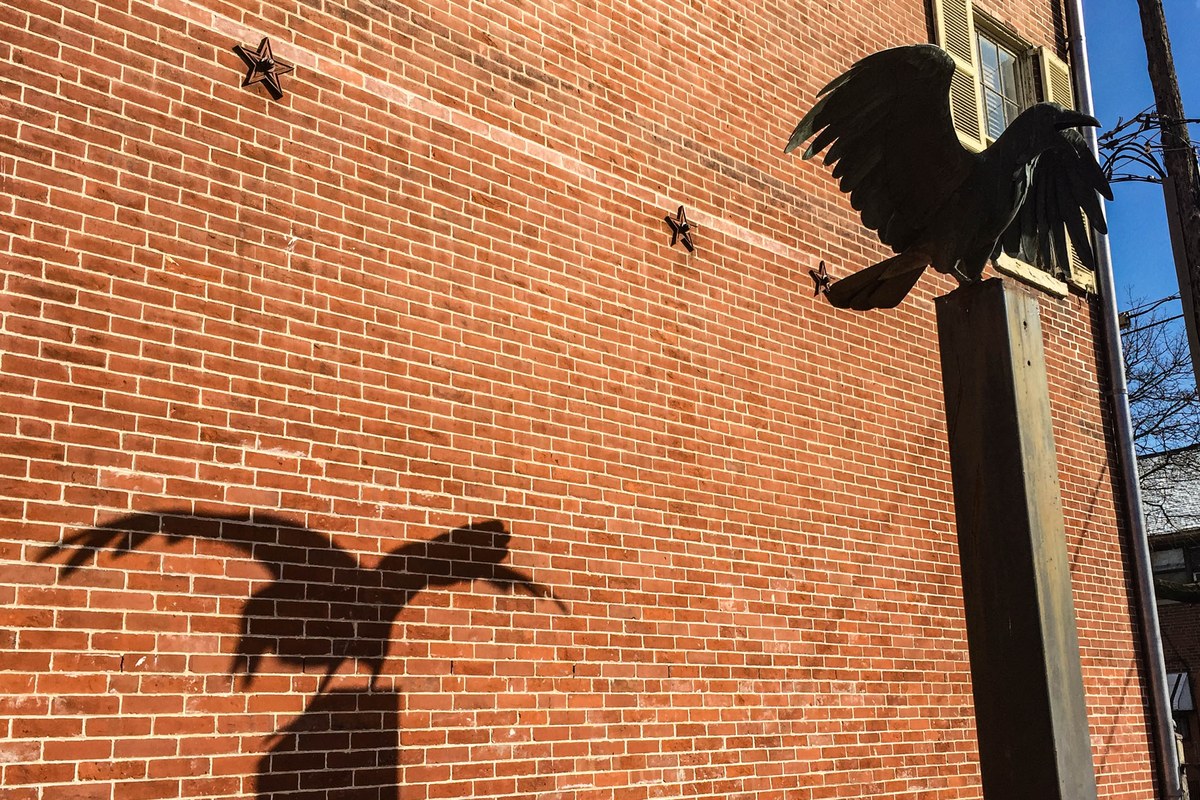
The connection that matters is a bird. Poe had reviewed Dickens' novel Barnaby Rudge, serialised in 1841, and was taken with one character in particular: Grip, a talking raven who follows the simple-minded Barnaby everywhere. Poe found him "intensely amusing", but thought the raven's croaking should have been used more, "prophetically", in the drama.
Grip was real. Dickens kept a pet raven of that name, with a large vocabulary and a habit of biting the children, which inspired the character. The bird died in March 1841, before the American trip, and Dickens had it stuffed. That bird is now in the Rare Book Department of the Free Library of Philadelphia.
Scholars cannot prove that Grip inspired The Raven, published in 1845. But the evidence is strong. In Barnaby Rudge, after Grip makes a noise, one character asks whether it was "him tapping at the door", and another replies, "'Tis someone knocking softly at the shutter." Poe's narrator hears "some one gently rapping, rapping at my chamber door".
"Poe knew about it," the historian Edward Pettit has said. "He wrote about it. And there's a talking raven in it. So the link seems fairly obvious to me."
Our take
The meeting failed on its own terms. Poe wanted a London publisher and did not get one. But he got something better: a conversation about how stories are built, and the memory of a fictional bird he thought had been wasted.
The Raven is that bird, given the prophetic voice Poe said Dickens had denied it. Few great poems can be traced so directly to a single book review. Philadelphia, which now owns the stuffed original, can claim a share in both writers. Nevermore, it turns out, began as a review.
Sources: Edgar Allan Poe National Historic Site, National Park Service; Charles Dickens, American Notes, Project Gutenberg; Open Culture