The billable hour has ruled law since the 1960s. Can AI kill it?

Ask a law firm what a job will cost and the answer usually starts with an hourly rate. That habit took hold in the 1950s and 1960s and has outlasted every attempt to replace it. Generative AI is the newest challenger, and it can do in minutes some work firms bill in hours.
How the clock took over
The American Bar Association's own history, written by its Commission on Billable Hours in 2002, says time was always one factor in a fee but did not become the most significant one until the 1960s. Before that, lawyers weighed difficulty, result and value to the client. "It was not until the 1950s and 1960s that timekeeping became routine," the commission wrote. By the late 1960s, it said, most mid-sized and large firms had shifted to hourly billing.
The ABA pushed the change itself. In 1958 it published a pamphlet, "The 1958 Lawyer and His 1938 Dollar", lamenting that lawyers' incomes had fallen behind those of doctors and dentists, according to a history in the Michigan Bar Journal. It urged lawyers to keep accurate time records and recommended about 1,300 billable hours a year, or five to six hours a day over 48 weeks. The same history credits the idea of logging a lawyer's time to Reginald Heber Smith, at a legal aid society in 1914.
The Supreme Court then knocked out a rival pricing system. Bar associations published minimum fee schedules, and in Goldfarb v. Virginia State Bar in 1975 the court ruled that one of them, which set a fee of 1% of a property's value for a title examination in Fairfax County, Virginia, was price fixing under the Sherman Act. The couple who sued had asked 36 other local lawyers; none of the 19 who replied would charge less. The ABA commission later said the billable hour was created partly to address antitrust concerns with fee schedules. The Michigan Bar Journal history dates hourly billing as the norm to the late 1970s.
From 1,300 hours to 1,900
The targets climbed. The ABA commission's 2002 model year for a typical associate set 1,900 hours of billable client work inside 2,300 recorded hours in total, about 50 hours a week, because 1,900 was typical at large firms. That is 600 more billable hours a year than the 1958 pamphlet suggested, an increase of 46%. The commission's verdict: "hourly billing survives, indeed reigns supreme."
The machine that works in minutes
AI ought to be a problem for that model. Clio, a legal software company, estimated in its 2025 Legal Trends Report that as much as 74% of hourly billable tasks could be automated or streamlined with AI. Under hourly billing, it notes, a lawyer who uses AI to work faster earns less.
Clients see the same arithmetic. In its 2026 Report on the State of the US Legal Market, the Thomson Reuters Institute found that 90% of legal dollars still flow through standard hourly rate arrangements, citing its Legal Tracker data. It called this "an almost absurd tension": technology that works in minutes, billed by the hour.
A few firms have dropped the hour. In May 2025 the Solicitors Regulation Authority, which regulates solicitors in England and Wales, authorised Garfield.Law, the first purely AI-based firm it has approved to provide regulated legal services. It helps businesses recover unpaid debts through the small claims process and charges a fixed fee per document: £2 for a polite chaser and £7.50 for a letter before action, according to its published price list. Named solicitors remain accountable, and the system will not propose case law, a guard against AI "hallucinations".
So far, the hour is winning
The data point the other way. Thomson Reuters found that the average law firm's worked rates rose 7.3% in 2025, the fastest growth since at least the financial crisis, while spending on technology rose 9.7%.
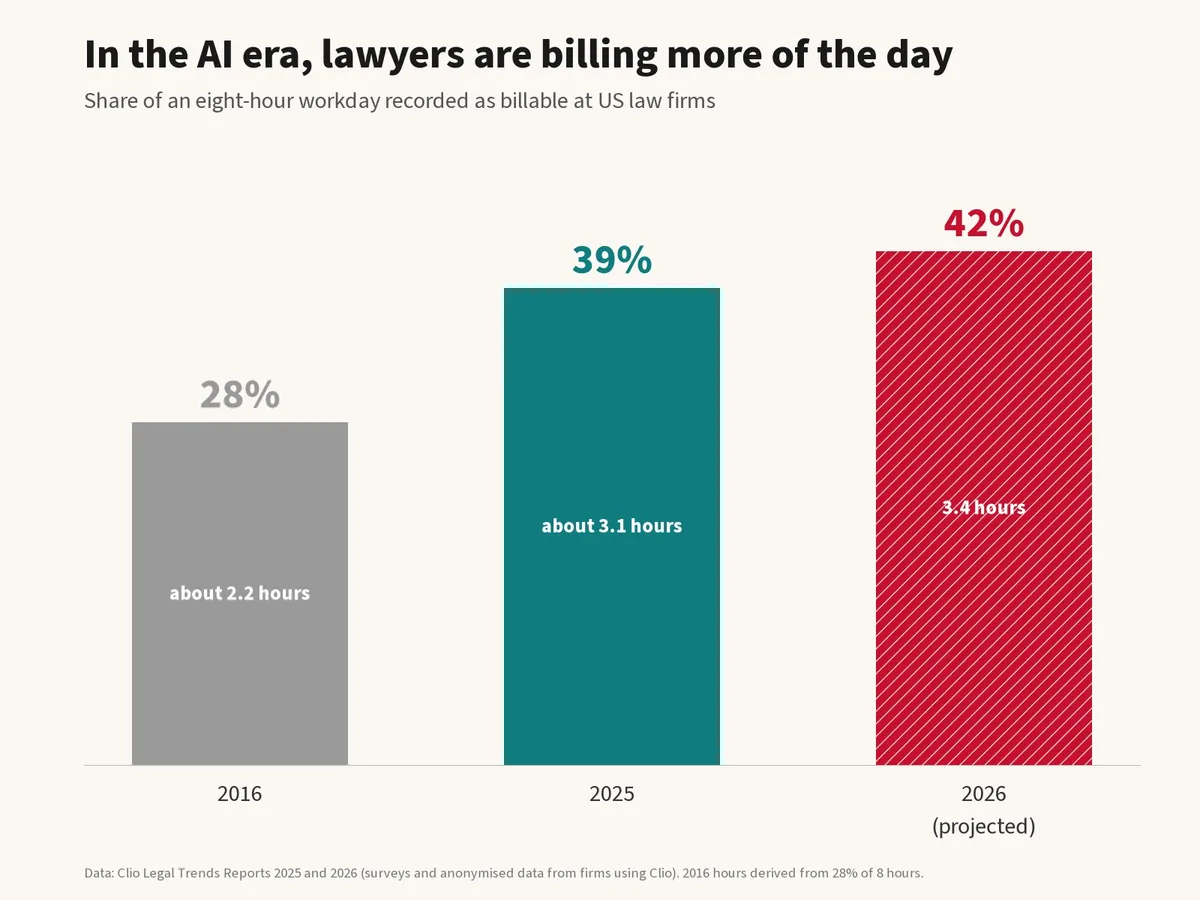
Clio's 2026 report, published on October 26, found the largest annual increase in billable time in the report's 11-year history. The share of a lawyer's workday recorded as billable is projected at 42% in 2026, up from 39% in 2025. At 3.4 hours a day, lawyers are recording 53% more billable work than in 2016. Some 85% of legal professionals report AI adoption at their firms. The figures come from surveys and anonymised data from firms using Clio.
The numbers, worked through
| Year | What happened | The number |
|---|---|---|
| 1914 | Reginald Heber Smith logs time at a legal aid society | Idea of recording time |
| 1958 | ABA pamphlet urges time records | 1,300 billable hours a year |
| Late 1960s | Most mid-sized and large firms bill by the hour | ABA commission history |
| 1975 | Goldfarb v. Virginia State Bar strikes down a minimum fee schedule | Fee had been 1% of property value |
| 2002 | ABA commission model associate year | 1,900 billable of 2,300 hours |
| May 2025 | Regulator authorises AI-based Garfield.Law | £2 chaser, £7.50 letter |
| 2025 | Law firm worked rates | +7.3% |
| 2026 | Share of legal dollars billed hourly | 90% |
| 2026 | Billable share of a lawyer's day (projected) | 42%, up from 28% in 2016 |
Now the squeeze. Thomson Reuters found firms with very different pricing strategies all collected between $553 and $580 an hour. Take a task that once took 10 hours: at $580 it bills $5,800. If AI cuts it to two hours, the bill falls to $1,160 at the same rate. To keep the $5,800, the firm needs $2,900 an hour, five times the rate.
Our take
The billable hour will not be killed by a tool that makes lawyers faster. It has survived email, online research and decades of talk about alternative fees because clients compare every other price back to it. On the evidence so far, lawyers are logging more billable time in the AI era, not less, and rates are rising faster than they have in years.
The real threat sits on the client's side of the table. Thomson Reuters says corporate legal departments have led their outside firms in generative AI use since 2022. A general counsel who can do routine work in-house at a fraction of the cost will stop paying for it by the hour. In our view, that is what breaks the model.
Expect a split rather than a death. Commodity work, such as debt letters, standard contracts and first drafts, moves to fixed prices, as Garfield's £2 letter shows. High-stakes work, where clients buy judgement and rarely haggle, stays hourly at higher rates. The firms with the best tools will bill fewer hours at much higher rates, which is the billable hour under another name.
If you pay a lawyer, ask whether the firm uses AI on your matter and where that shows up on the bill. Clio found 82% of consumers want to know when their lawyer uses AI. For anything routine, ask for a fixed fee.
What to watch: Thomson Reuters' next annual read on rate growth, and whether a large US firm publishes fixed AI-based pricing for whole categories of work.
Sources
- American Bar Association, ABA Commission on Billable Hours Report, 2001-2002 (August 2002)
- Supreme Court of the United States, Goldfarb v. Virginia State Bar, 421 U.S. 773 (decided June 16, 1975), US Reports via the Library of Congress
- Solicitors Regulation Authority, SRA approves first AI-driven law firm (May 6, 2025)
- Garfield.Law, Pricing chart (correct as of October 12, 2026)
- Clio, 2026 Legal Trends Report announcement (October 26, 2026)
- Clio, 2025 Legal Trends Report
- Thomson Reuters Institute, 2026 Report on the State of the US Legal Market (January 2026)
- Thomson Reuters Institute, Law firm rates in 2026
- Tim Batdorf, The billable hour and lawyer wellness, Michigan Bar Journal (March 2011)
- Chart and table: The Graze, calculated from the sources above