The Table: Beaujolais Nouveau 2026 arrives November 19, and there's less of it
At one minute past midnight on Thursday, November 19, the 2026 Beaujolais Nouveau goes on sale. This year there will be less of it. Hail, drought and heatwaves cut the harvest by about a tenth, and the growers say the wine in the tanks is unusually good.
Beaujolais Nouveau is the only wine in the world with a release date people put in their diaries. It is a red made from Gamay grapes grown just north of Lyon, picked in late summer, fermented for a few weeks and sold by the third Thursday of November. It is meant to be drunk young, slightly cool and without ceremony. Here's what to know before the corks come out, and what to drink when the novelty wears off.
The 2026 vintage
Inter Beaujolais, the region's trade body, set the official start of the 2026 harvest for August 13. That is remarkably early. The trade paper Vitisphere compared it with August 19 in 2025 and September 6 in 2024, and reported that picking finished around September 10.
It was a hard summer. A hailstorm on July 16 hit about 5,000 hectares of vines, with damage ranging from 5% to 95% depending on the plot, according to Jean-Marc Lafont, a grower in Lantignié and vice-president of Inter Beaujolais. Drought and heatwaves did the rest. First estimates put the crop at 320,000 to 330,000 hectolitres, about 10% less than in 2025, which was itself a very small year.
The consolation is quality. The grapes stayed small and concentrated. Lafont told Vitisphere he had been relieved not to find the prune and fig flavours that marked the scorching 2003 vintage. Instead, he said, the aromas were "very pure" and had stayed on the fruit, the colour was good and the wines were round and balanced. Demand for the new wines was already pushing prices up in the bulk market, he said.
How it's made
Every grape in Beaujolais has to be picked by hand. Nouveau is made by carbonic maceration: whole bunches go into a sealed tank filled with carbon dioxide, and the uncrushed berries begin to ferment from the inside. The method pulls out bright fruit while leaving the bitter tannins in the skins. The result is a purple-pink wine with high acidity, little tannin and flavours of cherry, strawberry and raspberry, often with a whiff of banana or pear drop.
It is bottled six to eight weeks after the harvest and isn't built to last. Drink it within a few months, and serve it lightly chilled, at about 13°C (55°F).
A party with a long history
Beaujolais growers were toasting the harvest with young wine back in the 1800s, and the bars of Lyon bought it by the barrel, sometimes floated down the Saône. When the Beaujolais appellation was created in 1937, the rules said the wine couldn't be sold before December 15. That was relaxed in 1951, when the growers' union set November 15 as the release date for what became known as Beaujolais Nouveau. In 1985 the date moved to the third Thursday of November, where it has stayed.
The marketing did the rest. Merchants such as Georges Duboeuf helped turn the release into a race, first to get bottles to Paris, then across Europe, North America and, by the 1990s, Asia. Bottles have travelled by Concorde, hot-air balloon, rickshaw and elephant. In the US, the wine is pitched as a Thanksgiving bottle; the holiday always falls exactly a week after the release.
Not everyone was charmed. By the late 1990s the flood of thin, simple Nouveau had given the whole region a bad name, and after the 2001 vintage more than 1.1 million cases of Beaujolais, most of it Nouveau, had to be destroyed or distilled. The region's answer has been a long push towards serious, terroir-driven wine. Nouveau still matters: in 2024 it sold 14.3 million bottles, 9 million of them in France, about 22% of all Beaujolais.
What to drink after the party: the ten crus
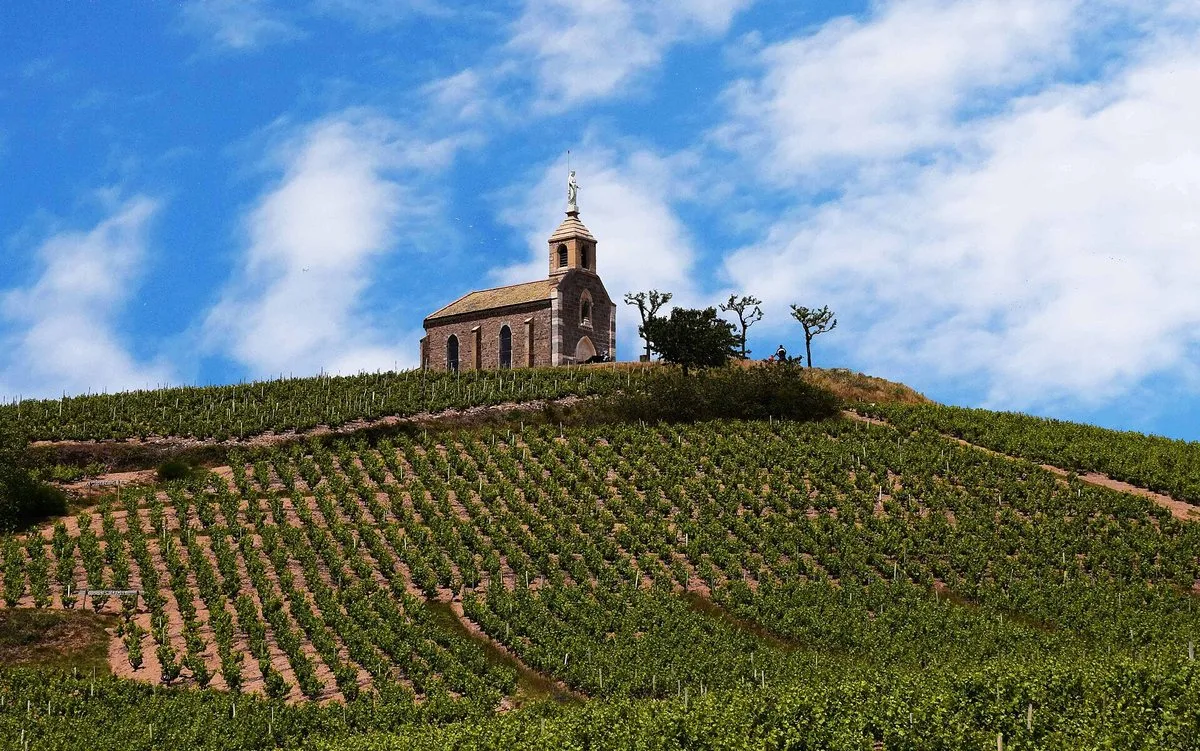
The best Beaujolais never appears as Nouveau. Vineyards in the ten crus, villages and hillsides in the foothills of the Beaujolais mountains in the north, aren't allowed to make it, and their labels often leave off the word Beaujolais altogether. These are the wines worth keeping in the rack. From lightest to fullest:
The lightest crus: Brouilly, Régnié, Chiroubles. Drink within about three years of the vintage. Brouilly is the largest cru, set around Mont Brouilly, with blueberry, cherry and raspberry fruit. Régnié became the tenth cru in 1988. Chiroubles has some of the highest vineyards in Beaujolais and a perfume that often suggests violets.
The middle weights: Côte de Brouilly, Fleurie, Saint-Amour. Best with a year or more in bottle. Côte de Brouilly comes from the upper slopes of Mont Brouilly, an extinct volcano, and is more concentrated than plain Brouilly. Fleurie, silky and floral, is one of the most widely exported crus to the US. Saint-Amour is known for spice and peach.
The ones to age: Chénas, Juliénas, Morgon, Moulin-à-Vent. Typically drunk four to ten years after the harvest. Chénas, the smallest cru, is named for the oak forests that once covered its hills. Juliénas takes its name from Julius Caesar. Morgon, especially from the Côte du Py hill, can turn silky and almost Burgundian with age. Moulin-à-Vent, named for a local windmill, makes some of the longest-lived wines in the region.
How to drink it
Nouveau is a lunch wine, a picnic wine and, in the US, a turkey wine. Its low tannin and bright acidity suit charcuterie, roast chicken, a cheese board and the cranberry and stuffing of a Thanksgiving table. In Burgundy and Beaujolais, cooks use it in coq au vin and in poached pears, which come out an unmistakable purple.
The crus suit the same food with more confidence. A young Fleurie or Chiroubles is lovely chilled with fish. A Morgon or Moulin-à-Vent with a few years on it will stand up to duck, game birds or beef. Either way, the old Beaujolais rule applies: open it, pour it, and don't overthink it.
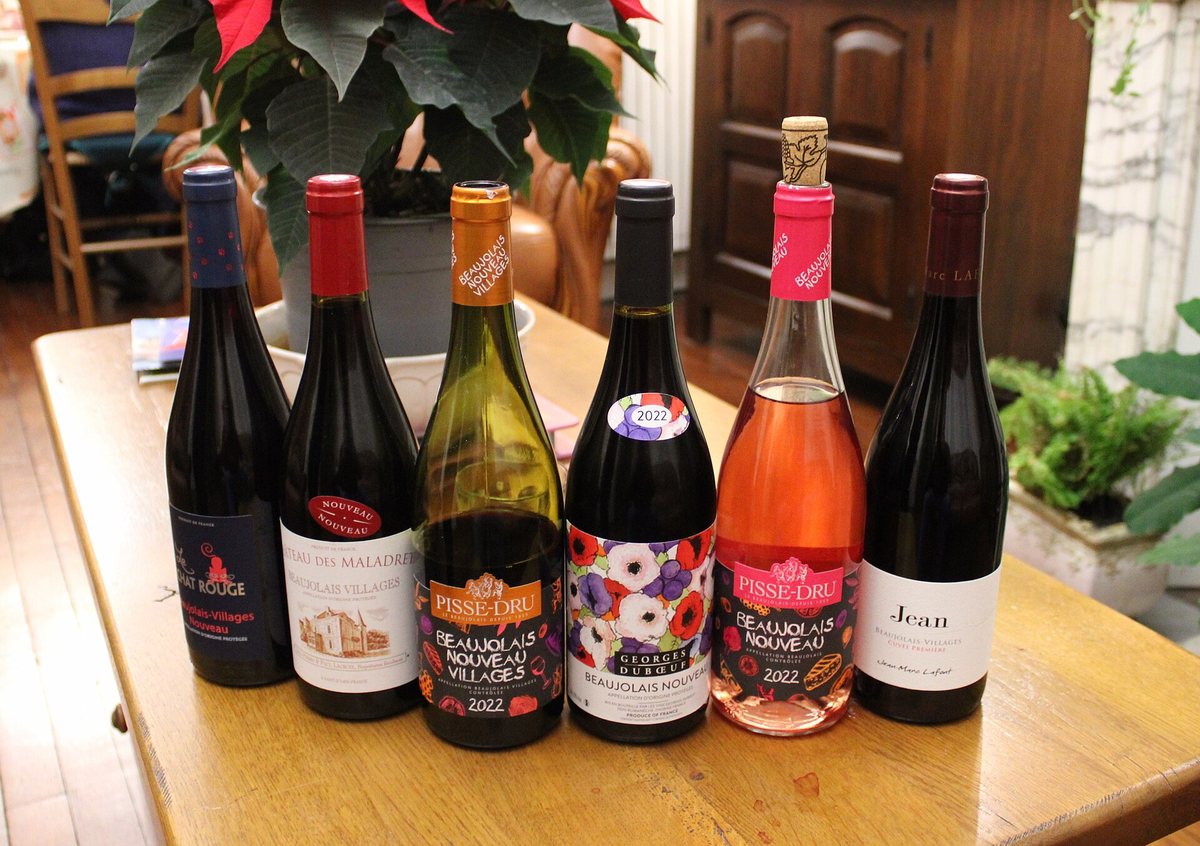
Sources: Inter Beaujolais note to the trade on the 2026 Beaujolais Nouveau, August 11, 2026; Vitisphere, October 2, 2026; Wikipedia, Beaujolais nouveau and Beaujolais wine. Top photo: Beaujolais Nouveau and Beaujolais-Villages Nouveau bottles from the 2022 vintage. Photo: René Hourdry, CC BY-SA 4.0, via Wikimedia Commons. The Table runs every Saturday.