Anthropic is selling $26bn of its IPO to its own suppliers
Anthropic's stock-market debut comes with a second, quieter deal attached. Seven of the companies that sell it chips, cloud capacity and software have agreed to buy $26bn of its shares at whatever price the IPO sets. They will pay no underwriting fees, and they will get no votes.
What the filing says
The second amendment to Anthropic's registration statement, filed with the Securities and Exchange Commission on Tuesday, November 10, sets a price range of $70 to $78 for 825 million Class A shares. Alongside it sits what the prospectus calls a "concurrent private placement".
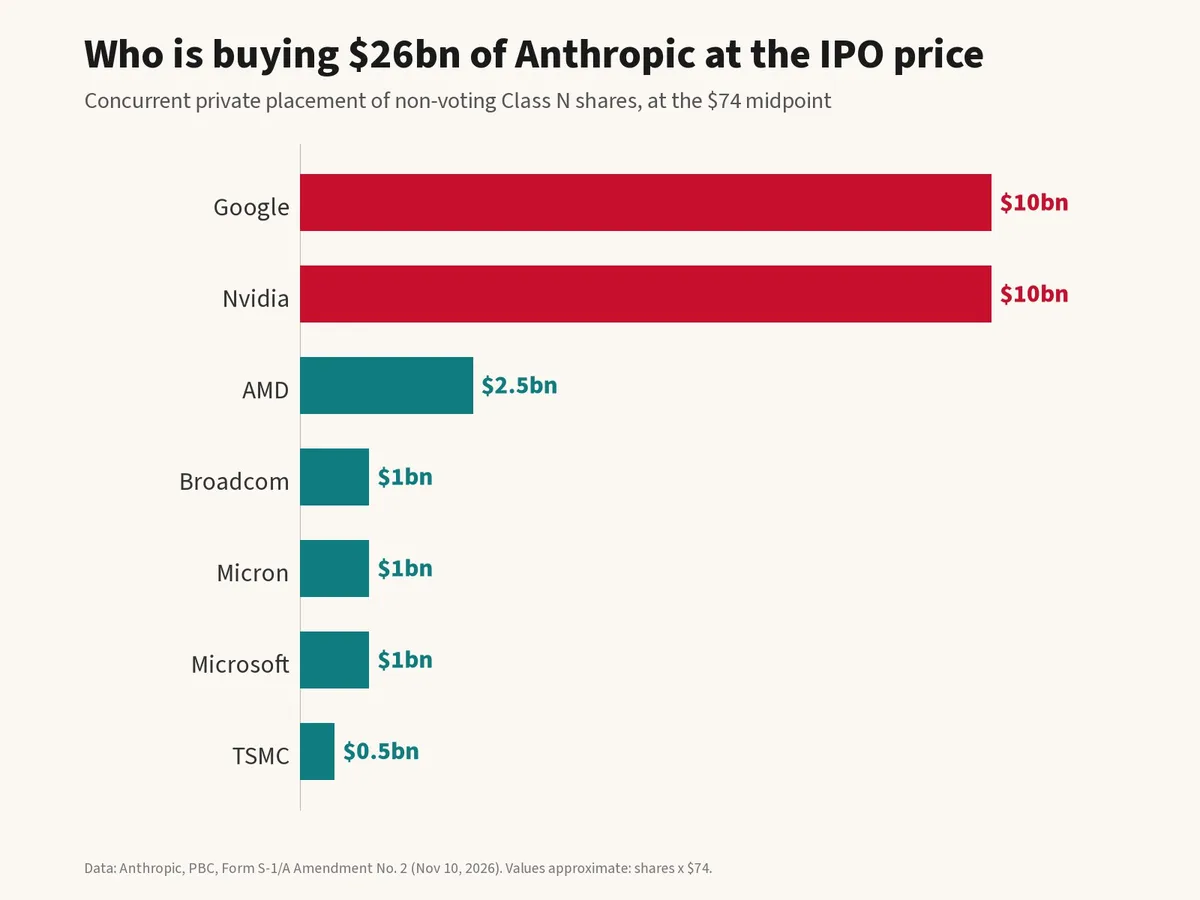
Immediately after the IPO closes, Google, Nvidia, AMD, Broadcom, Micron, Microsoft and TSMC will together buy $26bn of a separate class of stock, Class N, "at a price per share equal to the initial public offering price". At the $74 midpoint, the filing spells out the split: Google and Nvidia about $10bn each (135.1 million shares apiece), AMD about $2.5bn, Broadcom, Micron and Microsoft about $1bn each, and TSMC about $500m.
Three details matter. First, "the underwriters will not receive any underwriting discounts or commissions" on these shares, so Anthropic keeps every dollar. Second, Class N stock has "no voting rights, except as otherwise required by law"; the filing describes its holders as "primarily strategic business partners". Third, the shares are not registered in the offering and are not covered by the underwriters' lock-up agreements, although as restricted securities they can only be resold under a registration statement or an exemption such as Rule 144.
Who is buying, and what else they sell
Every buyer already does business with Anthropic, and the filing and a Reuters factbox built from it show how deep those ties run.
- Google sells Anthropic computing power on its TPU chips. Reuters puts its loans and share purchases since 2023 at $33.3bn, and its $10bn counts toward an existing 2026 funding deal.
- Nvidia supplies the GPUs that Anthropic trains and runs Claude on. No other tie is disclosed.
- AMD signed a hardware supply framework in July 2026 for its Helios rack systems and committed to buy up to $5bn of Class N stock as GPU deliveries hit milestones. The placement counts toward that pledge.
- Broadcom leases Anthropic specialised accelerators, and under a March 2026 note agreement Anthropic can issue it up to $42bn of convertible notes to fund the build-out.
- Microsoft has a commitment of at least $47.2bn: Anthropic has agreed to spend that much on its computing between November 2026 and June 2033, "regardless of actual usage".
- Micron and TSMC make the memory and the silicon. Neither has another disclosed tie.
At $78 a share, Reuters calculates, the $26bn buys about 2.55% of the company, with Google and Nvidia getting about 0.98% each.
Why it is unusual
In a normal IPO, banks build a book of fund managers who haggle over price, and the banks take a fee of a few per cent for the work. Here, a second deal worth about two-fifths of the IPO itself is pre-sold to buyers who have agreed in advance to take whatever price the book produces. These are, in effect, price-insensitive buyers, and that is the point: their return does not depend only on the share price. Every dollar Anthropic raises is a dollar it can spend on their chips, their cloud and their memory.
Total commitments for compute and infrastructure stand at about $900.9bn, the filing says. Against that, the placement looks less like an investment and more like vendor financing with a share certificate attached.
Our take
There is nothing improper here. The placement is legal, and Anthropic discloses it plainly in the prospectus. But investors should read the $26bn for what it is.
Start with the price signal. A placement that takes the IPO price as given tells you nothing about what the shares are worth. It tells you the suppliers value the customer.
Then the circularity. Nvidia sells the chips, Microsoft and Google sell the computing, Broadcom finances the accelerators, and all of them now buy stock that funds more purchases from them. If Anthropic keeps growing, everyone wins twice. If demand for AI slows, the suppliers lose on the shares and on the orders at the same time.
Finally, the votes. Founders already control the company through a Class F share with 50.1% of the vote, and a trust elects most of the board. Class A buyers were never getting much say. The seven largest new holders are getting none at all, by design. The cleanest way to read that: Anthropic wanted their money and their silicon, not their opinions.
Sources
- Anthropic, PBC, Amendment No. 2 to Form S-1 registration statement, US Securities and Exchange Commission (November 10, 2026): The Offering, Concurrent Private Placement, Description of Capital Stock and contractual-obligations sections
- Reuters, factbox on the Anthropic IPO windfalls and the placement buyers, via Investing.com (November 10, 2026)
- TechCrunch, Anthropic sets IPO price range of $70 to $78 per share (November 10, 2026)
- Stake percentages: Reuters calculations at $78 a share; share counts at $74 from the filing