
An airport screener tried to swallow $300 she allegedly stole from a bag. What really goes missing at security
CCTV at Manila's main airport in September 2023 showed a screener swallowing banknotes. In America, passengers left nearly $1m at checkpoints last year, mostly as coins.
By The Graze · November 15, 2026 · 5 min read
On 8 September 2023, at Terminal 1 of Manila's Ninoy Aquino International Airport, closed-circuit cameras recorded a security screener putting dollar bills into her mouth and trying to swallow them. An Office for Transportation Security report, later published by the Philippine News Agency, said she had taken $300 from a departing passenger's bag during inspection and swallowed the notes "to avoid getting caught." The clip has been circulating again. It is ugly, and it is three years old. The much larger, quieter loss at airport security is not theft. It is what travellers leave behind.
A theft on camera, and an official finding
The government's news agency named the screener as Irency Morados, a security screening officer, and said her supervisor and an X-ray operator "appeared to be in connivance." The Manila International Airport Authority condemned the incident. The officers were placed under preventive suspension pending a fuller investigation.
Two weeks later, after a Senate hearing, Transportation Secretary Jaime Bautista told reporters that investigators had found the screener guilty. She had said in an affidavit that she was eating chocolate. "Investigation showed that the employee swallowed the cash," Bautista said. He added that she and three colleagues faced administrative and criminal complaints.
Theft at the checkpoint is not only a Manila problem. In September 2023 the US Transportation Security Administration said it had removed three officers at Miami International Airport from screening after an employee reviewed camera footage following a complaint in July, and had given its findings to the Miami-Dade Police Department. The agency said it holds its officers to the highest professional and ethical standards and has no tolerance for misconduct in the workplace. Those cases, when they are proved, are crimes. They are also, in volume, a sideshow.
Nearly a million dollars, mostly in coins
In the year to 30 September 2025, TSA collected $967,897.97 in unclaimed money left at airport checkpoints in the United States: $960,838.06 in American currency and $7,059.91 in foreign currency. Almost all of it, the agency told Congress, is coins that passengers take out of their pockets and do not pick up again. The year before, the total was $939,814.20.
The cash is not a rounding error at a few busy terminals. Los Angeles International Airport alone accounted for $105,705.48. Newark, Kennedy, Dallas Fort Worth and Chicago O'Hare together added more than $216,000. The table below lists the ten hubs with the largest totals. Collections at smaller spoke airports are deposited with their hubs, so the figures are a little lumpy, but the official list is complete for the year.
| Airport | Unclaimed money, FY2025 |
|---|---|
| Los Angeles (LAX) | $105,705.48 |
| New York Kennedy (JFK) | $61,560.85 |
| Newark Liberty (EWR) | $56,312.09 |
| Dallas Fort Worth (DFW) | $54,539.94 |
| Chicago O'Hare (ORD) | $44,260.83 |
| Miami (MIA) | $40,019.86 |
| San Francisco (SFO) | $38,213.56 |
| Boston Logan (BOS) | $37,185.12 |
| Denver (DEN) | $31,118.18 |
| Las Vegas Harry Reid (LAS) | $28,797.14 |
Compiled by The Graze from the Transportation Security Administration's report "Unclaimed Money at Airports in Fiscal Year 2025", 6 May 2026. Amounts are as published. Collections at spoke airports are deposited with their hubs.
Money is only part of what is left. TSA estimates that about 90,000 to 100,000 items are left behind at checkpoints each month, more than a million a year. The agency holds them for at least 30 days. Unclaimed electronics then have their memory removed and destroyed, or are destroyed outright, to protect the data on them. Identity documents that are not claimed are destroyed. Some items are sold as surplus; the proceeds of those sales go to the US Treasury, not to TSA.
The loose cash is treated differently. A federal statute, section 44945 of title 49 of the US Code, says unclaimed money recovered at a security checkpoint "shall be retained by the Transportation Security Administration and shall remain available until expended for the purpose of providing civil aviation security." In fiscal 2025 TSA obligated $874,223 of that money for wireless and telecommunication equipment at checkpoints, and spent $1,130,073, including earlier obligations. Combined with unused balances from prior years, it had $1,842,067.98 available.
What officers say they never do
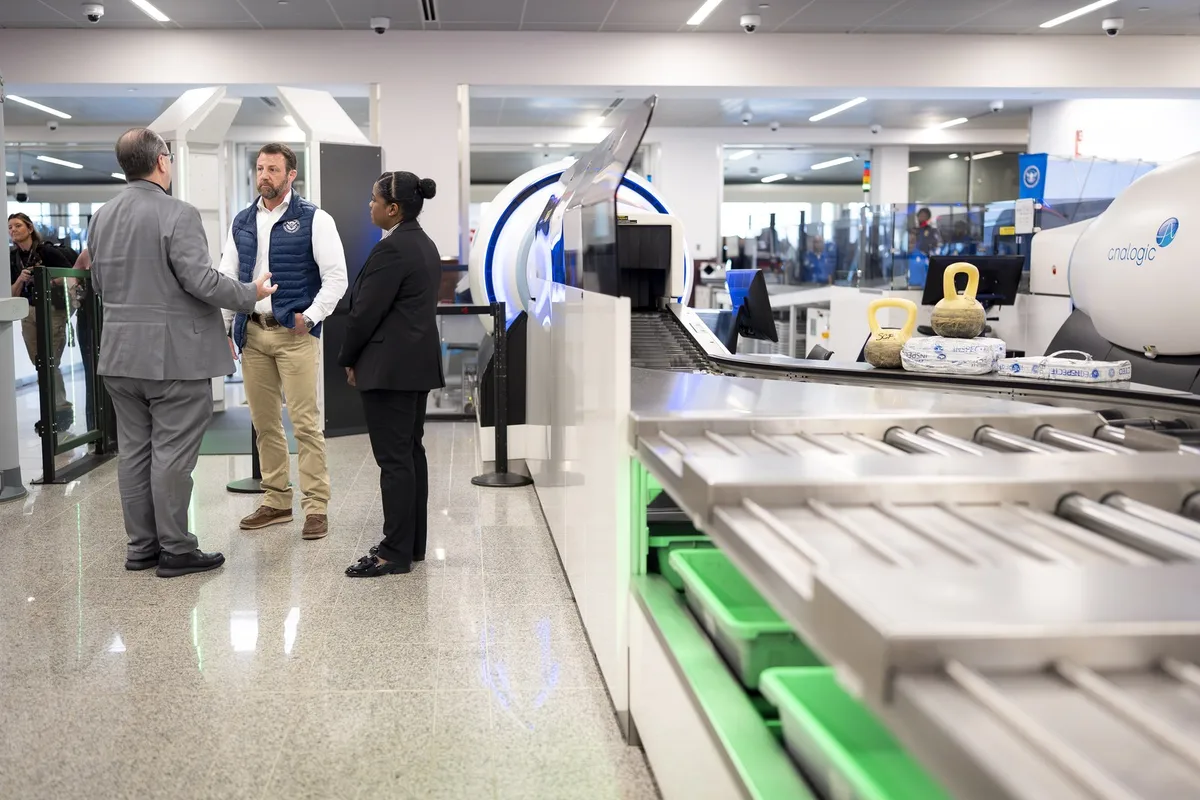
The practical advice is dull, and it comes from TSA itself. Officers tell travellers to empty their pockets into a carry-on bag before they reach the belt, and to put a phone in the bag rather than in a bin that has held other people's shoes. They say never to place keys, phones or boarding passes directly on the conveyor, because small items fall between the rollers and can be impossible to retrieve. If something is left, the agency publishes a lost-and-found contact for each airport. Passengers can collect an item, authorise someone else in writing, or have it shipped at their own expense. TSA is not authorised to pay the postage.
None of this is a guarantee against a dishonest official. The Manila recording, and the Miami investigation, exist. Most of what goes missing at the checkpoint, though, was never taken. It was put in a tray and walked away from.
Our take
The swallow clip earns its views because it confirms a suspicion every traveller has had in a queue: that the person on the other side of the belt can reach into a bag, and that the cameras, if they are even watched, will be watched too late. In the Manila case the cameras were watched, the officers were suspended, and the transport secretary said the investigation had found against them. That is how the system is supposed to work when someone steals.
It is not, however, where most of the money goes. Almost $968,000 left at American checkpoints in a year, nearly all of it coins, is a story about hurry and habit, not about a criminal trade at security. A million items a year would be a policing scandal if they had been stolen. They were left. The bins, the pockets and the thirty-day shelf are doing more of the taking than any screener.
The useful response is unglamorous. Put the wallet, the phone and the coins in the bag you are going to pick up. Look in the tray before you dress and walk on. If something is gone, call lost and found in the first 30 days, not a lawyer first. And when a clip of a theft is old, date it. The offence is real. The scale is not what the camera implies.
Sources
- Transportation Security Administration, Unclaimed Money at Airports in Fiscal Year 2025 (6 May 2026)
- Transportation Security Administration, Unclaimed Money at Airports in Fiscal Year 2024 (9 June 2025)
- Transportation Security Administration, How many lost and found items are found by TSA annually?
- Transportation Security Administration, Lost and Found
- Transportation Security Administration, What happens to items left at security checkpoints?
- 49 USC § 44945, Disposition of unclaimed money and clothing
- Transportation Security Administration, TSA officers share top six checkpoint dos and don'ts for travelers (8 August 2023)
- Transportation Security Administration, statement regarding the July incident involving MIA Transportation Security Officers (18 September 2023)
- Philippine News Agency, 3 screening personnel 'in connivance' in recent theft at NAIA (20 September 2023; original page no longer live)
- The Philippine Star, DOTr: OTS screener guilty of stealing $300 (28 September 2023), quoting Transportation Secretary Jaime Bautista