LIV Golf spent $5bn in five years. Where the money went
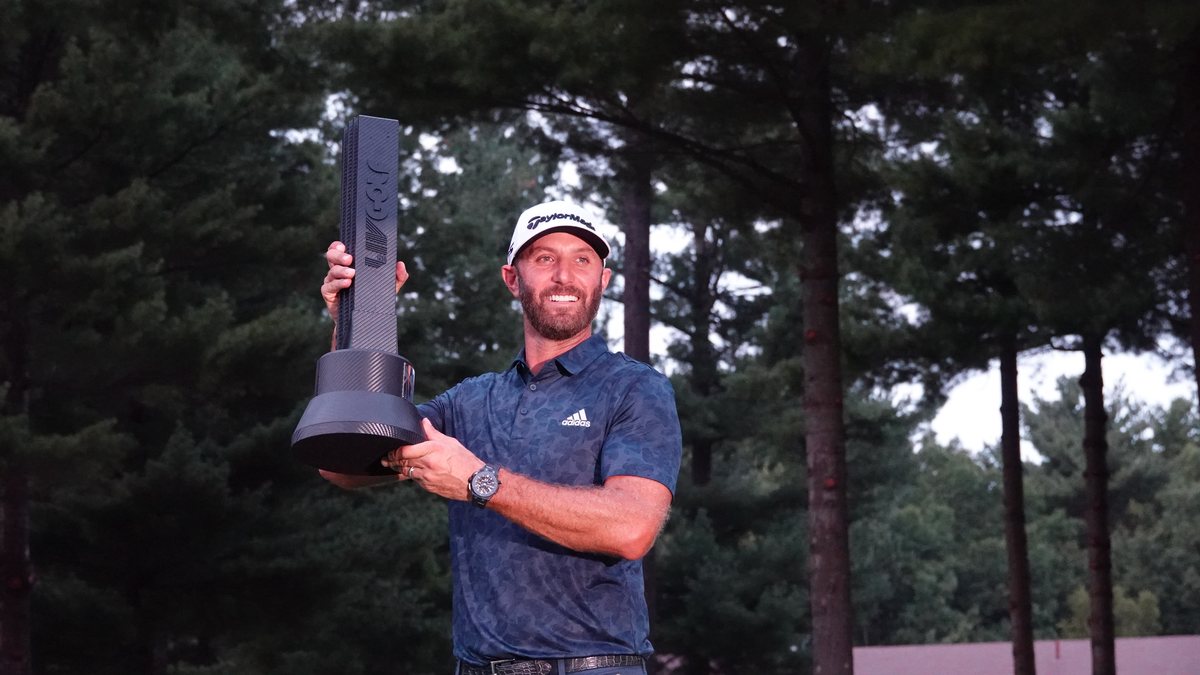
Saudi Arabia's Public Investment Fund put about $5.8bn into LIV Golf. When the league filed for bankruptcy on September 8, it had about $15m in the bank.
LIV never published consolidated accounts. The Chapter 11 filings in New Jersey are the first full look at its books. Read alongside the league's own announcements and the best outside estimates, they show where the money went, and why so little of it came back.
The money in
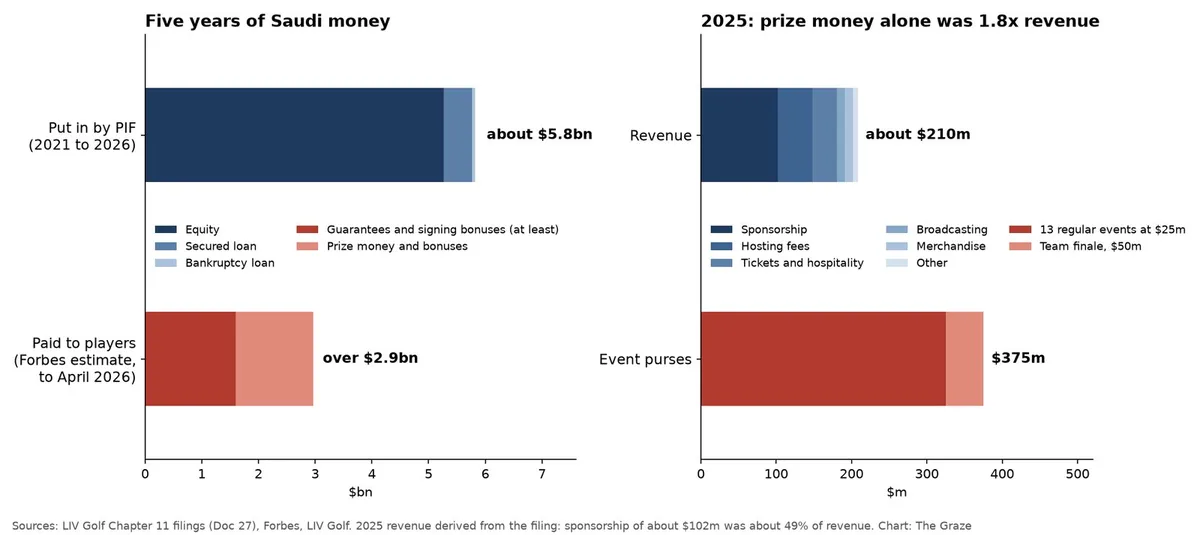
PIF was, in practice, the only investor. By the filing date the parent company, LIV Golf Investments, had issued 5,269,395,765 preference shares to the fund, about $5.3bn of equity, and PIF held 98.48% of the common ownership, according to the sworn declaration of David Orlofsky, the league's chief restructuring officer. Until June 2026 it had no funded debt at all.
That changed on April 30, when PIF said "the substantial investment required by LIV Golf over a longer term is no longer consistent with the current phase of PIF's investment strategy" and that it would fund only the rest of the 2026 season. It did so as a lender, not a shareholder. A loan signed on June 4 had about $495m outstanding by the filing, secured on substantially all of the group's assets. PIF then added $49.6m of bankruptcy financing.
The money out
Players took the largest share. Forbes estimated in April that LIV had paid nearly $1.36bn in prize money and championship bonuses (net of the 60% of team winnings that teams keep) and at least $1.6bn in guarantees and signing bonuses. The purses were the richest in golf: $25m at a regular event from 2022 to 2025, $50m at the 2025 team finale, and $30m an event in 2026, when the league promised $470m across 14 events.
Revenue never came close. The filing puts sponsorship, about 49% of 2025 revenue, at roughly $102m, up from $16m in 2023. That implies total 2025 revenue of about $210m. Broadcasting rights, the engine of every profitable league, were about 5% of it.
The result, in the declaration's words: LIV "ran at a loss for all years of operations." It had about $3bn of net operating losses at LIV Golf Inc. and about $2bn at LIV Golf Ltd, its UK arm, by the end of 2025.
| The ledger | Amount | Basis |
|---|---|---|
| PIF equity, 2021 to 2026 | about $5.27bn | Court declaration |
| PIF secured loan, June to September 2026 | about $495m | Court declaration |
| PIF bankruptcy loan | $49.6m | Court declaration |
| Total from PIF | about $5.8bn | Our sum |
| Prize money and bonuses paid to April 2026 | about $1.36bn | Forbes estimate |
| Player guarantees and signing bonuses | at least $1.6bn | Forbes estimate |
| Event purses in 2025 | $375m | Our sum: 13 events at $25m plus the $50m finale |
| Revenue in 2025 | about $210m | Our calculation from the filing |
| Losses to the end of 2025 | about $5bn | Court declaration |
| Cash at filing | about $15m | Court declaration |
How it unravelled
- April 30, 2026. PIF says it will fund only the 2026 season. Independent directors are already in place to look for new money.
- May to July. Ducera, LIV's investment bank, approaches more than 300 potential investors; 104 sign confidentiality agreements and two submit bids.
- June 4. PIF's secured loan is signed.
- April to August. To save cash, LIV cancels its New Orleans and Michigan events and halves the individual prize money at the Indianapolis finale.
- August 24. Team equity held by players and sponsors is cancelled to protect the tax losses.
- September 8. Chapter 11, with the credit arm of BC Partners lined up to anchor $300m for a smaller "LIV 2.0".
- November 5. BC Partners has walked away after too few players committed. LIV tells the court it will wind down and sell its assets.
- November 8. The Financial Times reports that BC Partners wants to buy PIF's roughly $50m bankruptcy loan to keep a successor alive. LIV says it remains open to alternatives.
Who is still owed
Fourteen players appear on LIV's list of its 30 largest unsecured creditors, with claims of about $45m between them: Jon Rahm $7.5m, Bryson DeChambeau $5.8m, Dustin Johnson $5.5m (listed as disputed) and Cameron Smith $4.8m among them. So are IMG Media ($3.2m), the UN refugee agency ($1.7m, under a grant agreement) and the State of Louisiana ($1.2m). The chief executive, Scott O'Neil, received more than $13.6m in pay, bonuses, retention payments and expenses between September 2025 and late August 2026, according to the filings, as reported by Golfweek.
What the PGA Tour gained and lost
The Tour won the war: its rival is gone and the players are coming back on its terms. Brooks Koepka returned this year under a one-time programme that cost him a $5m charity donation and his place in the Tour's player equity programme until 2030. Rahm and others who stayed through 2026 cannot return before August 24, 2027.
The fight had a price. In January 2024 the Tour sold a minority stake in a new for-profit arm, PGA Tour Enterprises, to Strategic Sports Group, a consortium led by Fenway's John Henry, for up to $3bn, $1.5bn of it up front. The framework deal with PIF announced in June 2023 never produced a merger. And its purses went up.
Our take
LIV was never a golf league. It was a $5bn signing bonus with tee times attached.
The numbers were broken from day one. In 2025 the prize money alone was about 1.8 times everything the league took in, before a single guarantee, flight or concert was paid. Broadcasting brought in about 5% of revenue. When the networks will not pay to show your product, you do not have a sport. You have a sponsorship.
The sharpest move in the whole story was PIF's last half-billion. For four years the fund was the shareholder that absorbed every loss. In June it became a secured lender, first in line ahead of the players and vendors its money was paying. Anyone who signs with a venture backed by one rich owner should remember it: a guarantee is only as good as the balance sheet behind it, and an owner's strategy is not a contract.
The winners are the stars who signed early. Johnson, DeChambeau and Koepka joined in 2022 on deals reported at more than $100m each; their claims in the bankruptcy run to a few million dollars apiece. The losers are the middle of the roster, the production companies and the State of Louisiana.
What to watch: whether PIF sells its bankruptcy loan to BC Partners, the November 24 hearing, the December 11 deadline for creditors to file claims, and August 24, 2027, when Rahm and the other holdouts first become eligible to return to the PGA Tour. It won the war. It sold part of itself to private investors to pay for it.
Sources
- In re LIV Golf New Jersey LLC, Case No. 26-20189 (Bankr. D.N.J.): Declaration of David Orlofsky, chief restructuring officer, Doc 27; voluntary petition and list of 30 largest unsecured creditors, Doc 1; case calendar, Omni Agent Solutions
- LIV Golf, Strategic action and restructuring support agreement with BC Partners (September 8, 2026); update on the court-supervised process; 2026 competition and format updates
- PIF statement, April 30, 2026, via GOLF.com and BBC Sport
- Forbes, Here's how much LIV Golf paid its players
- NBC Sports, LIV Golf lawyers confirm league will shut down; Los Angeles Times, LIV Golf's bid to survive collapses
- Golfweek, Why did LIV fail? and BC Partners renews push, per FT report
- The Golf News Net, 2025 LIV Golf Michigan team championship purse; BBC Sport, LIV Golf's 2023 league announcement
- CNBC, PGA Tour secures up to $3 billion from US investors
- Ledger, chart and calculations: The Graze, from the sources above