A start-up wants to sell investors a cut of college athletes' pay
Can a person sell shares in their own future earnings? Finance has toyed with the idea for decades. A college football start-up now plans to try it, though not in the obvious way.
LevelUp Sports, founded by the college football analyst Bud Elliott, said on October 29 that it plans offerings on Republic, the crowdfunding platform, that would let ordinary investors buy securities tied to specific college athletes' future income. LevelUp pays a player cash up front in exchange for an agreed share of what he earns in college: name, image and likeness (NIL) deals and the revenue-share pay that schools now hand out. Each security will come bundled with a collectible digital card.
"College athletes are creating significant economic value through NIL, yet the investment opportunity around that value is still in its early stages," said Andrew Durgee, Republic's co-chief executive.
Elliott, creator of the Blue-Chip Ratio recruiting metric, will pick the players. "I can love a player and pass on a deal," he said. "Talent still has a price." No offering is open yet; the first athlete will be named before one is. In his newsletter, Elliott sells it as the thrill of pulling a rookie card: "When the player breaks out, the card shares in it."
The old idea, flipped
The classic version of this trade funds young athletes while they are broke, in exchange for a slice of a professional fortune that most will never earn. LevelUp does the opposite. Professional earnings are excluded, along with cost-of-living payments and W-2 wages. Investors are betting only on college money.
That money is now real. In the first year of revenue sharing under the House settlement, schools paid athletes $1.8bn directly, according to the College Sports Commission, and each can share up to $21.58mn this academic year. That is before outside NIL deals. One NFL executive complained this year that players "make more money in college" and are staying longer to collect it.
A decade ago none of this could have been sold. Sports betting was largely banned until the Supreme Court's 2018 Murphy ruling, and amateurism rules began to crack only when the Court struck down NCAA limits on education-related benefits in NCAA v Alston in 2021. Ten days later, the NCAA let players earn from NIL.
So the product is a short, capped bet that a backup becomes a starter and his deals grow. That is a reasonable thing to want a piece of. But the athletes who once needed this kind of money most were minor leaguers on bus rides. A college star with seven-figure NIL deals does not need an investor. The players who will take the deal are the ones the market has not yet noticed, which is exactly Elliott's pitch, and exactly the risk.
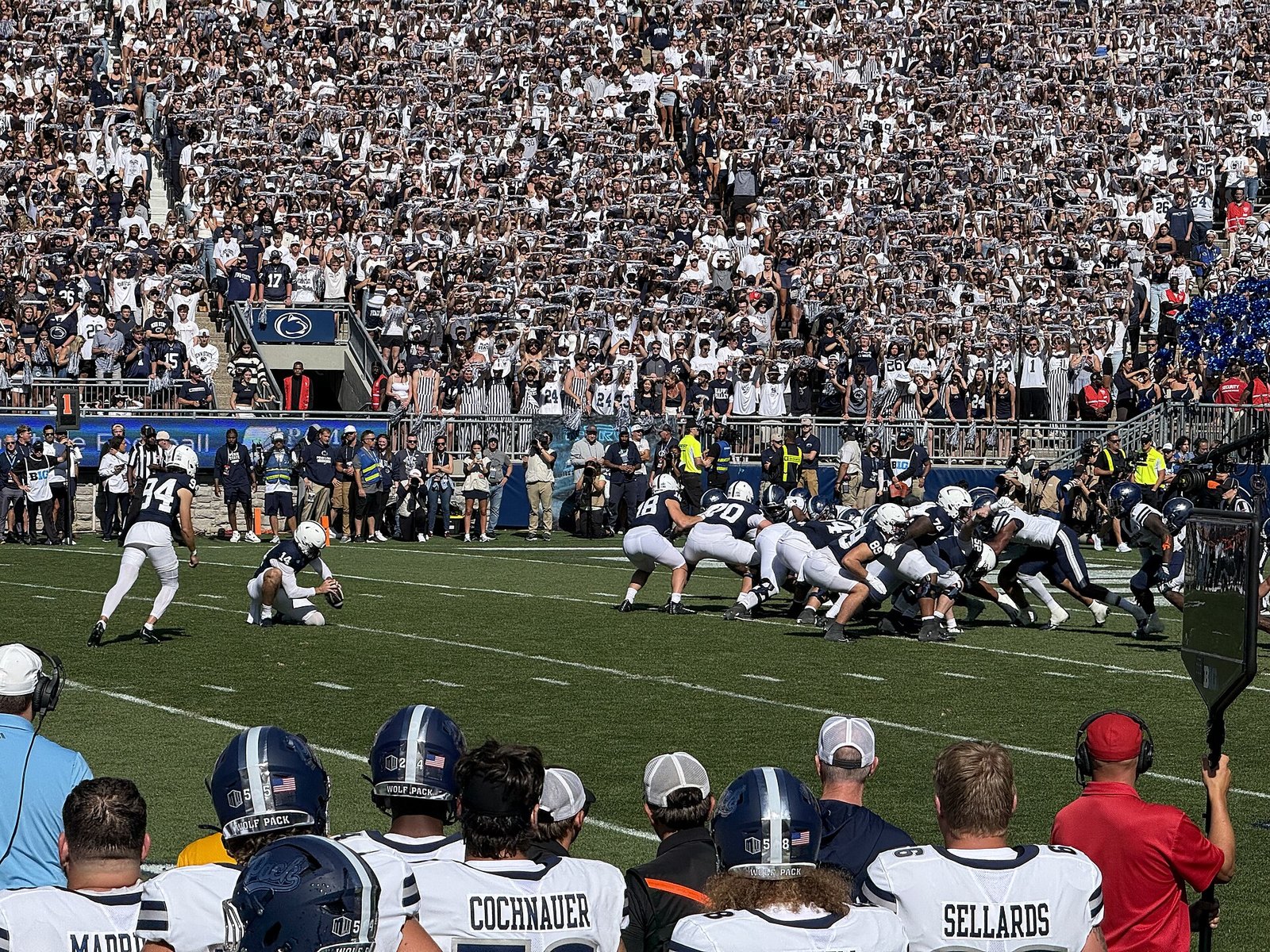
_Image: College football at Beaver Stadium, Penn State, in August 2025. Photo by Famartin, Wikimedia Commons, CC BY-SA 4.0. Cropped.