America's air traffic control is finally ejecting the floppy disk
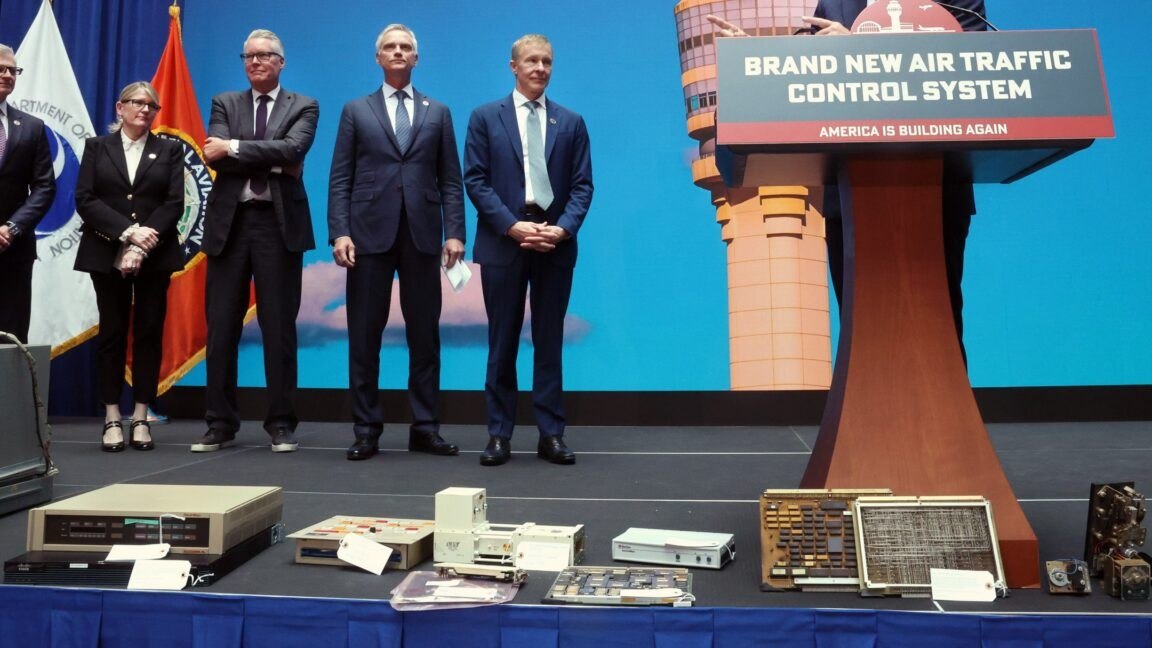
Transportation secretary Sean Duffy at the May 2025 air traffic control announcement. The display-system rollout now targets completion in 2028. Photo: Win McNamee / Getty Images, via Ars Technica.
In the AI economy, a two-year-old chip can look obsolete. In parts of America's air traffic control system, floppy disks have remained part of the information pipeline.
The Federal Aviation Administration says it is now beginning to replace legacy information-display systems with a unified platform called E-IDS. The stated target is 435 sites by the end of 2028. That is welcome news, although “finally retiring floppy disks” and “the whole air traffic control system is now modern” are very different claims.
The upgrade concerns the information controllers need around the work of managing aircraft: weather, airport status, equipment problems, airspace restrictions and safety notices. Its value is less photogenic than a new terminal. Getting the right warning in front of the right person quickly is the point.
What is actually being replaced?
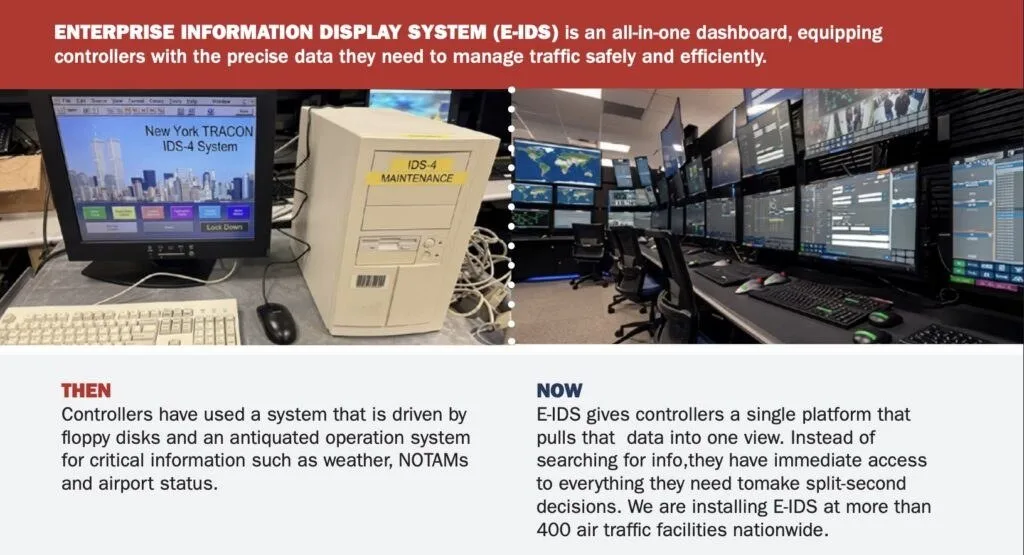
E-IDS stands for Enterprise Information Display System. The FAA's announcement names four legacy systems: IDS-4, ACE-IDS, NIDS and ERIDS. Some trace their technology to the 1980s; Ars Technica reports that IDS-4 runs on MS-DOS and has been used since the early 1990s.
That does not mean floppy disks are steering aeroplanes. These are information-display tools used in control towers, terminal radar approach facilities and route-control centres. Their job is to present operational material, including charts and notices, that supports the controller's decisions.
A consolidated system should reduce the need to search across different displays, manually update information or work around hardware at the end of its supported life. The FAA says the platform will allow controllers to share critical alerts, pilot reports and restricted-airspace schedules more quickly.
Two acronyms with real safety consequences
A PIREP is a pilot report: first-hand information about conditions encountered in flight. A NOTAM is a notice about a relevant hazard or an abnormal condition. Neither is useful simply because it exists somewhere in an agency's network. It has to reach the people who need it while it is still actionable.
The FAA identifies pilot-report capabilities and timely distribution of NOTAM information as safety problems E-IDS is intended to address. That gives the project a more concrete purpose than the government's broad promise of “21st-century” technology.
There is also an operating-cost argument. Old equipment can be expensive precisely because it looks cheap: replacement parts, specialist support and improvised fixes consume resources without producing a visible new asset. The agency says consolidation will reduce costly repairs and workarounds. Whether the promised savings materialise will depend on implementation, not the announcement's adjectives.
A rollout, not a switch
The first five facilities identified by the FAA are Atlantic City International, Nashville International and Greater Rochester International airports, plus data-processing hubs in Atlanta and Salt Lake City. The deadline for the full 435-site programme is the end of 2028. That is the date to watch, rather than assuming the fleet of old displays vanished with this week's press release.
Nor is the project a brand-new invention. Ars traces a Leidos design-and-development contract to August 2020 and places E-IDS within the longer NextGen modernisation effort. The work has crossed administrations. Political credit is easier to deliver than a safe, nationwide technology migration.
The implementation challenge is real. Controllers need reliable information during the transition as well as after it. Installing screens is only one part of the job; data flows, local configuration, staff training, maintenance and contingency arrangements also have to work.
The milestone deserves attention without exaggeration. America is retiring a conspicuously outdated piece of aviation infrastructure. It is not replacing every radar, solving every staffing problem or automating the controller out of the tower. The achievement will be a much less dramatic one: fewer fragile workarounds between a safety notice and the person responsible for acting on it.
Source: Ars Technica