Financial analysts are more exposed to AI than CEOs
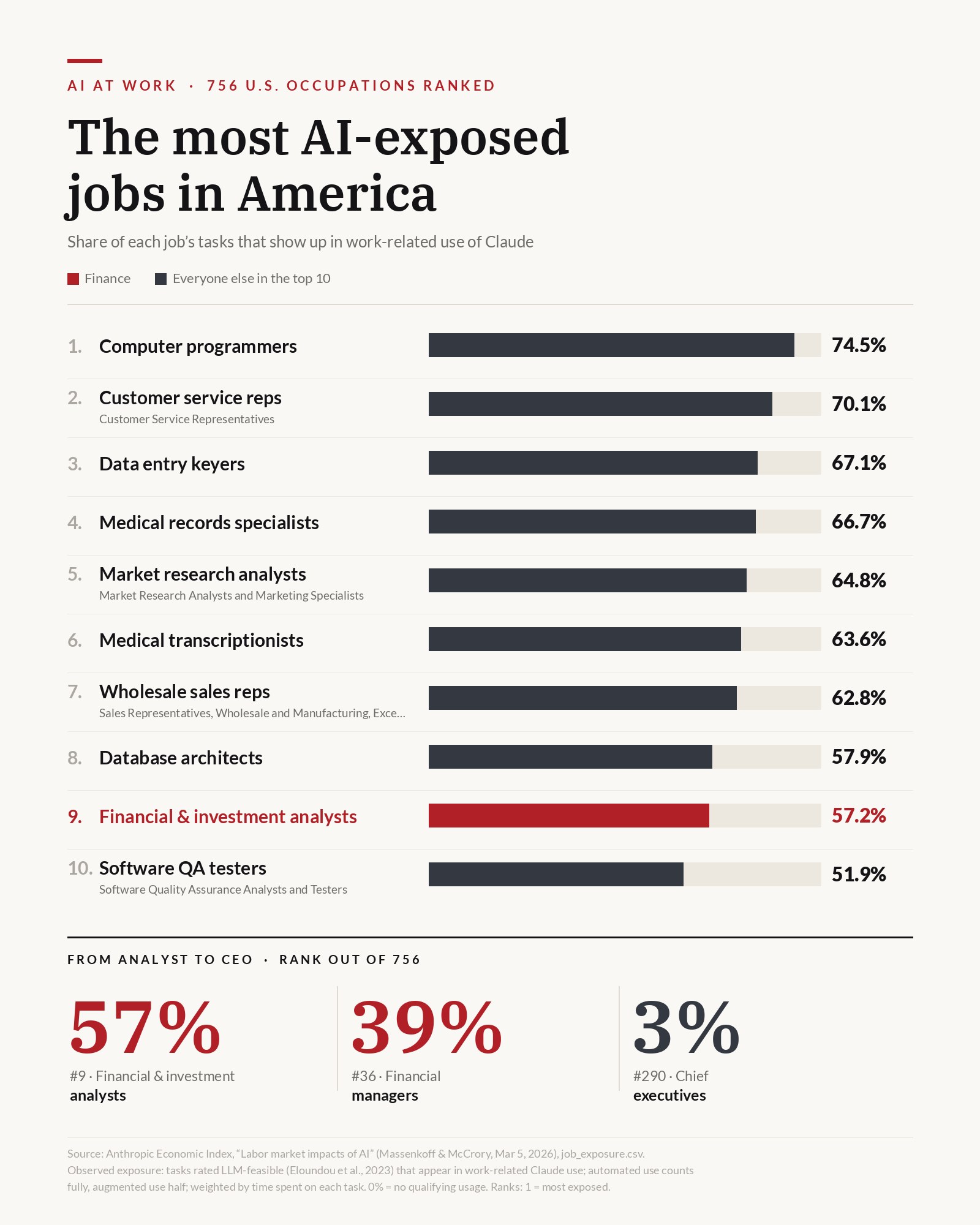
Anthropic's economists ranked 756 U.S. occupations by how much of each job shows up in real Claude use. Financial and investment analysts came in at 57%, ninth on the list. Chief executives came in at 3%, rank 290.
That gap is the story. The people who staff the models and decks sit near the top of the exposure table. The people who hire them sit near the bottom.
What the number measures
Anthropic's "observed exposure" score is not a forecast that AI replaces a role. It is the share of a job's tasks that appear in work-related Claude traffic, limited to tasks that large language models can theoretically speed up, with automated use counted in full and augmented use at half weight. The company is clear that current coverage is still well below theoretical capability: in Computer & Math occupations, for example, Claude covers about a third of tasks even though most of those tasks look feasible on paper.
So 57% does not mean AI does 57% of an analyst's job. It means more than half of the task mix that defines the role already shows up in how professionals use the model at work.
Where finance sits
We pulled Anthropic's published `job_exposure.csv` and lined up related finance roles against the same ranking:
| Occupation | Observed exposure | Rank of 756 |
|---|---|---|
| Financial and investment analysts | 57% | 9 |
| Securities and financial services sales agents | 44% | 23 |
| Financial managers | 39% | 36 |
| Personal financial advisors | 35% | 48 |
| Accountants and auditors | 35% | 49 |
| Economists | 24% | 96 |
| Credit analysts | 17% | 137 |
| Budget analysts | 7% | 220 |
| Actuaries | 5% | 245 |
| Chief executives | 3% | 290 |
Analysts and sales roles cluster high. Controllers of process, budget and actuarial work sit lower. The CEO line is not an argument that executives are safe forever. It is a statement about whose tasks are already in the usage data.
The top of the full list is still software and paperwork: computer programmers at 75%, customer service representatives at 70%, data entry keyers at 67%. Finance is not alone. It is simply close enough to the top that the hierarchy inside a bank is visible in one column of numbers.
What the labour data say so far
Anthropic matched the exposure ranks to Current Population Survey unemployment and to BLS employment projections through 2034. Higher observed exposure lines up with slightly weaker projected job growth. It has not, so far, lined up with a clear rise in unemployment for the most exposed workers since late 2022. The one soft signal is hiring: job-finding rates for workers aged 22 to 25 in high-exposure occupations look weaker than for the same age group in low-exposure work.
That is the part boards should read twice. The people who sign off on next year's analyst class are the least exposed on the sheet. The class itself is not.
Our take
The chart is useful because it separates what AI could do from what usage already shows. A lot of AI commentary still treats every white-collar task as equally threatened. Anthropic's own traffic says otherwise. Inside finance, the threat is uneven: research and markets production sit high; judgement roles that allocate capital and set headcount sit low.
If hiring of junior analysts slows while CEO exposure stays near zero, the firm does not look "AI native". It looks like it automated the apprenticeship and kept the title structure. The risk is not only to the analyst. It is to the pipeline that used to turn analysts into managers.
Watch three things: whether the next Economic Index update lifts or cuts the analyst score; whether BLS revisions keep pairing high exposure with weaker projected growth; and whether banks' graduate-hire numbers move before unemployment does. Exposure is a map of where the work already is. It is not yet a map of where the layoffs are.
Sources
- Anthropic, Labor market impacts of AI (Massenkoff & McCrory, Mar 5, 2026)
- Anthropic Economic Index, job_exposure.csv (756 occupations; ranks and percentages calculated by The Graze)
- Eloundou, Manning, Mishkin and Rock, GPTs are GPTs (2023; theoretical task-exposure measure used in the Anthropic paper)
- U.S. Bureau of Labor Statistics, Employment Projections, 2024–2034 (growth comparisons cited in the Anthropic paper)