NEURALINK MOVED INTO AN ALS PATIENT'S HOME FOR 72 HOURS
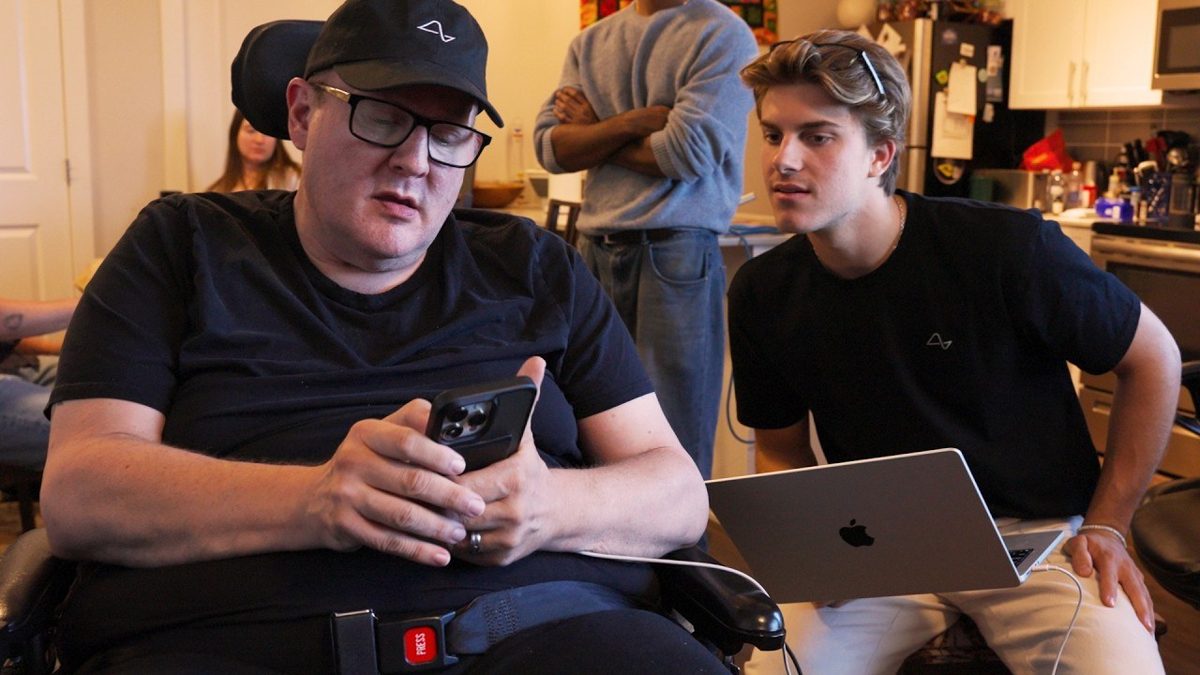
Neuralink sent a team of engineers to live in a man's house for three days. They left with eight new features, and he left them with a phone call to his wife.
The man is Kenneth Shock, who posts on X as @Cyborg21 and whose X bio reads "Neuralink p21 · VOICE2 (thought-to-speech)." "That's me," he wrote. "72 hours of Neuralink engineers in my living room. Best part? Cheryl and I joked on the phone again. ALS sucks, my life doesn't." Elon Musk reposted it.
Why they moved in
The company's own write-up is blunt about the problem: "None of the engineers building this software have an implant," so they can't feel the difference between a good design and a frustrating one. Only the patient can. So they sat next to him, watched where he hesitated, and shipped fixes the same day. Neuralink says it "compressed weeks of feedback loops into hours."
What they built in 72 hours
- No more buttons. The software now detects when he is trying to speak and starts and stops decoding on its own.
- A live brain meter. Real-time visuals show which ways of imagining speech fire the strongest signals, so he can tune the decoder like a game.
- "Hey Neuralink." A prototype where he thinks the phrase, names a task, and a Grok agent carries it out on the computer.
- Coffee, ordered by thought. The Bloom mobile app was tested in public, including ordering coffee.
- A thought keyboard. An iPhone keyboard that drops brain-decoded dictation into any app.
- Faster fixes. A new editing flow to correct the decoder's mistakes quickly.
- Lock-screen start. Speech can begin without unlocking the phone.
- Phone calls. Decoded speech goes straight into the call's audio, with an optional greeting: "This call is from someone using an assistive communication device."
That last one is the story. Per Neuralink, he and his wife started their relationship over phone calls. Watching them joke on the phone again was, in the company's words, "one of the most memorable moments of the week."
The number behind it
A day earlier, Neuralink posted that one VOICE participant with ALS hit 75 words per minute at a 5.8% word error rate, on a 125,000-word vocabulary, in their first week. Musk reposted that too.
For scale, per Inside BCI: a Stanford-led team reported 62 words per minute with a 23.8% error rate in 2023, and natural conversation runs about 160 words per minute.
The caveats are real. The result covers one participant's first week and comes from a company post, not a peer-reviewed paper. Inside BCI notes its roughly 94% accuracy still trails UC Davis's sustained 97.5%. The VOICE study's main goal is safety, and the devices are investigational, not FDA-approved.
Still: three days in a living room, and a man with ALS is joking with his wife on the phone. That's the product.
Photo: Neuralink.